

What’s it Like to Be an RBT? Day in the Life of a Registered Behavior Technician

%2013.avif)

Registered Behavior Technicians are the heart of every ABA session. They show up every single day and build genuine connections with the children and families receiving Applied Behavior Analysis (ABA) services. They implement individualized treatment plans, take careful notes, and track data on a child’s progress toward their goals. In short, they are the ABA direct service providers.
But what does a typical day actually look like for a behavior technician? Let's walk through a typical RBT day in the life.
Preparing for the Session
Every great session starts before the child even walks through the door. And for a behavior technician, that preparation is all about one thing: knowing your kids. Every child is different, and what works for one child might not work for another. A behavior technician has to think ahead:
What motivates this child?
What kind of energy will help them engage?
What toys or activities will make learning feel fun today?
As the day begins, they’ll need to review any notes and communication logs from the previous day.
What happened yesterday?
Did any children have breakthroughs?
Were there any challenges to watch for today?
This information helps BTs pick up right where they left off. And at Behavior Frontiers, this process is made even easier through our proprietary PrioraCare™ platform. Rather than sorting through paper notes or manual logs, BTs can quickly review each child's progress, session notes, and program updates in real time. This way, they walk into every session fully prepared and ready to make the most of every minute.
Next, they prepare materials for the programs they'll be running. They may set up activity stations, sensory areas, and learning spaces throughout the center. Everything is organized and ready to go before the first child walks through the door.
They also think ahead about the type of learners they'll be working with that day. Depending on the day, some children may need a high energy approach, while others may need calm and quiet. BTs mentally prepare to match their energy and teaching style to each child's needs.
Following a Session Schedule
Every ABA session follows an individualized treatment plan designed by the child's Board Certified Behavior Analyst (BCBA). The behavior technician's job is to implement that plan with fidelity while remaining flexible and responsive to the child's needs at the moment.
Each session is structured, but not rigid. There's a balance between following the plan and staying attuned to how the child is feeling in that moment — whether they are ready to push for a breakthrough, or when they need a break. It's a skill that takes both training and genuine connection.
Each session begins with re-establishing rapport. BTs might start with smiles, playful interactions, or a favorite song — whatever it takes to make the child feel seen, safe, and excited for the day ahead. Next, they pair themselves with reinforcers by running a preference assessment to identify which activity or toy the child is motivated by that day. Once they identify a reinforcer (maybe it's bubbles, pom poms, or building blocks) they use the Premack Principle:
"First work, then bubbles!" or "You'll get the blocks back after we finish this puzzle."
From there, the BT presents instructions for programs and prompts and reinforces accordingly. They often start with easier programs or programs the child is ready to master, building behavior momentum toward more difficult ones.
Throughout the morning, children rotate through different learning areas within the center. This may include one-on-one instruction tables, sensory rooms, play areas, and motor skill zones. The BTs move with them, keeping them engaged along the way. A child might work on matching colors at a table, then transition to the music area for movement and rhythm activities, then join a small group for cooperative play.
Learning happens through a happy balance of connection and instruction, with the center's specialized spaces and resources creating endless opportunities for skill-building that feels like play.
Working in a Center-Based Environment
One of the best things about working in a center is the community. Behavior technicians are never working in isolation. They're part of a warm, collaborative team that supports each other and the children they serve every single day.
With that, the center environment offers unique benefits:
- Immediate access to clinical support: BCBAs and clinical supervisors are on-site, available for real-time troubleshooting, coaching, and support.
- Collaboration with peers: BTs work as a team, sharing observations, coordinating transitions, and supporting one another throughout the day.
- Specialized resources: Centers are equipped with sensory rooms, adaptive equipment, motor skills areas, dramatic play spaces, and a wide variety of toys and materials that support skill-building.
- Peer interaction opportunities: Children learn alongside other kids in age-based cohorts, practicing social skills (patience, sharing, following group instructions, and making friends).
- Structured routines: The center schedule provides predictability and consistency, which helps children feel safe and ready to learn.
BTs move fluidly between one-on-one instruction, group circle time, sensory breaks, and transitions. They might help a child practice communication skills during snack time, support turn-taking during a group game, or guide a child through emotions with calm, consistent responses.
Interacting with Other Staff
Behavior technicians work as part of a collaborative team that includes BCBAs, case managers, clinical supervisors, and other BTs. Communication is constant.
Before and after sessions, BTs review notes from supervisors and other team members. They update communication logs so the next BT who works with the child knows what happened:
What programs were used?
How did the child respond?
Were there any challenges or breakthroughs?
In center-based settings, BTs often work alongside other staff members throughout the day, coordinating transitions, sharing observations, and supporting one another. They attend team meetings where they discuss client progress, troubleshoot challenges, and celebrate wins.
This collaboration ensures consistency. When everyone on the team is aligned, every child benefits.
Encountering Challenging Behaviors
Not every session goes perfectly, and that's okay. Challenging behaviors are a natural part of the growth process, and every behavior technician is trained to meet these moments with calm, consistency, and compassion.
Whether it's an outburst, elopement, or refusal to participate, BTs see these moments not as setbacks but as opportunities. They’re always a chance for the child to practice the very skills they've built and to discover they have the tools to navigate even the hardest moments.
BTs follow the individualized Behavior Intervention Plan (BIP) designed for that child, which outlines proactive strategies to prevent these challenges, new replacement skills to help the child express themselves more effectively, and response strategies to use when this happens.
The goals are always the same:
- Keep everyone safe
- Avoid reinforcing the challenging behavior
- Redirect to the replacement skill
Behavior technicians know that all behavior is information, and they use that information to help children build better ways to communicate and cope.

Following the Plan and Collecting Data
The BCBA designs the program, but it's the BT who brings it to life. They make sure the plan is happening in session after session, and day after day.
BTs implement programs exactly as written, using the correct prompts, reinforcement schedules, and teaching procedures. And they are always sure to collect important data.
Throughout the session, BTs may track:
- Target behaviors
- Antecedents and consequences (ABC data)
- Skill acquisition
- Engagement and participation
- Environmental variables
- Responses
- Prompts given
- Errors
- Overall progress

This data tells the clinical team what's working and what needs to be adjusted.
At Behavior Frontiers, data is collected and monitored through our proprietary PrioraCare™ platform. We built our own software because we believe real-time decisions lead to better outcomes. While relying on manual data collection can work, we see the power in capturing live data. This way, our clinicians can make faster, more precise decisions and make sure every session counts.
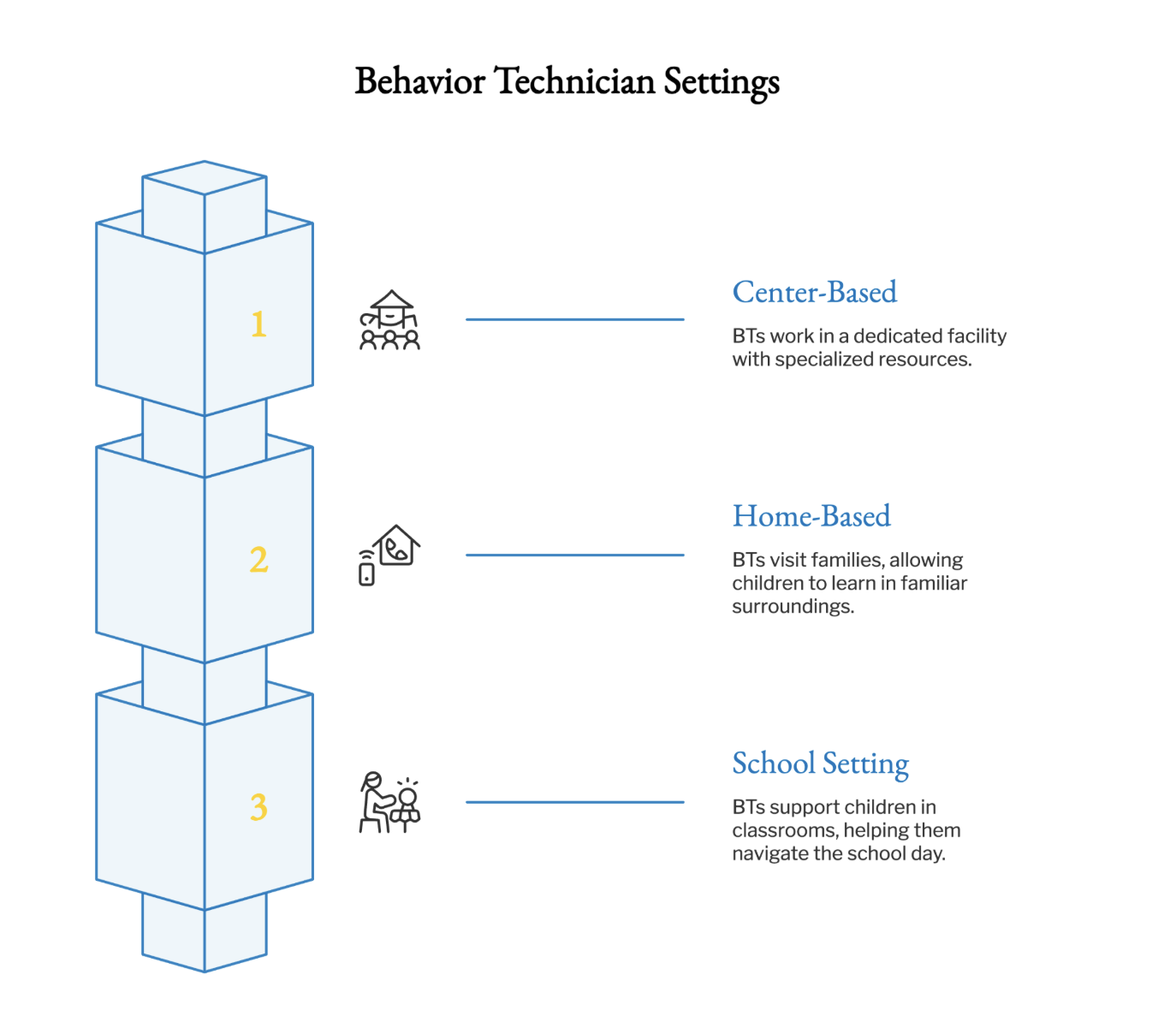
Settings: Center-Based, Home-Based, and School
Behavior technicians work in a variety of settings, and each comes with its own rhythms and responsibilities.
Center-Based Setting
In center-based programs, BTs work with children in a dedicated facility designed for learning and play. Sessions often include a mix of one-on-one instruction and group activities, giving children opportunities to practice social skills with peers.
BTs move fluidly between individual programs, group circle time, sensory breaks, and transitions. They collaborate closely with other staff throughout the day and have immediate access to clinical supervisors for support and troubleshooting.
The center environment offers specialized resources (sensory rooms, adaptive equipment, and a wide variety of toys and materials) that support skill-building in engaging, playful ways.
Home-Based Setting
In home-based ABA, the BT comes to the family. This allows the child to learn in familiar surroundings and makes it easier for parents and siblings to participate.
Home-based sessions look similar in structure to center-based ones (rapport-building, program implementation, data collection) but they happen at the kitchen table, in the playroom, or wherever the child feels most comfortable.
Home-based BTs often help families generalize skills into daily routines. They might work on mealtime skills during snack, practice transitions during cleanup, or coach parents on how to reinforce skills throughout the day.
School Setting
Some Behavior Technicians work as 1:1 aides in schools, supporting children with autism with behavioral skills in the classroom. They help the child navigate the school day.
In schools, BTs help with transitions, managing sensory overload, staying on task during lessons, and playing appropriately with peers on the playground. They work closely with teachers and special education staff to ensure the child is included and supported.
School-based BTs are the glue that keeps the classroom and the child's ABA program in communication. They lean into consistency and help skills connect from therapy into real-world situations.
The Rewards of Being a Behavior Technician
Being a Behavior Technician is one of the most rewarding careers you'll find. Every day looks a little different, and that's what makes it so special. It takes patience, creativity, and a genuine love for helping children grow. And what you get in return is something truly priceless.
BTs get to see progress up close. While building relationships with families, they see progress first-hand. They see goals reached, small wins achieved, and small moments that make all the difference.
If you're passionate about helping children grow, love working collaboratively, and want a career where every small win matters, becoming a Behavior Technician might be the perfect fit.
Interested in joining the Behavior Frontiers team?
We're always looking for compassionate, dedicated Behavior Technicians to support children and families. Contact us to learn more about career opportunities at Behavior Frontiers.