June 23, 2020

Celebrating Independence Day with Children with Sensory Issues
Celebrating Independence Day with Children with Sensory Issues — Behavior Frontiers

July Fourth can be a wonderful time for everyone. However, for children with sensory issues, the unusual sights, sounds, and smells that go along with celebrating the holiday can be very overwhelming. With proper preparation and guidance, your special child can build memories for years to come, without having to be afraid! The following list of tips can help to ensure the comfort and happiness of both you and your child.

  1. Work to prepare your child in advance for the things that they might see. Look for online videos of fireworks displays, and watch them with your child. If your child responds well to story books, maybe try reading them a social story about what will happen on the Fourth! Any preparation you can do in advance will help your child to better understand what will be happening, and manage their (and your) expectations appropriately.
  2. Managing expectations with a visual chart will help your child understand the activities planned for the day. This is especially important for those children who expect the same routine day to day. Marking a calendar and counting down the days is a great way to create enthusiasm for the day. Many children thrive on routine and moving from one activity to another is easier if they understand exactly what is going to happen next.
  3. If you plan to attend a large fireworks display, do your research in advance. Choose the show with the most variety in viewing areas. Children who cannot tolerate crowds or noise can benefit from a fireworks show viewable from a vehicle.
  4. Whether you will be celebrating at home or at an event, prepare the accommodations that your child might need to keep them happy. This could include ear covers or plugs, a weighted vest or blanket, or eye covering. Gather some of your child’s favorite items that help with his or her stress, such as fidgets, preferred toys, or treats. Your child might enjoy helping you gather these items to pack in a “go to” bag to take to the celebration!
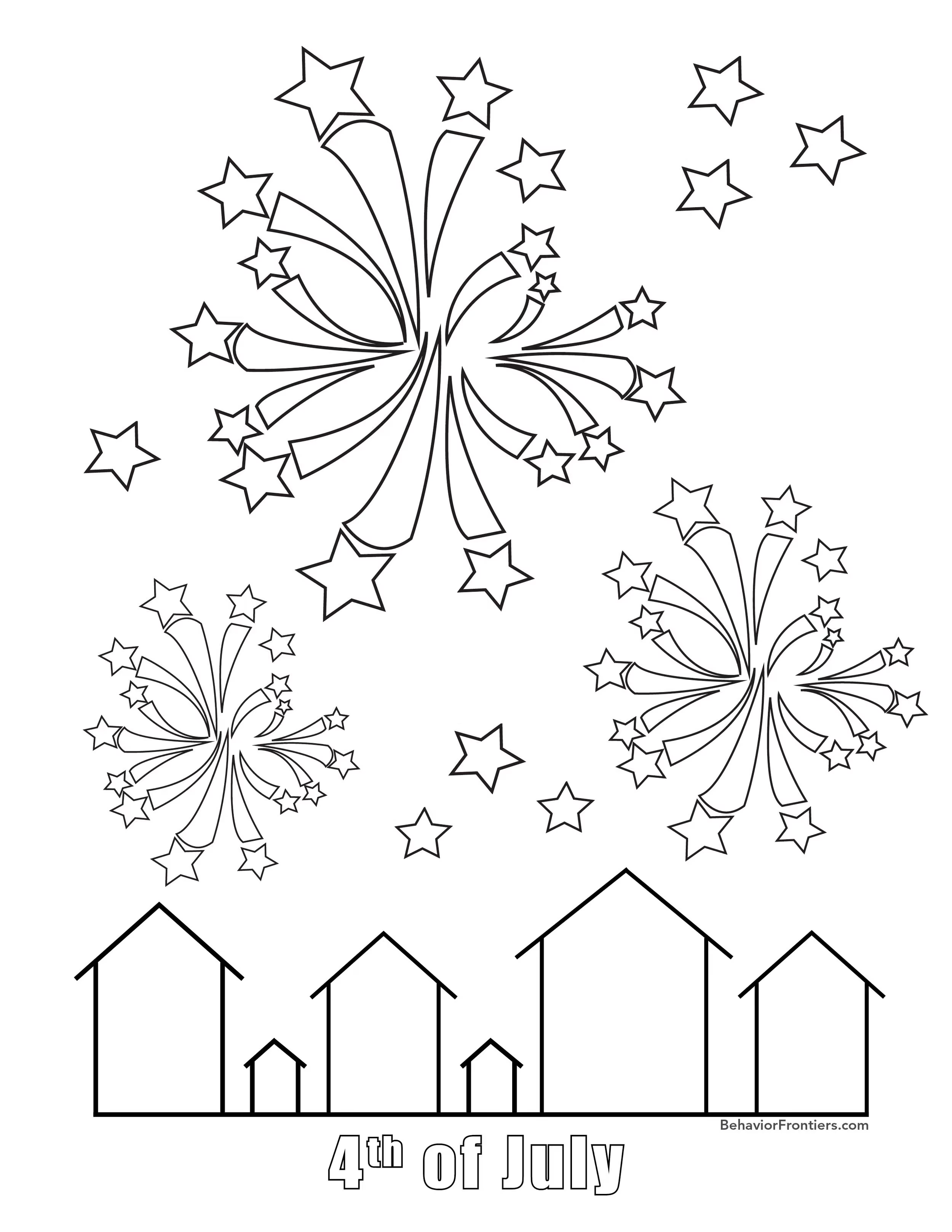
  5. Explain how fireworks work and what they are made of. Describe all of the colors, smells, and sounds. Use this coloring sheet to fill in the bright colors and location of the fireworks!
  6. Consider an alternative celebration. With the COVID-19 pandemic still in full swing, many of us will be celebrating at home this year. While this definitely means that many of our plans have been cancelled, it also gives us a great opportunity to expand our horizons! If your child understands the concept of birthdays, think about throwing a birthday party for America. Explain to your child that this is America’s birthday, and make or serve flag-themed or patriotic food, such as a red, white and blue birthday cake, or fruit cut into star shapes. Buy or make some plain sugar cookies and decorate them in patriotic colors with your child! The possibilities are endless.
  7. Enjoy the celebration the best way possible. Going in with an open mind and back-up plan will allow everyone to have a great event.

While most fireworks displays are relatively short, each experience big or small is helping your child feel confident about celebrations and new things. Take lots of pictures that can be used as tools for years to come.

Allie Wyatt
Expansion Coordinator, Bakersfield, CA
Tuesday, June 23
View Our Previous Blog Posts

7 Famous People with Autism Who've Shared Their Diagnosis
September 8, 2026

7 Famous People with Autism Who've Shared Their Diagnosis

An autism diagnosis never determines your success. For many of the most creative, driven, and groundbreaking minds in history, it may have been the very thing that fueled it. An intense focus, pattern recognition, and a willingness to see the world differently are not limitations. They're superpowers. And when a person with autism is given the right support and space to grow, truly incredible things can happen.
What Is DRA in ABA Therapy? (Differential Reinforcement of Alternative Behavior)
September 8, 2026

What Is DRA in ABA Therapy? (Differential Reinforcement of Alternative Behavior)

Every time your child wants to play with a toy, they have big emotions until they get it. At school, when presented with difficult work, they might run away. These are all examples of behaviors your child might exhibit to serve a communicative purpose. They might need something or want your attention. Or maybe they just want access to an opportunity. Whatever the behavior might be—it works, so it continues. Sometimes, we as adults may reinforce these behaviors without realizing it.
The 7 Dimensions of ABA Therapy (Baer, Wolf & Risley, 1968)
September 8, 2026

The 7 Dimensions of ABA Therapy (Baer, Wolf & Risley, 1968)

What guides every intervention in Applied Behavior Analysis (ABA) therapy?The 7 dimensions of ABA.Think of ABA therapy like a multi-dimensional figure. It has many angles, perspectives, and ways to evaluate it. That is exactly what the dimensions do. They give clinicians and families a complete way to see how well an intervention is working, from every angle.
Errorless Learning in ABA: How and Why Behavior Therapists Use It
September 8, 2026

Errorless Learning in ABA: How and Why Behavior Therapists Use It

In Applied Behavior Analysis (ABA) therapy, errorless learning is a way to teach new skills by giving the right amount of support from the very beginning.When your child with autism is learning something new, mistakes are part of the process. But for some kiddos, too many mistakes too quickly can feel uncomfortable, frustrating, or discouraging. The last thing we want is for your child to shut down, guess, avoid the task, or lose confidence before the skill has a chance to grow. That's where errorless learning can help.
Stimming and Autism: What It Is, Why It Happens, and When to Support It
September 8, 2026

Stimming and Autism: What It Is, Why It Happens, and When to Support It

Have you noticed your child rocking, flapping their hands, or making the same sounds on repeat?What you’re observing is called stimming. Stimming (short for self-stimulating behavior) refers to repetitive motions, sounds, or interactions with objects, and it’s far more common than you may think. In fact, close to 44% of people with autism engage in some form of stimming.
What Are the Benefits of Center-Based ABA Therapy? What Parents Should Know
September 3, 2026

What Are the Benefits of Center-Based ABA Therapy? What Parents Should Know

If your child recently received an autism diagnosis, the next steps can feel exciting in some ways. Now, your child has access to all the support they need. But after that diagnosis comes a fresh set of questions, one of them being: what's the right next step? To help you understand if your kiddo is a good fit for center-based ABA therapy, we'll cover: the definition of center-based ABA, the benefits of center-based ABA, and the key differences between center-based and in-home ABA.
Find ABA Therapy Near Me