
May 31, 2022

Daycare or Center-Based ABA: Which is Right for My Child?
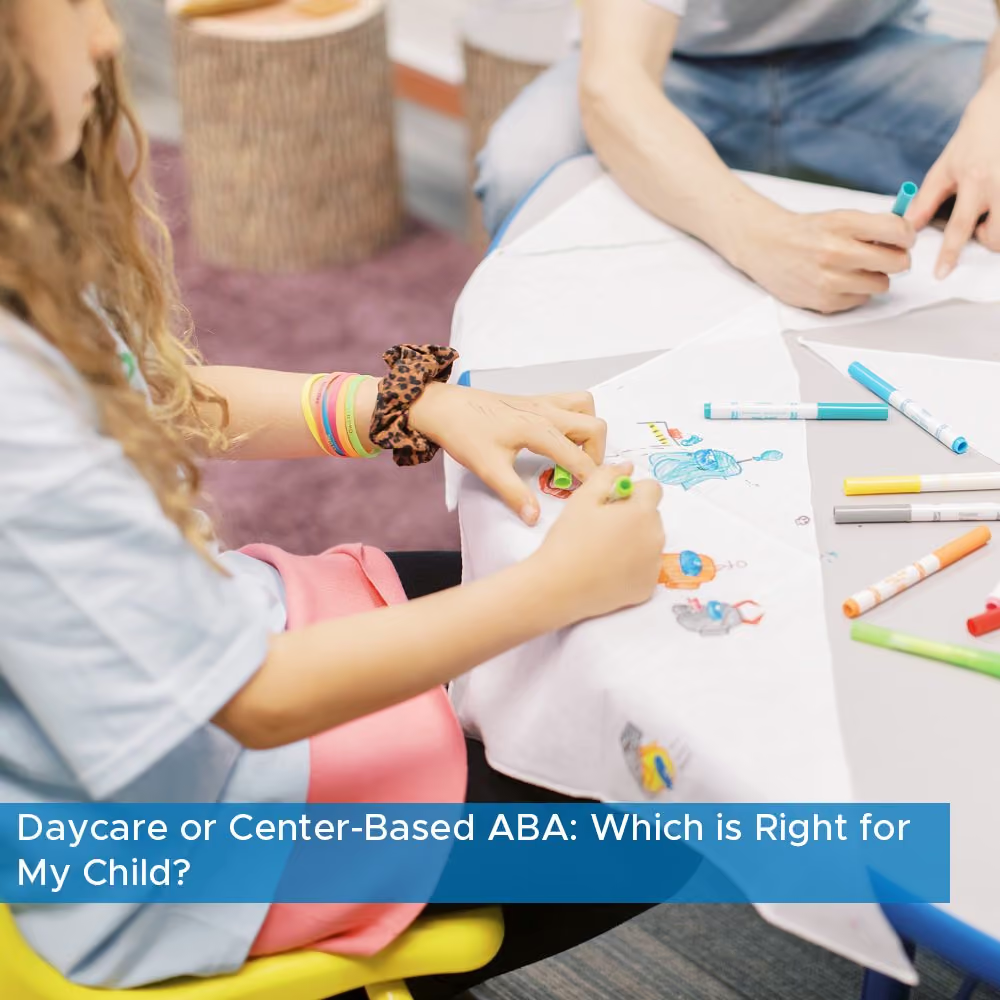
Daycare or Center-Based ABA: Which is Right for My Child? — Behavior Frontiers

Parents and caregivers of children with autism have many decisions they have to make regarding the care of their children. Those decisions become even more complicated when the parent or caregiver has responsibilities outside the home, such as work or school, and it leaves the parent with a lot of questions: Who will watch your child while you are unavailable? Will they be trained to meet your child’s specific needs? Will your child benefit from their time, or will you have to find additional time for your child’s treatment?

When presented with these questions, most parents choose one of two options: enrolling their child in daycare and scheduling ABA services in the evening, or enrolling their child in a center-based ABA program. There are benefits to both, depending upon the needs of your child, but today, we would like to talk about some of the specific positives of utilizing an ABA Treatment Center rather than a daycare program.

  • When a family opts for daycare with additional in-home therapy, there is added strain on time for the child and the entire family. This comes from the need to schedule therapy sessions when the child and a responsible adult are both home. Conversely, by combining both child supervision and ABA treatment, the family gets the benefits of both in the same block of time, meaning that free time is truly free, rather than being taken up by an in-home session.
  • Daycare providers may not be fully trained on how to handle your child’s specific autism-related needs. In a center, because all employees are trained ABA practitioners, your child will consistently be receiving appropriate care. This means that, even during playtime, if your child begins to tantrum or be overwhelmed, they will be attended to by people who are experts in your child’s specific needs.
  • In a daycare setting, multiple children are supervised by a limited number of adults. By definition, this means that your child cannot always be receiving one-on-one supervision. In a Behavior Frontiers Autism Treatment Center, the ratio is 1:1. Your child will be consistently supervised by the same one person, leading to better outcomes, fewer changes to adapt to, and an ABA technician who fully knows your child and their specific challenges.
  • Professional daycare services can be costly, leading to a steep financial burden for many families. However, because ABA treatment is medically necessary, it is covered by most insurances. This can drastically reduce the financial burden caused by paying for separate childcare.

If you live in the Los Angeles, Sacramento, or Detroit areas, Behavior Frontiers has an Autism Treatment Center available for you! Contact us for more information.

View Our Previous Blog Posts

7 Famous People with Autism Who've Shared Their Diagnosis
September 8, 2026

7 Famous People with Autism Who've Shared Their Diagnosis

An autism diagnosis never determines your success. For many of the most creative, driven, and groundbreaking minds in history, it may have been the very thing that fueled it. An intense focus, pattern recognition, and a willingness to see the world differently are not limitations. They're superpowers. And when a person with autism is given the right support and space to grow, truly incredible things can happen.
What Is DRA in ABA Therapy? (Differential Reinforcement of Alternative Behavior)
September 8, 2026

What Is DRA in ABA Therapy? (Differential Reinforcement of Alternative Behavior)

Every time your child wants to play with a toy, they have big emotions until they get it. At school, when presented with difficult work, they might run away. These are all examples of behaviors your child might exhibit to serve a communicative purpose. They might need something or want your attention. Or maybe they just want access to an opportunity. Whatever the behavior might be—it works, so it continues. Sometimes, we as adults may reinforce these behaviors without realizing it.
The 7 Dimensions of ABA Therapy (Baer, Wolf & Risley, 1968)
September 8, 2026

The 7 Dimensions of ABA Therapy (Baer, Wolf & Risley, 1968)

What guides every intervention in Applied Behavior Analysis (ABA) therapy?The 7 dimensions of ABA.Think of ABA therapy like a multi-dimensional figure. It has many angles, perspectives, and ways to evaluate it. That is exactly what the dimensions do. They give clinicians and families a complete way to see how well an intervention is working, from every angle.
Errorless Learning in ABA: How and Why Behavior Therapists Use It
September 8, 2026

Errorless Learning in ABA: How and Why Behavior Therapists Use It

In Applied Behavior Analysis (ABA) therapy, errorless learning is a way to teach new skills by giving the right amount of support from the very beginning.When your child with autism is learning something new, mistakes are part of the process. But for some kiddos, too many mistakes too quickly can feel uncomfortable, frustrating, or discouraging. The last thing we want is for your child to shut down, guess, avoid the task, or lose confidence before the skill has a chance to grow. That's where errorless learning can help.
Stimming and Autism: What It Is, Why It Happens, and When to Support It
September 8, 2026

Stimming and Autism: What It Is, Why It Happens, and When to Support It

Have you noticed your child rocking, flapping their hands, or making the same sounds on repeat?What you’re observing is called stimming. Stimming (short for self-stimulating behavior) refers to repetitive motions, sounds, or interactions with objects, and it’s far more common than you may think. In fact, close to 44% of people with autism engage in some form of stimming.
What Are the Benefits of Center-Based ABA Therapy? What Parents Should Know
September 3, 2026

What Are the Benefits of Center-Based ABA Therapy? What Parents Should Know

If your child recently received an autism diagnosis, the next steps can feel exciting in some ways. Now, your child has access to all the support they need. But after that diagnosis comes a fresh set of questions, one of them being: what's the right next step? To help you understand if your kiddo is a good fit for center-based ABA therapy, we'll cover: the definition of center-based ABA, the benefits of center-based ABA, and the key differences between center-based and in-home ABA.
Find ABA Therapy Near Me