
February 25, 2020

Five Years, Four Promotions – That’s How Behavior Frontiers Rolls!
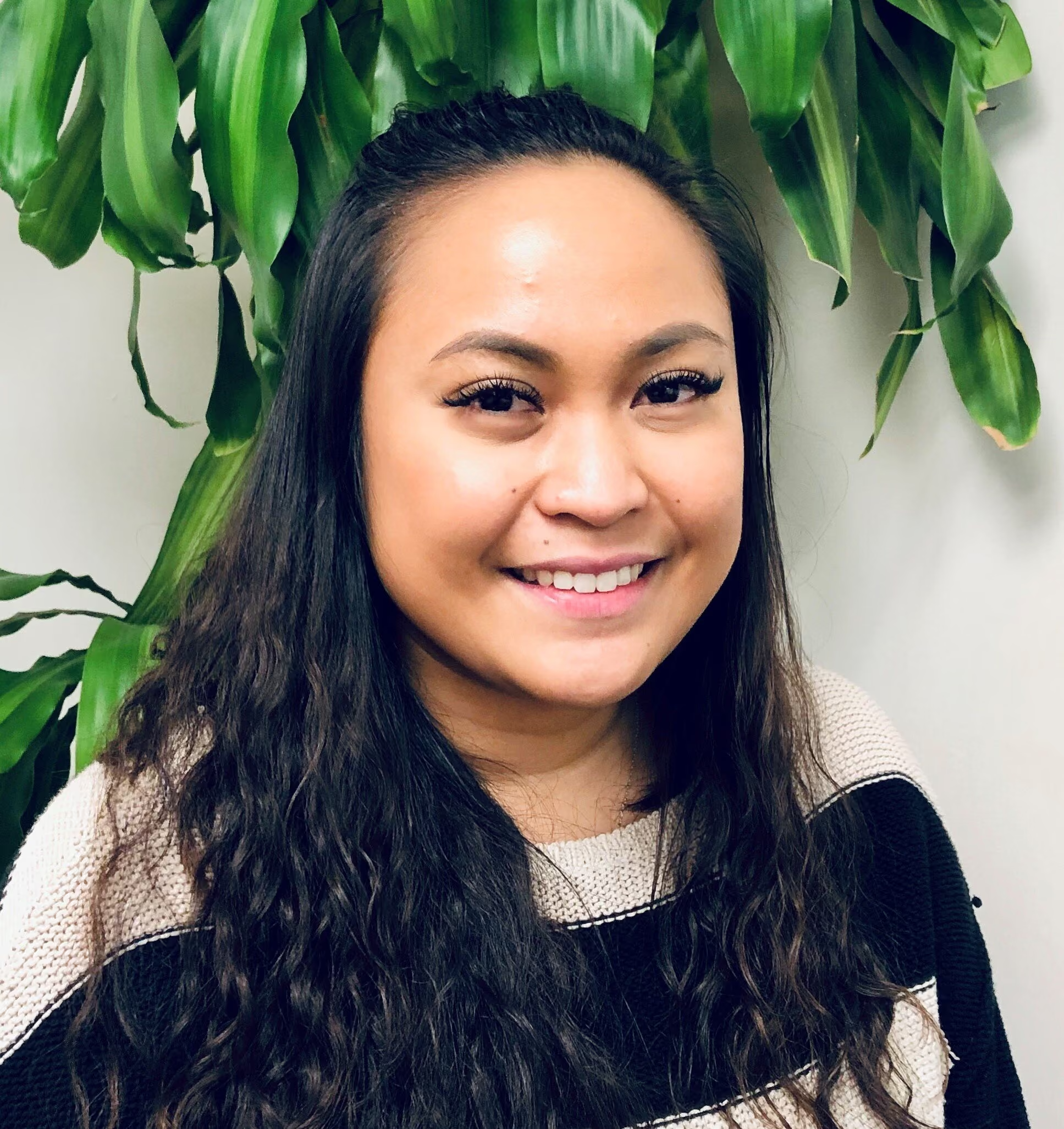
Five Years, Four Promotions – That’s How Behavior Frontiers Rolls! — Behavior Frontiers

I joined the Behavior Frontiers team about five years ago after graduating from the University of California, Davis with a Bachelor of Arts degree in Sociology and a minor in Psychology. I had already worked as a Behavior Technician while in college and knew that this was the field I wanted to pursue. I moved to San Jose, CA, and started my journey at Behavior Frontiers as a behavior technician. Shortly thereafter, I was promoted to a Senior Behavior Technician position.

While working as a full-time senior behavior technician, I was also a full-time graduate student working towards becoming a Board Certified Behavior Analyst (BCBA). Throughout this wildly busy period I enjoyed the full support of my supervisors going so far as carving out time from their busy schedules to allow me to interview them for homework assignments and to meet with me to clear up any confusion I had. Their involvement and support of my academic pursuits carried over to ensuring that I was successfully and productively applying what I learned in school to my work with my clients.

As I progressed through my master’s program, my supervisors began to prepare me to meet the rigors of the Case Manager position. They taught me about me about assessments, report writing, programming, and so much more, and upon receipt of my Master of Education in Curriculum and Instruction, I was promoted to Case Manager. After working as a case manager for about two years, and gaining invaluable experience in that role, I successfully passed the big BCBA exam (I WAS SO EXCITED) and soon thereafter was promoted, again – this time to Associate Clinical Director for the San Jose Region.

Throughout my time at Behavior Frontiers I have had the support of supervisors and co-workers at all levels, and they are the reason I am a BCBA. Behavior Frontiers provided me with tremendous opportunities to grow within the company and actively participated in ensuring I developed the skills necessary to progress in my career. As a BCBA, they continue to support my growth by offering Continuing Education Units and conference participation as well as internal trainings to ensure I maintain my current skills and learn new ones.

Samantha Pansoy, M.Ed., BCBA
Associate Clinical Director – San Jose, CA
February 25, 2020

View Our Previous Blog Posts

7 Famous People with Autism Who've Shared Their Diagnosis
September 8, 2026

7 Famous People with Autism Who've Shared Their Diagnosis

An autism diagnosis never determines your success. For many of the most creative, driven, and groundbreaking minds in history, it may have been the very thing that fueled it. An intense focus, pattern recognition, and a willingness to see the world differently are not limitations. They're superpowers. And when a person with autism is given the right support and space to grow, truly incredible things can happen.
What Is DRA in ABA Therapy? (Differential Reinforcement of Alternative Behavior)
September 8, 2026

What Is DRA in ABA Therapy? (Differential Reinforcement of Alternative Behavior)

Every time your child wants to play with a toy, they have big emotions until they get it. At school, when presented with difficult work, they might run away. These are all examples of behaviors your child might exhibit to serve a communicative purpose. They might need something or want your attention. Or maybe they just want access to an opportunity. Whatever the behavior might be—it works, so it continues. Sometimes, we as adults may reinforce these behaviors without realizing it.
The 7 Dimensions of ABA Therapy (Baer, Wolf & Risley, 1968)
September 8, 2026

The 7 Dimensions of ABA Therapy (Baer, Wolf & Risley, 1968)

What guides every intervention in Applied Behavior Analysis (ABA) therapy?The 7 dimensions of ABA.Think of ABA therapy like a multi-dimensional figure. It has many angles, perspectives, and ways to evaluate it. That is exactly what the dimensions do. They give clinicians and families a complete way to see how well an intervention is working, from every angle.
Errorless Learning in ABA: How and Why Behavior Therapists Use It
September 8, 2026

Errorless Learning in ABA: How and Why Behavior Therapists Use It

In Applied Behavior Analysis (ABA) therapy, errorless learning is a way to teach new skills by giving the right amount of support from the very beginning.When your child with autism is learning something new, mistakes are part of the process. But for some kiddos, too many mistakes too quickly can feel uncomfortable, frustrating, or discouraging. The last thing we want is for your child to shut down, guess, avoid the task, or lose confidence before the skill has a chance to grow. That's where errorless learning can help.
Stimming and Autism: What It Is, Why It Happens, and When to Support It
September 8, 2026

Stimming and Autism: What It Is, Why It Happens, and When to Support It

Have you noticed your child rocking, flapping their hands, or making the same sounds on repeat?What you’re observing is called stimming. Stimming (short for self-stimulating behavior) refers to repetitive motions, sounds, or interactions with objects, and it’s far more common than you may think. In fact, close to 44% of people with autism engage in some form of stimming.
What Are the Benefits of Center-Based ABA Therapy? What Parents Should Know
September 3, 2026

What Are the Benefits of Center-Based ABA Therapy? What Parents Should Know

If your child recently received an autism diagnosis, the next steps can feel exciting in some ways. Now, your child has access to all the support they need. But after that diagnosis comes a fresh set of questions, one of them being: what's the right next step? To help you understand if your kiddo is a good fit for center-based ABA therapy, we'll cover: the definition of center-based ABA, the benefits of center-based ABA, and the key differences between center-based and in-home ABA.
Find ABA Therapy Near Me