
October 18, 2022

Celebrate Halloween with Behavior Frontiers!

Celebrate Halloween with Behavior Frontiers! — Behavior Frontiers

Halloween can be a great time for children and families. From costume parties to trick-or-treating, this holiday can provide some awesome opportunities for fun and socializing. However, for parents or caregivers of children with autism, it can also be a complicated time, filled with lots of questions: will my child be able to tolerate their costume? If we participate in any events, will there be too much light or noise that will affect my child? Can we all take part in the celebrations together?

With that in mind, we have some ideas for how you can help your child to take part in the celebrations, while minimizing stress for them and for the rest of your family.

Costumes

Children with autism can have a number of sensory issues that may make costumes difficult. Things like a cape tied around the neck or a mask that covers the whole face can cause a lot of stress for your child. Allow your children to have a choice in their Halloween costumes, and try it on in advance. If you notice that they’re pulling or tugging on the costume, or acting as if they want to remove it, it may be causing them sensory issues. If your child is unwilling to wear any costume, consider letting them wear pajamas or regular clothes.

Trick or Treating

A child with Autism may appear to be uncomfortable or unwilling to greet people as they open their door, make eye contact, say “Trick or Treat”, or hold out their bag/bucket. Even if your child has participated in trick or treating in the past, they may need help with the routine. Set up expectations in advance by preparing them 1-2 weeks before the holiday using stories, visual reminders, movies, or photographs. Review memories from past Halloweens and remind him/her about trick or treating, costumes, candy, and how to behave when trick or treating. Watch a movie or cartoon about trick or treating and have your child practice saying, “Trick or Treat”. Visuals, such as a poster, can help children with Autism understand complex or abstract concepts. Go over this information several times before the day approaches. On the night of Halloween remind the child of the routine as needed. For example, as you approach someone’s front porch say to your child “Okay, first we go knock on the door, and then what do we say?”

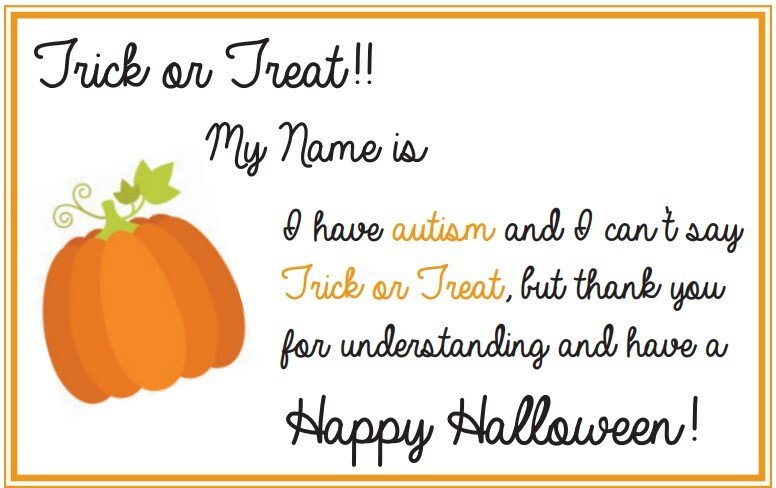
If your child has limited language abilities, you can print cards that say “Trick or Treat”, or use our free printable (at the bottom of this article) and tape it to their bucket or bag! Then, instead of practicing having them verbally say the words, work with them on going to the door and showing their sign.

Participate in Other Events

There are many different types of events that occur around this time, and some of them may be a better fit for your child’s needs. For example, a Trunk or Treat event is usually confined to one area, so your child would only have to adapt to one new place, and you can leave quickly if your child becomes overwhelmed. Also, reach out to your local Autism Society office! Many of them are either hosting sensory-friendly events or can direct you to those who are.

Join Us For a Behavior Frontiers Halloween Event!

One of our Behavior Frontiers offices is hosting a sensory-friendly Halloween Event! If you are in the Sacramento, CA area, we would love to see you and your family at our free, sensory-friendly Halloween party. Space is limited, and tickets are going fast, so sign up today! We hope to see you there.

To download our free printable, CLICK HERE!
View Our Previous Blog Posts

7 Famous People with Autism Who've Shared Their Diagnosis
September 8, 2026

7 Famous People with Autism Who've Shared Their Diagnosis

An autism diagnosis never determines your success. For many of the most creative, driven, and groundbreaking minds in history, it may have been the very thing that fueled it. An intense focus, pattern recognition, and a willingness to see the world differently are not limitations. They're superpowers. And when a person with autism is given the right support and space to grow, truly incredible things can happen.
What Is DRA in ABA Therapy? (Differential Reinforcement of Alternative Behavior)
September 8, 2026

What Is DRA in ABA Therapy? (Differential Reinforcement of Alternative Behavior)

Every time your child wants to play with a toy, they have big emotions until they get it. At school, when presented with difficult work, they might run away. These are all examples of behaviors your child might exhibit to serve a communicative purpose. They might need something or want your attention. Or maybe they just want access to an opportunity. Whatever the behavior might be—it works, so it continues. Sometimes, we as adults may reinforce these behaviors without realizing it.
The 7 Dimensions of ABA Therapy (Baer, Wolf & Risley, 1968)
September 8, 2026

The 7 Dimensions of ABA Therapy (Baer, Wolf & Risley, 1968)

What guides every intervention in Applied Behavior Analysis (ABA) therapy?The 7 dimensions of ABA.Think of ABA therapy like a multi-dimensional figure. It has many angles, perspectives, and ways to evaluate it. That is exactly what the dimensions do. They give clinicians and families a complete way to see how well an intervention is working, from every angle.
Errorless Learning in ABA: How and Why Behavior Therapists Use It
September 8, 2026

Errorless Learning in ABA: How and Why Behavior Therapists Use It

In Applied Behavior Analysis (ABA) therapy, errorless learning is a way to teach new skills by giving the right amount of support from the very beginning.When your child with autism is learning something new, mistakes are part of the process. But for some kiddos, too many mistakes too quickly can feel uncomfortable, frustrating, or discouraging. The last thing we want is for your child to shut down, guess, avoid the task, or lose confidence before the skill has a chance to grow. That's where errorless learning can help.
Stimming and Autism: What It Is, Why It Happens, and When to Support It
September 8, 2026

Stimming and Autism: What It Is, Why It Happens, and When to Support It

Have you noticed your child rocking, flapping their hands, or making the same sounds on repeat?What you’re observing is called stimming. Stimming (short for self-stimulating behavior) refers to repetitive motions, sounds, or interactions with objects, and it’s far more common than you may think. In fact, close to 44% of people with autism engage in some form of stimming.
What Are the Benefits of Center-Based ABA Therapy? What Parents Should Know
September 3, 2026

What Are the Benefits of Center-Based ABA Therapy? What Parents Should Know

If your child recently received an autism diagnosis, the next steps can feel exciting in some ways. Now, your child has access to all the support they need. But after that diagnosis comes a fresh set of questions, one of them being: what's the right next step? To help you understand if your kiddo is a good fit for center-based ABA therapy, we'll cover: the definition of center-based ABA, the benefits of center-based ABA, and the key differences between center-based and in-home ABA.
Find ABA Therapy Near Me