

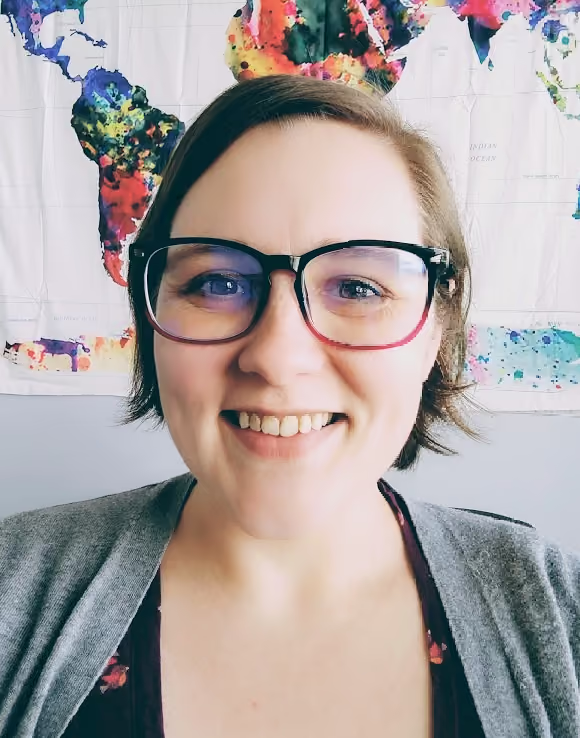
Employee Spotlight: Allie Wyatt
%2013.avif)

I stumbled into my job at Behavior Frontiers the way most people find employment these days – a help wanted ad on an online job board. The available position was for an Administrative Assistant, a job that I was definitely qualified for, having worked in similar positions for the past twelve years. I eagerly applied, and hopefully waited for a response.
The response was quick to come, and a job offer soon to follow. When I started work, I had the incredibly exciting responsibility of essentially opening a new office. The clinical staff had received keys to the office just a week before, so I walked into the kind of chaos I thrive on: phones and internet hadn’t been set up yet, most of the furniture was still in boxes, and all we had in the way of a break room was a coffeemaker in an office in a back corner. I got right to work, doing my best to “make a house a home”. I built furniture, set up filing systems, got our kitchen and break all set up, and got our clinical staff settled in.
After things calmed down a bit, I found something new to do that allowed me to flex my creative muscle: making stimuli for our clients. I loved spending time making intricate token boards specially tailored to the clients’ interests, and I loved even more when our case managers would come in and tell me how much the kiddos had loved them, how much more attentive they were, and how much more motivated they were to earn their tokens.
On my first Administrative Professionals Day with Behavior Frontiers, my clinical staff brought me flowers, and I cried. In all of my years of working these types of jobs, I have never worked for a company that did any more than send out an email for the day, if they acknowledged it at all. This was the first day that I really understood the company culture of Behavior Frontiers. Not just because of the flowers (though they were very nice), but because all day, 90 percent of the emails I received were company-wide shout-outs, from clinical staff singing the praises and listing the accomplishments of the administrators in their offices. They wanted to make sure that everyone knew just how incredibly valuable their admins were to all of their efforts.
My responsibilities quickly started to change. Our Regional Clinical Director came to visit our office, and she saw something in me that I had never really seen in myself: a capacity for more. She started assigning me work, and I became her unofficial assistant. Three months later, she called me.
“What do you want from your future with Behavior Frontiers?” she asked. I was completely stumped. I wasn’t sure what I wanted for my future at all, much less anything specific. “Well, I want you to think about it,” she continued, “because whatever you want to do, I’m going to help you get there.” And she was true to her word. She worked tirelessly to find the right spot for me. She introduced me to other people within the company, who also had faith in me, and who then also worked on my behalf.
Finally, about a year ago, I was promoted to Expansion Coordinator. With Behavior Frontiers opening new offices all the time, they needed someone to help make sure that everything runs as smoothly as possible, and so this position was created. I work a lot on marketing, business development, training, you name it. Every day is different, and most days are exciting (in a good way, I promise!).
“The moral of the story is, I never imagined that this is the kind of work I would end up doing. It took people that saw and believed in my abilities, and a company that was willing to stand behind those people. ”
It took management who actively look for ways to promote from within and to bring people up within the company. And it took a wonderful group of people, who believe so strongly in the inherent skills of their administrative assistants. I’m still not sure what I want for my future, but I know that it will be with Behavior Frontiers.
Allie Wyatt joined Behavior Frontiers as an Administrative Assistant for the Bakersfield, CA office in 2016. She began working as the Expansion Coordinator in 2018, responsible for assisting in all operations involved in opening a new location.
June 18, 2019