

Choosing a Quality ABA Agency for Your Child with Autism
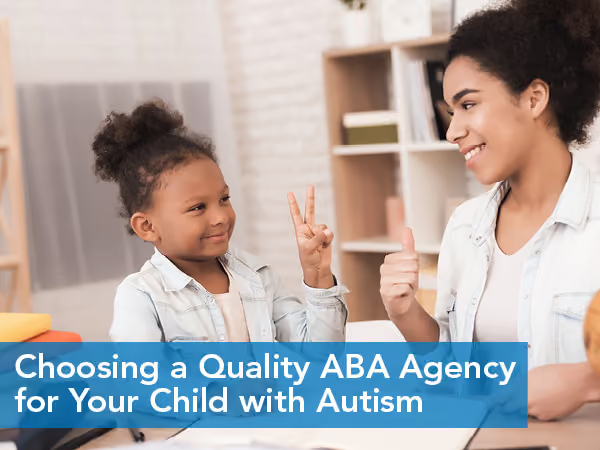
%2013.avif)

There are countless agencies that advertise themselves as providers of Applied Behavior Analysis (ABA) based therapy services, but finding a good quality service is not always easy. How should a parent of a newly diagnosed child navigate the field of behavior intervention service providers?
Here are some questions to ask of potential agencies:
1. "What are the minimum educational requirements for the direct interventionists?"
Direct interventionists, also commonly known as behavior therapists, specialists, technicians, or instructors, are the people who will work with your child on a daily basis. It is reasonable to expect that the behavior technician have at least a bachelor's degree in psychology, education, or a related field. Ideally, your child’s behavior technician should be a Registered Behavior Technician (RBT), Board Certified Autism Technician (BCAT) or Applied Behavior Analyst Technician (ABAT). RBTs, BCATs and ABATs have taken comprehensive training in autism and ABA methods and have demonstrated their competence by passing written and/or field examinations. If the technicians are not certified, you may want to ask about the training the agency has provided. All ABA technicians, regardless of their certifications, should be consistently and regularly supervised.
2. "What are the minimum educational requirements for supervisory staff?"
All ABA technicians should be supervised by a person who holds a master's degree in psychology or a related field with experience in the fields of autism and ABA. Ideally, this person should also be a Board Certified Behavior Analyst (BCBA) or Board Certified Assistant Behavior Analyst (BCaBA). This means s/he has taken the specific required coursework in behavior analysis and met the experience requirement of the Behavior Analysis Certification Board. The BCBA (or BCaBA) is certified to design and supervise behavior analytic programming and intervention plans.
3. "What type of training is required for direct intervention technicians?"
An agency should provide new ABA technicians with training in ABA methods as well as field training where the trainee observes an experienced technician and then has to demonstrate competency in several skill areas before being sent off to work on his/her own. Initial training should cover the topics such as reinforcement, discrete trial teaching, prompting, naturalistic teaching strategies, data collection, and reductive interventions.
4. “What is your supervisor to client ratio and how often will the supervisor provide direct supervision?”
Lower supervisor to client ratios mean more time for your child’s supervisor to address your child’s needs. In order to for the supervisor to be able to keep your child’s program running smoothly, it is best that supervisors have no more than 15 clients at a time. Frequency and amount of direct supervision may vary by the number of funded hours and the needs of the child; however, a good general rule is that the supervisor should observe your child directly at least 1-2 times per month. It will help to know how many supervision hours the funding source has authorized for your child so you know what to expect. Most behavioral agencies also offer the option to pay privately, in which case you may be able to pay for supervision hours separately if you choose to do so. The effectiveness of behavioral programs may be diminished by the lack of or insufficient supervision.
5. “What resources does your agency have to address my child’s needs?”
When interviewing potential agencies, keep your child’s age, diagnosis, and unique needs in mind. Express your main concerns in detail. Is your child exhibiting dangerous self-injurious behaviors or aggression? Is your child able to communicate well with adults, but has difficulty relating to peers and making friends? Does your child have another diagnosis such as ADHD, emotional disturbance, or Rett Syndrome? You will want to ensure that the agency has experience with your child’s diagnosis and age level and that the agency has curricula targeting all of your child’s skill deficits. Also, you will want to be aware of the type of reductive interventions the staff might use to address your child’s problem behaviors. While agency staff members will not be able to give specific recommendations until your child is observed and assessed, they should be able to tell you about general techniques that the agency uses to reduce problematic behaviors. You will want to ensure that you are comfortable with those techniques and that they are research-based before selecting your agency. If you are interested, you may also want to ask if the agency offers parent training, which will help you to create the most consistent environment possible for your child.
Regardless of who you choose to provide your child’s behavior intervention program, you will want to ensure the following once the service is in place:
1. The direct technicians should be taking data on any problem behaviors as well as on your child’s acquisition of new skills and progress towards their goals. You should also receive reports on your child’s progress based on this data (this happens quarterly, semi-annually or when report cards come out for school district services).
2. The technician should follow established by the BCBA supervisor and communicate with the BCBA supervisor frequently. Becoming familiar with your child’s behavior intervention plan will help you to know that the technician is in fact following that plan.
3. As the parent, you should be informed of the techniques being used with your child and have the opportunity to agree or disagree with the use of those techniques and request changes to the existing program. Keep up to date on the names of specific strategies being used in your child’s program. These can, will, and should change from time to time as your child progresses or shows differing needs. Make sure that all of the strategies being used with your child are research-based (e.g., discrete trial training/teaching (DTT), naturalistic teaching (NATS), etc.). There are many research-based strategies within the field of ABA, but if you are skeptical, you can always ask your BCBA supervisor to point you in the direction of research that supports a specific technique.
4. Most importantly, make sure you feel comfortable and satisfied with your child’s progress. If not, the BCBA supervisor should be willing to set up a meeting with you to discuss possible changes to your child’s behavior intervention program.
June 11, 2019