

Differential Reinforcement in ABA: The Most Powerful Tool Behavior Therapists Use

%2013.avif)

Differential reinforcement is a behavior-support strategy that strengthens one response while reducing another. It has two moving parts: reinforcing the behavior you want to see more of, and reducing reinforcement for the challenging behavior that isn’t meeting your child’s needs in the best way.
In Applied Behavior Analysis (ABA) therapy for children with autism, instead of focusing only on stopping challenging behaviors (like hitting, crying, or eloping), we use differential reinforcement to teach children what to do instead to communicate their needs more effectively—often called replacement behaviors. It's a compassionate and understanding strategy that’s also very effective.
If you've heard this term as you navigate your child's autism diagnosis but still need some clarification, consider this your guide.
We'll walk through how differential reinforcement is used in ABA therapy, the five types of differential reinforcement, and real-life examples.
What is Differential Reinforcement?
First, it’s important to note that differential reinforcement is not punishment. It is a thoughtful, intentional process of redirecting challenging behavior and teaching (and rewarding) alternate behaviors that better helps your child express their needs.
For parents, here is a simple way to think about it: your child's Board Certified Behavior Analyst (BCBA) identifies why a behavior is happening and then finds a better way for your child to meet that same need. The goal is always to give your child more tools for success.
How Is Differential Reinforcement Used in ABA Therapy?
Differential reinforcement is mainly used for three reasons:
- To decrease challenging behaviors like aggression, self-injury, or elopement
- To increase more appropriate behaviors, like communication, turn-taking, or completing daily routines
- To adjust the rate of a behavior that is appropriate but occurring too frequently or not frequently enough
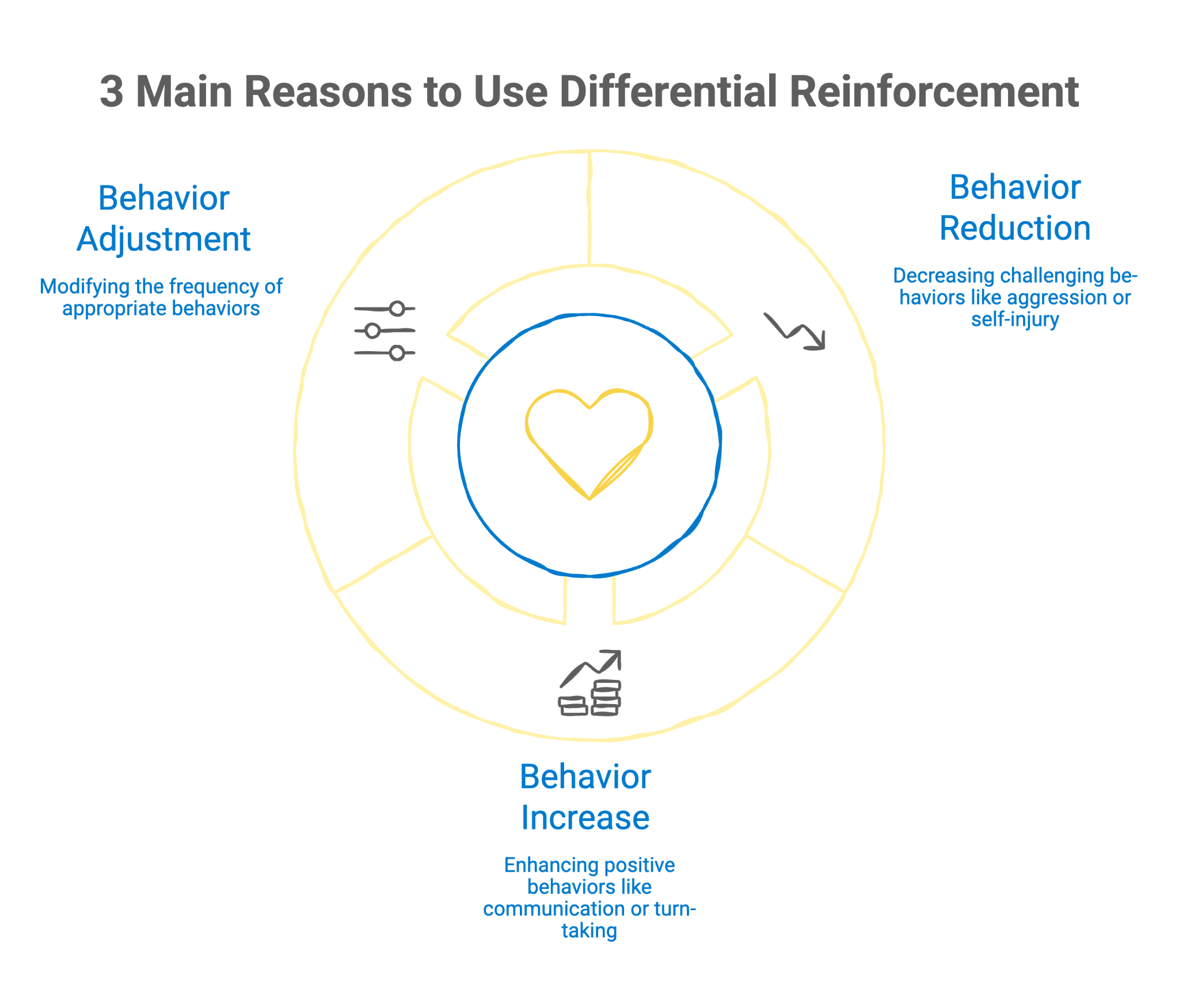
Explaining the three reasons to use differential reinforcement.
The starting point is always a functional behavior assessment. Before a BCBA designs any differential reinforcement program, they first want to understand why a behavior is happening.
That “why” (the function of the behavior) determines everything: which type of differential reinforcement to use, what the replacement behavior should be, and how to structure reinforcement so the plan works.
The Five Types of Differential Reinforcement and Real-Life Examples
Not all differential reinforcement looks the same. There are five distinct types, and each one is designed for a different situation. The right choice depends on the behavior, its function, and your child's individual needs.
DRA: Differential Reinforcement of Alternative Behavior
DRA reinforces an appropriate alternative behavior that serves the same function as the challenging behavior. The replacement behavior must be functionally equivalent, meaning it produces the same outcome the original behavior was providing, but in a safer or more appropriate way.
Example: A child hits during a difficult task to avoid doing it. So, they’re taught to hand over a break card instead of hitting. The function is the same (getting a break), but the form is one that works better for them to communicate their needs.
DRI: Differential Reinforcement of Incompatible Behavior
DRI reinforces a behavior that the child cannot physically perform at the same time as the challenging behavior. The incompatible behavior should also be functionally matched, not just physically incompatible, so that it meets their needs.
Example: A child runs away from the table to access toys. When they stay seated and raise their hand to request a turn, that behavior is reinforced. Sitting still prevents leaving the table by definition.
DRI feels natural because it does not try to force a child to stop something. It simply makes the better choice easier and the challenging choice harder through consistent positive reinforcement.
DRO: Differential Reinforcement of Other Behavior
DRO reinforces a stretch of time in which a concerning behavior does not occur. Your child does not have to perform a specific replacement behavior to earn reinforcement. They simply need to go a set amount of time without the challenging behavior occurring.
This approach can be especially helpful for behaviors that pose a safety risk and that need a fast response. It’s also helpful when the function of the behavior is not fully understood or when teachers and caregivers need a simple, straightforward system to implement.
Example: A child engages in self-injurious behavior, like banging their head on the wall. For every 10-minute interval in which the behavior does not occur, they receive access to a preferred activity.
While DRO can reduce behavior quickly, it doesn’t teach new skills on its own. It should always be paired with skill-building so your child has something meaningful to replace the original behavior with.
DRL: Differential Reinforcement of Low Rates
DRL is used when a behavior is appropriate, but it happens too frequently. The goal is not to eliminate the behavior, but regulate it.
Example: A child asks to help every two minutes. When at least five minutes pass between requests, the child is reinforced. In this way, the acceptable behavior isn’t eliminated, but dialed back to an appropriate amount.
DRL helps build independence and self-regulation. It communicates, “Your behavior makes sense, but we need to change the pace.” It still supports the behavior while teaching moderation.
DRH: Differential Reinforcement of Higher Rates
DRH is the flip side of DRL. It is used when a behavior is appropriate and already in a child's repertoire, but is not happening frequently enough for your child to benefit.
Example: A child knows how to initiate greetings with peers but rarely does so. When they do initiate a greeting, they’re reinforced and encouraged. The criteria to gain reinforcement increases gradually as the child builds confidence and momentum in this area.
DRH celebrates growth. It starts from what your child can already do and builds on it from there.
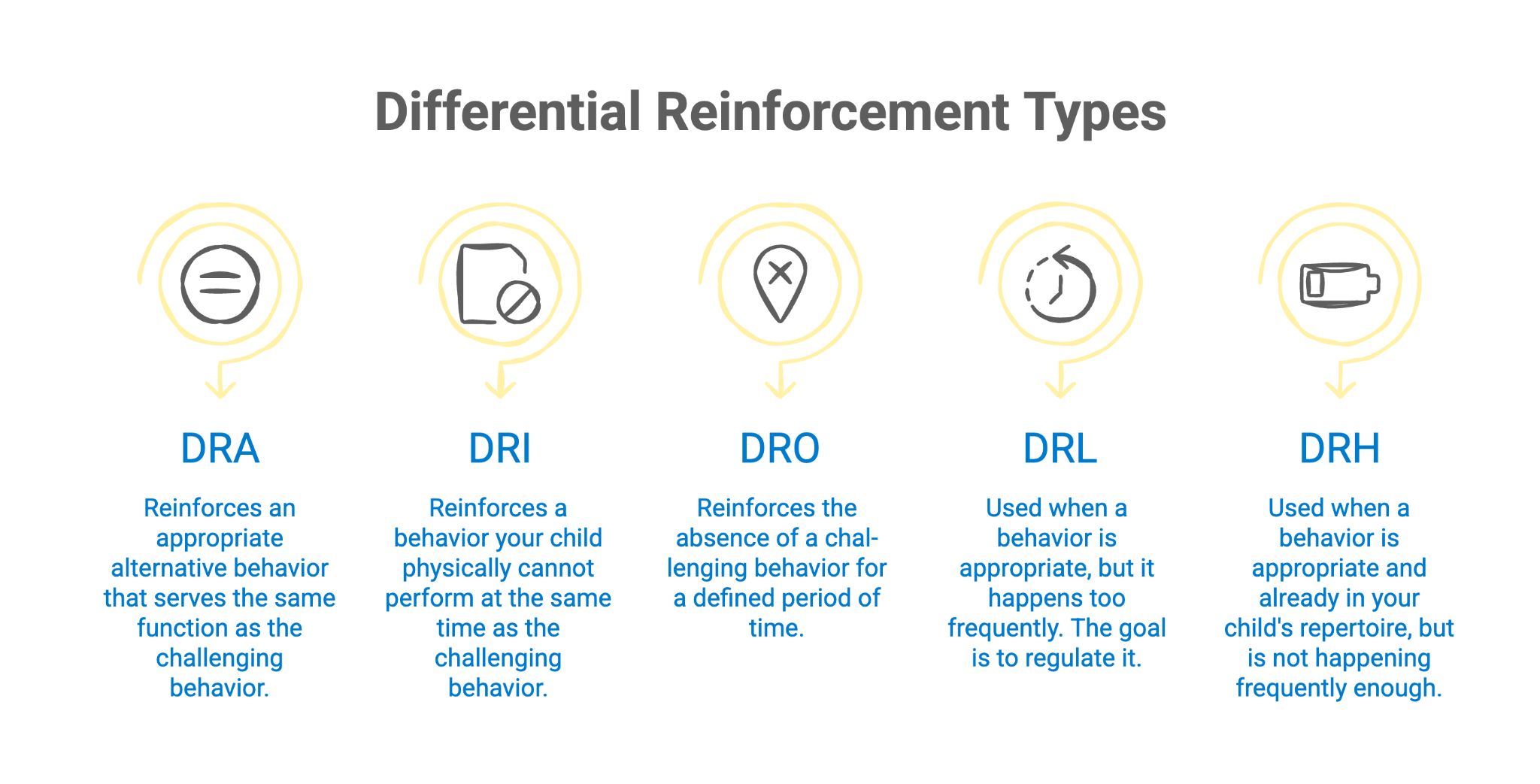
The five types of differential reinforcement.
Pairing Extinction With Replacement Behaviors
Extinction means no longer providing the reinforcer that has been maintaining a concerning behavior, so that a new, more effective behavior has room to take its place.
Here’s a quick scenario to describe it:
A child throws their plate at the dinner table when they’re done eating. Every time they throw a plate, their parent rushes over, removes the plate, and lets them get down from the table. The throwing behavior works to accomplish what they need, so it continues.
In this case, using extinction to stop the behavior would mean no longer rushing over, removing the plate, or granting them an escape.
But extinction isn’t a standalone strategy. It works best paired with teaching and reinforcing a better way for your child to meet that same need. When both pieces are in place, the replacement behavior has room to grow.
Let’s finish that scenario paired with teaching a replacement behavior:
When a child throws their dinner plate to show they’re done eating, the parent does not rush over, pick up the plate, and allow them to get down. They will then encourage the replacement behavior: tapping the table when they’re finished. After they do that, the parent can grab their plate and let them get down.
Over time, the plate throwing stops working. But tapping the table works every time. When this happens, the replacement behavior wins.
According to a study in the Journal of Applied Behavior Analysis, extinction is not always possible, and it is not always the right choice. Sometimes a caregiver cannot physically prevent a child from escaping a difficult task. Or, the act of stepping in to protect a child, which is always the right thing to do, can itself become reinforcing. In those moments, traditional extinction isn’t a safe or practical option. A different approach is needed instead, and that is okay.
Research shows that when extinction is not feasible, clinicians can still produce meaningful reductions in challenging behavior by making the reinforcement for appropriate behavior more immediate, longer lasting, and higher quality than what the original behavior produces. Even when a concerning behavior still contacts some reinforcement, stacking those advantages in favor of the replacement behavior can shift the balance over time.
This is grounded in something called the matching law, which describes how behavior naturally gravitates toward whichever option produces the most reinforcement.
Your child's BCBA is always thoughtfully weighing what is safest, most ethical, and most effective for your child specifically. The goal is always the same: giving your child a better way to communicate needs (and making sure the better way is the best choice).
What Differential Reinforcement Looks Like at Behavior Frontiers
At Behavior Frontiers, differential reinforcement is a reflection of how we see behavior: as communication. It also reflects how we view your child, who is a capable, growing human worthy of the best support.
Every program begins with a thorough functional behavior assessment, or FBA, matching your child with the right behavior goals. BCBAs design individualized programs, and Behavior Technicians implement them with consistency and care. Progress is tracked in real time through our proprietary PrioraCare™ platform, so programs are refined quickly as your child grows and needs shift.
Caregiver training is also woven into every plan. Because the skills your child builds in sessions become even more meaningful when the people who love them most understand how to support those same skills at home.
If you have questions about your child's behavior plan, or if you're just beginning to explore ABA therapy, we'd love to connect you with a BCBA who can help.
Ready to take the first step? Reach out to us and after a brief intake, you'll be connected with a Board Certified Behavior Analyst (BCBA) to begin building a plan tailored to your child's unique needs.
Frequently Asked Questions
What is a simple definition of differential reinforcement?
Differential reinforcement means reinforcing a desired behavior while reducing reinforcement for a less helpful one. The goal is always to build up what you want to see, not only reduce what you do not. It is one of the most compassionate and effective strategies in ABA because it focuses on teaching rather than just reducing a behavior.
What is differential reinforcement of alternative behavior?
Differential reinforcement of alternative behavior, or DRA, is a procedure in which an appropriate replacement behavior is reinforced while reinforcement is reduced for the original behavior. The key is that the replacement behavior must be functionally equivalent, meaning it gives your child the same outcome the challenging behavior was giving them, just in a safer or more appropriate way.
What is the difference between DRA, DRI, and DRO?
DRA reinforces an alternative behavior that serves the same function as the problem behavior.
DRI reinforces a behavior that your child physically cannot perform at the same time as the problem behavior.
DRO reinforces the absence of the problem behavior for a set period of time.
Each approach has its place depending on the behavior, its function, and your child's individual needs.
Can differential reinforcement be used without extinction?
Yes, and research supports this directly. A study published in the Journal of Applied Behavior Analysis found that when reinforcement for appropriate behavior was made more immediate, longer lasting, and higher quality than what the challenging behavior produced, meaningful reductions in the original behavior still occurred, even without full extinction in place.
What are a few differential reinforcement examples?
Differential reinforcement shows up in many different ways depending on the child and the behavior being addressed. Here are a few real-life examples across the different types:
- DRA example: A child leaves the classroom when they want to escape work. So, they are reinforced to hand over a break card instead. The break is the same, but the way they ask for it is safer and more appropriate.
- DRI example: A child who runs from the table to access toys is reinforced for staying seated and raising their hand to request a turn. Staying seated makes running impossible.
- DRO example: A child earns access to a preferred activity for every 10 minutes they go without hitting.
- DRL example: A child who asks for help every two minutes is reinforced when at least five minutes pass between requests. The behavior itself is not wrong, just the frequency.
- DRH example: A child who rarely greets peers despite knowing how to is reinforced for doing so more often, with the expectation gradually increasing over time.
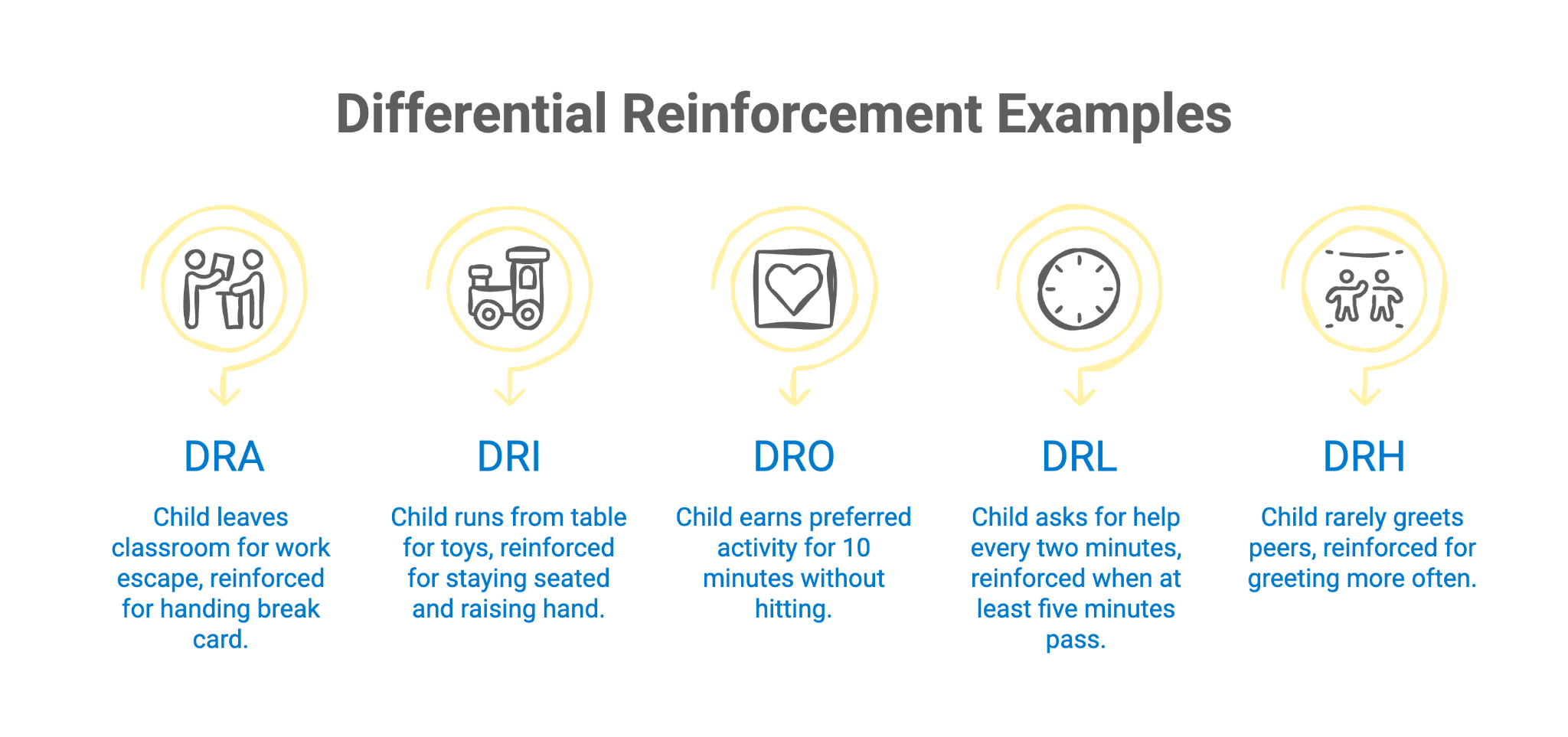
Real-life examples of differential reinforcement.