What Is DRO in ABA? Differential Reinforcement of Other Behavior



Do any of these behaviors sound a bit familiar?
Your child bites their hand during quiet activities.
At school, they call out during circle time again and again.
At home, they get up from the dinner table over and over, no matter how many times you ask them to sit.
With some behaviors, there’s an obvious swap for an alternative behavior. But that’s not the case for all of them.
That's where a specific Applied Behavior Analysis (ABA) tool can help out: Differential Reinforcement of Other Behavior (DRO), another type of differential reinforcement used in ABA therapy. It’s one of five types of reinforcement that can help your child learn skills and build behaviors that help them succeed.
However, DRO works a little differently from the rest. Instead of reinforcing a specific replacement behavior, it reinforces the absence of the behavior during a set window of time.
So, consider this your in-depth look at DRO, including how it works, practical DRO examples, when it's the right choice, and how it compares to other types of differential reinforcement.
What Is DRO in ABA?
DRO stands for “Differential Reinforcement of Other Behavior,” and it's a technique used in ABA therapy where reinforcement is delivered when a target behavior does not occur during a specific period of time.
In other words, any other behavior that happens besides the target behavior is reinforced instead of the target behavior. In this way, the absence of the target behavior is what you’re aiming for.
Here’s a quick example:
Let’s say your child frequently interrupts when others are talking. For every period of time they go without interrupting, they receive a small reward.
Over time, this strategy can reduce the target behavior and eventually taper it off completely. In a way, it honors those quiet moments that often go unnoticed. It shows that every moment counts and can be used to help your child develop skills and behaviors that set them up for success.
How Does DRO Work?
DRO is rooted in data, decades of research, and established ABA principles.
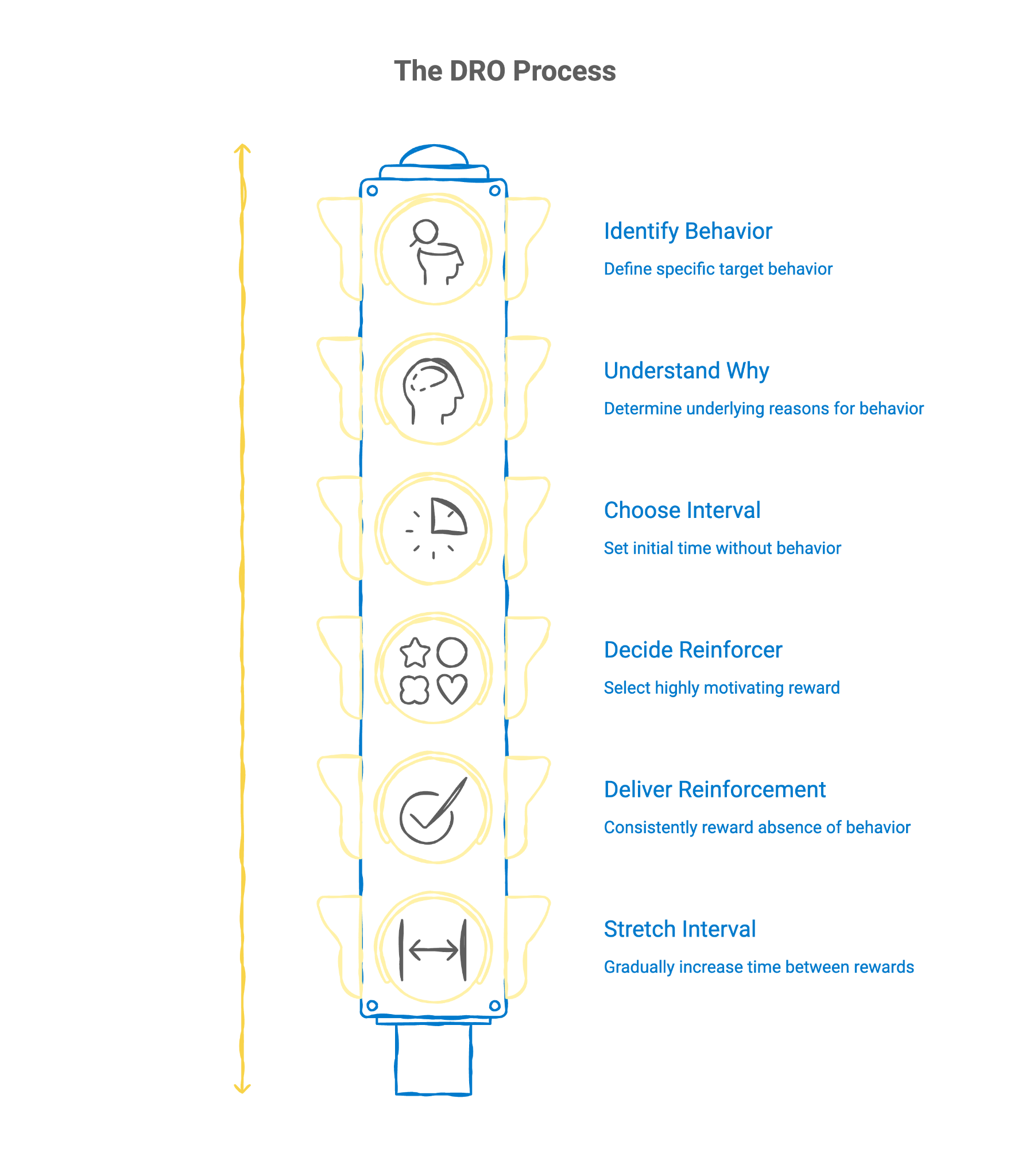
Here's the process that goes into it:
- Identify the behavior. Make sure to be specific here. DRO only works when everyone knows the exact behavior.
- Understand the “why.” A functional behavior assessment (FBA) tells your child’s BCBA what’s behind the behavior. Understanding this helps them make informed decisions going forward.
- Choose the interval. How long does your child currently go without the behavior? This will help you arrive at a starting point.
- Decide what the reinforcer is. What does your child love most? It could be praise, a sticker, a preferred activity, or extra time with something they love. In order for DRO to work, the reinforcer must be something your child loves.
- Deliver reinforcement. Make sure to deliver reinforcement consistently and at the end of each interval where the behavior didn’t happen.
- Stretch the interval gradually. As your child gains more success, stretch out the time interval.
Be Realistic About Time Intervals
Let’s say your child taps objects every three minutes during quiet activities. Setting a ten-minute time interval would be a difficult goal to reach (and a bit demotivating).
For them, going even 30 seconds longer would be a win. So, it all depends on where your child is and finding that realistic, reachable time interval.
Within this process, it’s important for your child to gain confidence. And a great way to do that is to set up the process for success from the beginning. Every small win counts.
DRO Examples
Your child's BCBA or Behavior Technician will always adjust how DRO is implemented depending on your child's specific behavior and needs.
Let's bring a few examples of DRO in ABA to life so you can see how it works in everyday scenarios.
You'll notice the same pattern in each of these:
Identify target behavior → Understand the "why" → Set the interval → Reinforce → Reflect
Example 1: Getting up During Dinner
Target behavior: Your child leaves the table repeatedly during dinner.
The “why:” Sitting still through a whole meal is hard, and getting up has always worked as a way to take a break from it.
The interval: A 10-minute timer, set at a length your child can realistically make it through.
Reinforcement: If they stay at the table for the full 10 minutes, they earn extra TV time after dinner.
Reflection: You aren't rewarding a specific action here. You're rewarding a full window without the behavior. As those windows stretch, so does your child's ability to sit through a meal.
Example 2: Hand-Biting During Quiet Activities
Target behavior: Your child bites their hand during quiet time.
The “why:” The behavior may be self-soothing, or tied to how the quiet feels to them. An FBA helps identify it.
The interval: Every 10 minutes, once shorter intervals have been mastered.
Reinforcement: Praise and a sticker at the end of each interval without hand-biting.
Reflection: During those ten minutes, your child can do anything appropriate they like. Over time, the behavior decreases as those stretches keep getting noticed and reinforced.
Example 3: Calling Out During Car Rides
Target behavior: Your child shouts from the back seat throughout the drive to school.
The “why:” The drive is long, the back seat is boring, and calling out reliably gets a response from the front.
The interval: Three minutes to start, tracked on a timer your child can see.
Reinforcement: At the end of each quiet interval, your child picks the next song.
Reflection: Notice there's no specific replacement being taught here. Your child isn't learning a new way to get your attention, but rather being reinforced for stretches of time the target behavior didn’t happen.
No matter the situation, your child's BCBA or Behavior Technician will always reflect on the process, track data, and make adjustments as needed to support their success.
At Behavior Frontiers, we track all data in real-time through our proprietary clinical outcomes platform, PrioraCare™. From the very beginning, we monitor your child's progress and identify which goals are up next. You never have to wonder how your child is doing.
When Is DRO the Right Choice?
DRO isn't always the right choice for every behavior. Like every tool in ABA, it's best used in certain situations. Another approach, Differential Reinforcement of Alternative Behavior (DRA), can also be a good fit.
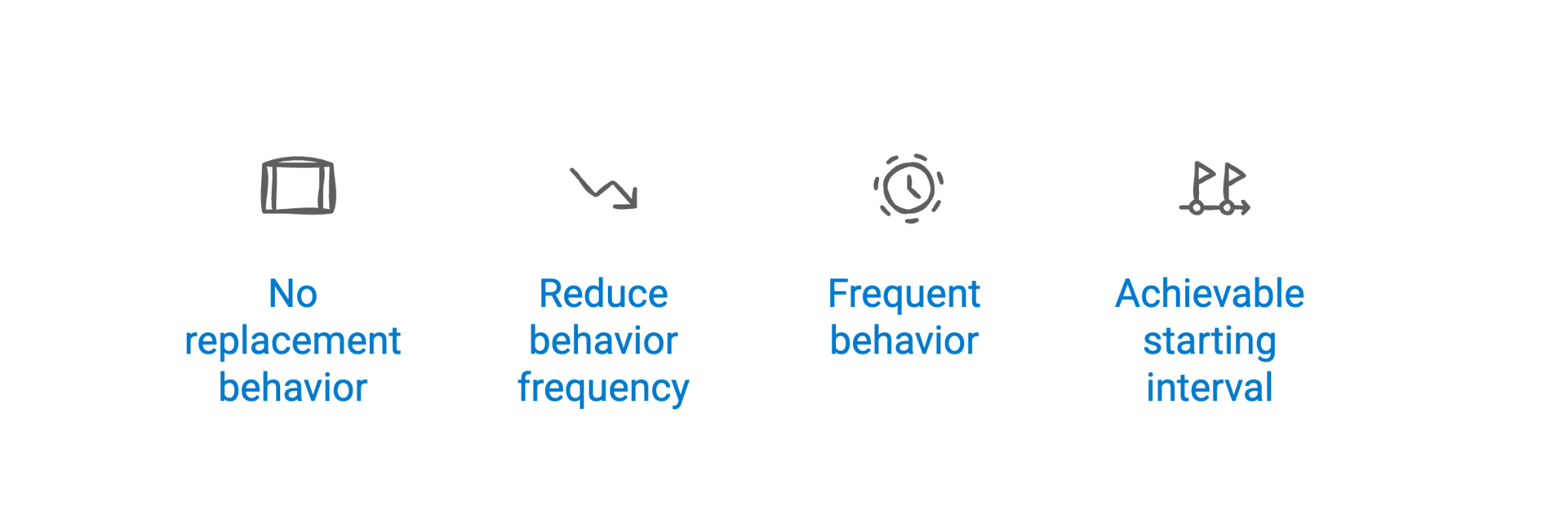
DRO tends to be a good fit when:
- There isn't a clear replacement behavior to teach
- It’s important for the target behavior to happen less often
- The behavior happens frequently enough that short intervals make sense
- Your child can succeed at the starting interval
DRA may be the better fit when:
- The behavior clearly serves a purpose your child could meet another way
- There's an obvious skill to teach instead, like handing over a break card rather than running from a task
DRO vs. DRA
Here's the simplest way to tell the difference between the two:
- DRA reinforces a specific alternative behavior that serves the same purpose as the one you want to change. There's always a replacement involved.
- DRO reinforces the absence of the behavior, with no particular alternative required.
But, these strategies aren’t competitors. Instead of asking, “Which one is better?” it’s more helpful to ask, “Which one is more aligned with my child?”
And really, your child’s BCBA may use both, sometimes for different goals within the same program. For a closer look at DRA, read our guide about DRA in ABA therapy.
DRO and Extinction
If you spend any time researching DRO, you'll run into extinction.
Extinction means withholding reinforcement for a behavior that was previously reinforced. And research shows that DRO's effects can be stronger when the target behavior isn't receiving any reinforcement at all.
But there's a catch:
Extinction often produces what's called an extinction burst, where the behavior temporarily escalates before it starts to decrease.
There's also a growing recognition in the field that extinction isn't right for every behavior or every child. In some situations, it can be unaligned and uncomfortable for the child experiencing it.
So, if extinction comes up as part of your child's plan, your BCBA will walk you through what it involves, what to expect, and whether it's appropriate for your child specifically. That conversation should happen before any interventions begin.
DRA vs. DRO, DRI, DRL, and DRH: What Is the Difference?
Differential reinforcement isn't limited to one type. In fact, there are five types of differential reinforcement, and each is a powerful tool in helping build more effective behaviors.
Each type of differential reinforcement is designed for different behaviors and situations. While some types may seem similar, their slight nuances make a big difference in how well they support your child's daily life.
If you want a more in-depth guide on the differences between all five types, read our guide all about differential reinforcement.
What DRO Looks Like at Behavior Frontiers
DRO is a procedure, yes. But it’s deeply rooted in compassion and humanness with celebration always baked in.
It all starts with understanding your child. If the DRO strategy aligns with your child’s needs, you’ll find the interval data exciting and satisfying to watch. Time windows grow longer and progress continues to build. And you get a front-row seat.
At Behavior Frontiers, we partner with you to make all that progress possible. We offer both center-based and in-home ABA therapy to meet your child’s needs exactly. And since we care deeply about progress and your child reaching their goals, we track all data through PrioraCare™, our made-from-scratch data tracking platform built to monitor progress live and keep everyone informed.
If you’d like to learn more about how we use DRO and other evidence-based strategies to help your child with autism, reach out to us. After a brief conversation, you'll be connected with a BCBA to begin building a plan designed around your child's unique needs.
Frequently Asked Questions
What does DRO stand for in ABA?
DRO stands for Differential Reinforcement of Other Behavior. It's one of five types of differential reinforcement, and it works by delivering reinforcement when a target behavior does not occur during a set period of time. The "other" refers to any other appropriate behavior your child engages in during that window.
Unlike some other types, DRO doesn't require teaching a specific replacement behavior. The reinforcement is tied to the absence of the target behavior itself.
What is the difference between DRO and DRA?
DRA reinforces a specific alternative behavior that serves the same purpose as the behavior being addressed. There's always a replacement involved, like teaching a child to ask for a snack instead of screaming for one.
DRO reinforces the absence of the behavior for a set period of time, with no specific alternative required. Your child can do anything appropriate during that window.
DRA tends to be the better fit when a behavior has a clear communicative function and there's a meaningful alternative to teach. DRO tends to be the better fit for high-frequency behaviors, or when identifying a single replacement behavior is difficult.
What is an example of DRO in ABA?
A child bites their hand during quiet activities. Rather than teaching a specific replacement, their therapist sets a timer for ten minutes. At the end of every ten-minute interval without hand-biting, the child receives praise and a sticker.
During those ten minutes, the child can do anything appropriate they like. The reinforcement is tied only to the absence of hand-biting. Over time, the behavior decreases as those quiet stretches keep getting recognized.
Can I use DRO at home?
Yes, and it works best when it matches what's already happening in therapy.
The most important thing to get right is the time interval. It needs to be realistic and aligned. Always ask your BCBA what interval your child is currently working with and what reinforcer they're using. Then, keep it consistent across all environments.
When is DRO used in ABA therapy?
DRO is typically used when there isn't a clear replacement behavior to teach, or when the primary goal is simply for a behavior to happen less often.
Before DRO is implemented, a BCBA conducts a functional behavior assessment to identify the "why" behind the behavior. That understanding informs the interval length, the reinforcer, and how quickly the intervals stretch over time.