Prompt Hierarchy in ABA: From Most-to-Least Support



Using prompts is a foundational strategy that allows children with autism to learn new skills. If your child is already in Applied Behavior Analysis (ABA) therapy, chances are you’ve seen them used in real time. (They’re used all the time during ABA sessions at Behavior Frontiers!)
But, prompting can be a bit tricky. If used incorrectly, prompts can cause your child to become dependent on them, rather than learning to complete the skill on their own. That’s where prompt hierarchies come in.
A prompt hierarchy in ABA helps guide how and when prompts are used, so children can gradually become more independent as they master a skill. The key is to use them correctly, consistently, and in alignment with what your child needs.
So, after reading this, you’ll understand:
- What a prompt is and why they’re temporary
- The three types of prompts
- Most-to-least vs. least-to-most prompting
- How to fade prompts
- What this could look like for your child
What Is a Prompt in ABA?
A prompt is any added support that makes it more likely your child will give the desired response. It could be something as simple as telling them what to do, pointing to an object, showing them how, or gently guiding them through the action.
If you think about it, it’s the opposite of an “all-or-nothing” mindset. Your child doesn’t have to master a skill before they can celebrate. Prompts allow for mini celebrations along the way, which build confidence and eventually independence.
But, here’s the most important aspect of effective prompting: prompts are always temporary.
Every plan in ABA therapy that includes prompting also includes a path away from prompts. And that gradual removal is where a prompt hierarchy comes in.
Let’s look at a quick example:
In the early stages of learning a new skill, the prompt triggers a response from your child. So, if your child is learning to wash their hands, they are prompted to stand by the sink. But the goal is for the natural cue to do the heavy lifting. Eventually, they will see the sink and know it means to wash their hands.
Prompting from a person (behavior therapist, parent, or BCBA) allows the world to become your child’s natural prompt. But not all prompts provide the same level of support. This is where the concept of “intrusiveness” becomes important.
What Does “Intrusiveness” Mean?
This word, while it sometimes sounds abrupt, is meant to measure how much prompting support is needed for your child.
Here’s an example:
- Higher intrusiveness: physically guiding your child’s hands through brushing their teeth
- Lower intrusiveness: pointing to the toothbrush for your child to pick it up
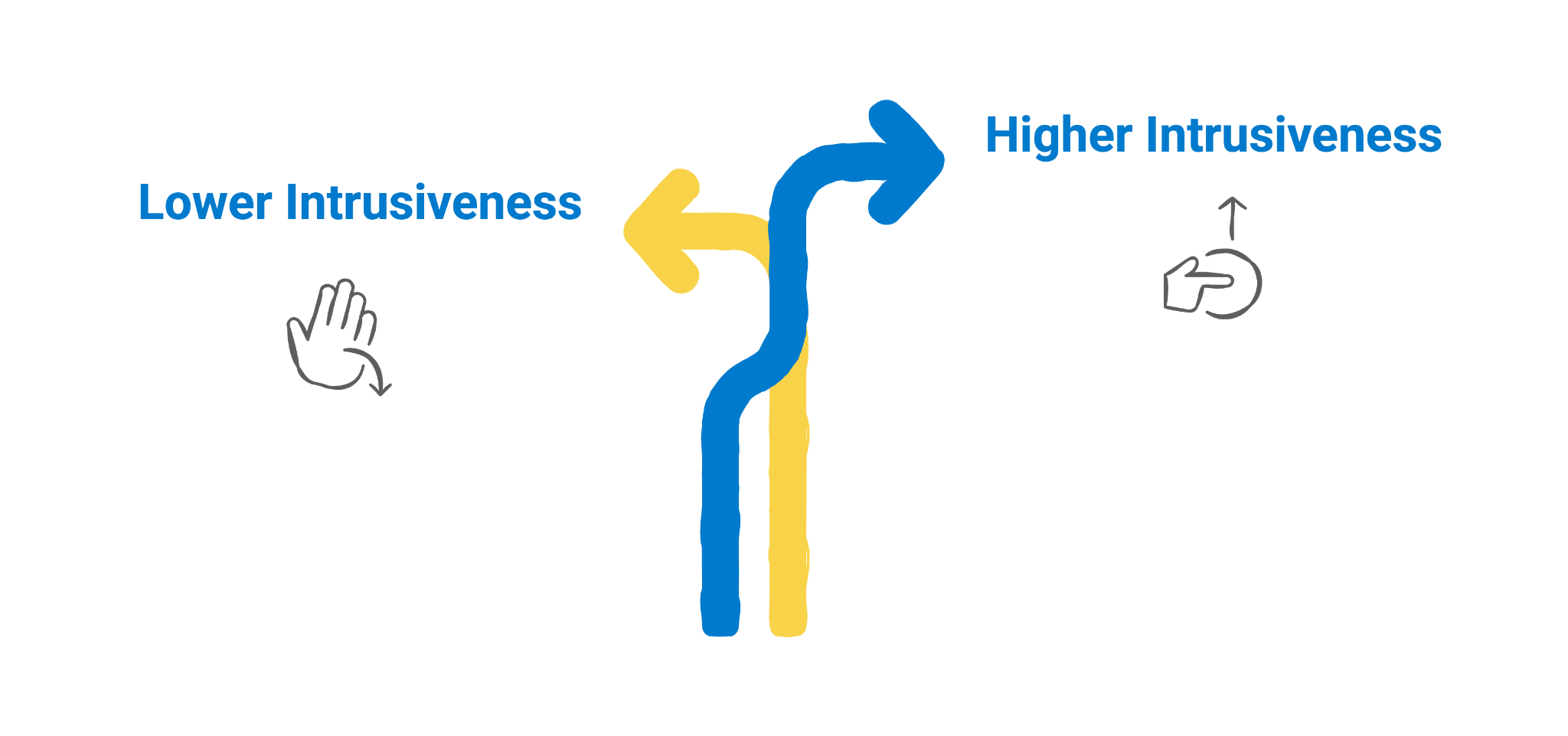
Levels of intrusiveness.
On this continuum, neither end is “better” or “worse.” Just like levels of autism, it simply measures how much support is needed, in this case when using prompts.
This measurement allows your child’s BCBA to make important decisions about where to start with prompting. These decisions will help your child’s path to independence take shape.
The 3 Types of Prompts in ABA
If you’ve already researched “prompt hierarchy,” you may have stumbled across a single pyramid showing you the most intrusive prompts at the bottom and the least intrusive at the top.
Like this one:
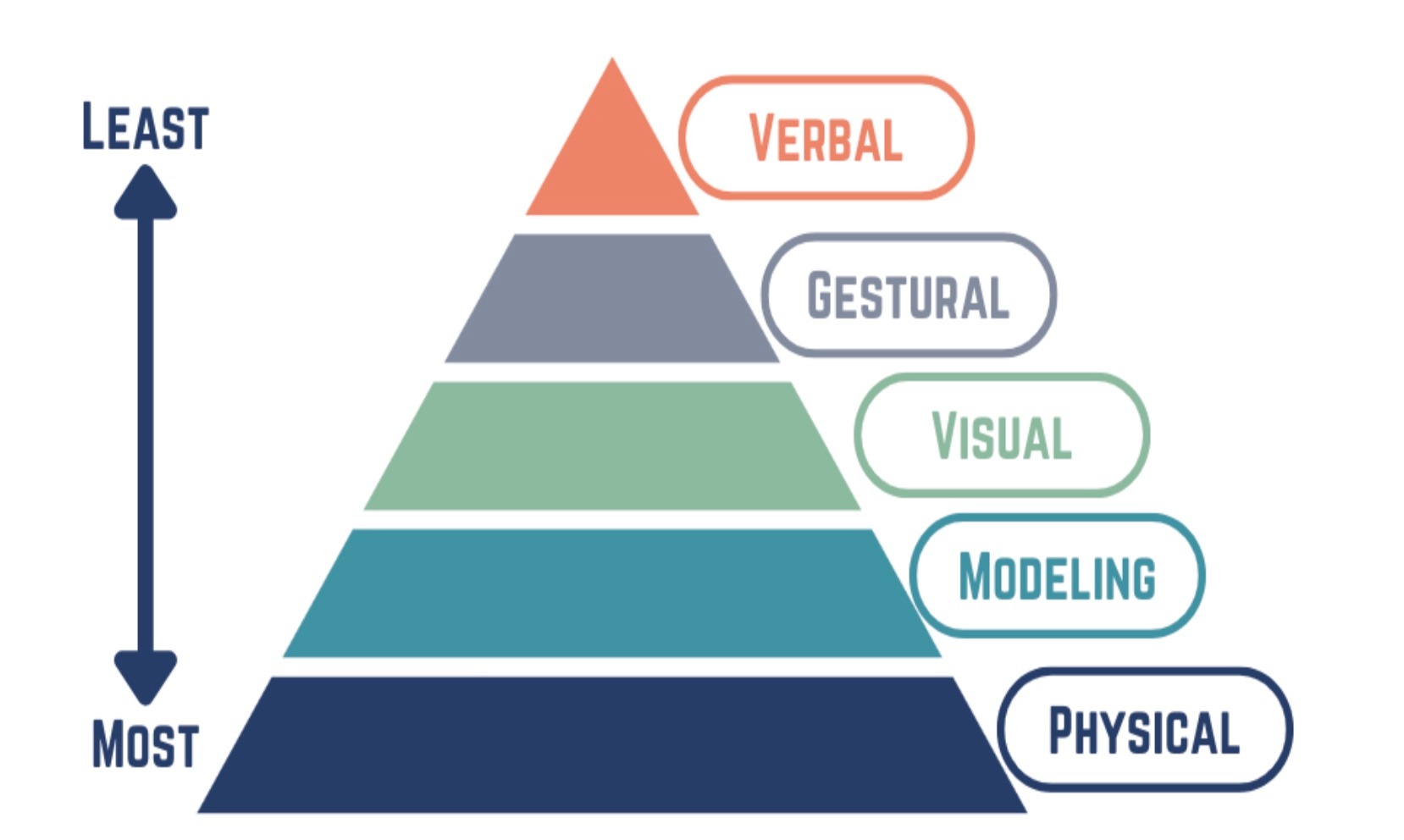
Source: https://masteraba.academy/post/Prompt-hierarchy
Caption: a common version of the prompt hierarchy pyramid.
While this can be helpful for visualization, it’s a bit misleading.
Let’s say your child is learning to say a new word. For this particular skill, physical prompting (which is at the bottom of the pyramid) wouldn’t be necessary. But your child might need more intrusive verbal prompts compared to another child. So, where would a more intrusive verbal prompt land on the pyramid?
While the prompt hierarchy pyramid can give us a good start in understanding prompt hierarchies, it can be more useful to look at each type of prompt in its own category. Within their own categories, they may vary in levels of intrusiveness.
Physical Prompts
A physical prompt means your child’s therapist (or you) are physically guiding them while teaching them a skill.
They can look like this:
- Full: The therapist physically moves your child's body through the action.
- Partial: The therapist uses lighter pressure, with the two of them completing the action together.
- Light touch or shadow: The therapist uses very light contact or simply follows your child's movement without touching at all.
Why they fade so well: The transitions can be nearly seamless. Your child's therapist can shift their hand position slightly, or ease off the pressure just a little, without ever making a big jump between levels.
Verbal Prompts
Verbal prompts are auditory cues that guide your child toward the answer.
They can look like this:
- Full: The therapist says the entire response.
- Partial: The therapist says part of it.
- Phonemic: The therapist gives only the first sound.
A little tidbit about verbal prompts: They can be much more difficult to fade. Children tend to hold onto them longer, mostly because making that jump from a verbal cue to nothing at all can be a big leap.
For that reason, they're used carefully. They show up most often with verbal skills, though not exclusively.
Visual Prompts
Visual prompts are visual cues that point toward the right response.
They can look like this:
- Model: The therapist demonstrates the action.
- Stimulus: The material itself is changed to point toward the right answer.
- Positional: The items are arranged to make the correct response more likely.
- Gestural: The therapist points, looks toward something, or uses another movement to indicate the answer.
How they're actually used: Visual prompts offer the most variety of the three, though they take time to create.
Therapists rarely fade straight down this list from model to stimulus to positional to gestural. More often, a visual prompt gets paired with one of the other two categories as part of a larger fading plan.
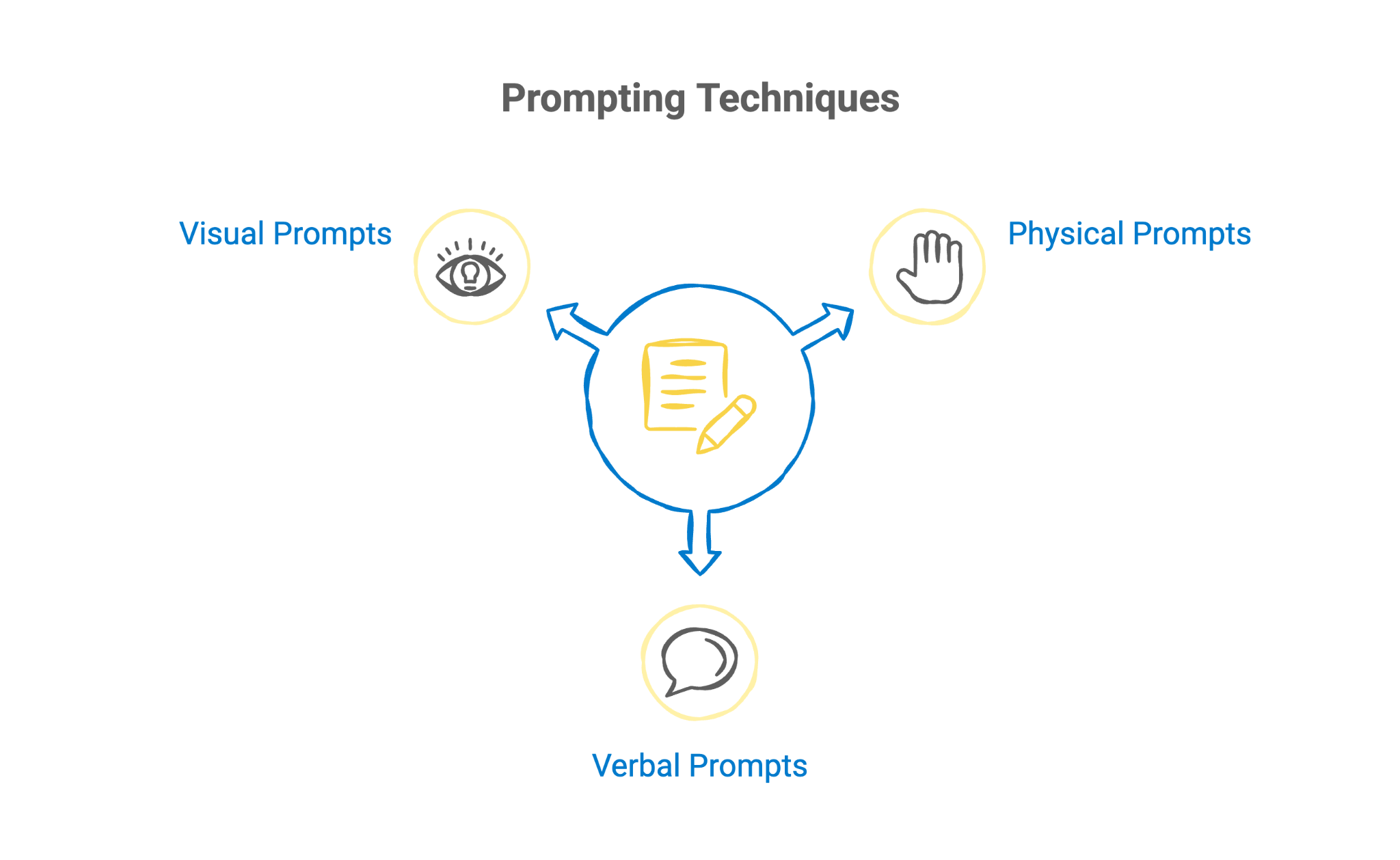
Different types of prompts in ABA.
Most-to-Least vs. Least-to-Most Prompting
Once you know what type of prompting should be used, there’s another question to answer: Which direction do you move? There are a few ways to view it:
Most-to-Least Prompting
This type of prompting starts with substantial help and reduces it as your child gains momentum.
Tends to suit children:
- Who acquire new skills at a slower pace
- With fewer prerequisite skills in place
- Who show frequent or intense escape-driven behavior
The main strength: It results in far fewer errors along the way. This is also why most-to-least is closely tied to errorless learning, where your child rarely encounters failure at all as they learn a new skill.
Real-life example: Your child is learning to put on their coat. On day one, their therapist guides their arms into both sleeves, hand over hand, start to finish. Later on, the therapist gets the first sleeve started and your child pushes their arm the rest of the way through. Then as time goes on, they give your child a light touch on the shoulder. After that, they might make a gesture toward the coat hook. Eventually, they won’t provide a prompt because your child sees the coat and puts it on.
Least-to-Most Prompting
This type of prompting starts with minimal help and adds more only if your child needs it.
Tends to suit children:
- Who already have solid foundational skills
- Who become prompt-dependent easily
- Without high rates of escape-driven behavior
The main strength: Your child gets a chance to respond on their own first, every single time.
Real-life example: Your child's therapist says, “Put on your coat,” and then waits. If your child does it, great. If they don't, the therapist points to the coat. Then, if they don’t go to the coat, your child’s therapist models putting on their own coat. If that doesn't work, they step in with physical guidance to help your child through it.
Which One is Better?
Research comparing the two approaches has found that both work, and that the better choice depends on your child, the skill being taught, and consistency.
A few things that research does suggest:
- Least-to-most has been faster, depending on the child, though it might produce more errors along the way.
- Most-to-least tends to reduce errors, and pairing it with a brief time delay can make it more efficient.
- Teaching simpler procedures helps make either process more efficient (they are easier to teach, carry across multiple environments, and maintain consistency).
How Prompt Fading Works
Prompt fading is the process of gradually reducing help until your child responds on their own.
There are three common approaches:
- Most-to-least fading: Start with the most help and reduce over time. Guide your child's hands, then move to verbal cues, then gestures, then nothing at all.
- Least-to-most fading: Start minimal and add only when needed. A verbal cue first, then a gesture if that doesn't work, then perhaps physical guidance.
- Time delay: Build in a pause before using the prompt. Wait a second after the instruction before giving a verbal cue, then wait a little longer before adding a gesture. That pause can give your child room to respond on their own first.
There's also graduated guidance, which fades physical support moment to moment within the task itself rather than between attempts. It's especially useful for skills with multiple steps or a lot of movement involved.
Ways to Make Fading Work
- Patience and consistency: Independence takes time, and rushing it usually costs more time than it saves.
- Watching progress closely: Once your child is doing well, fading can move faster.
- Flexibility: If one approach isn't working, trying another may help.
- Reinforcing independence specifically: Celebrating each step toward a goal gives your child a reason to keep trying without help.
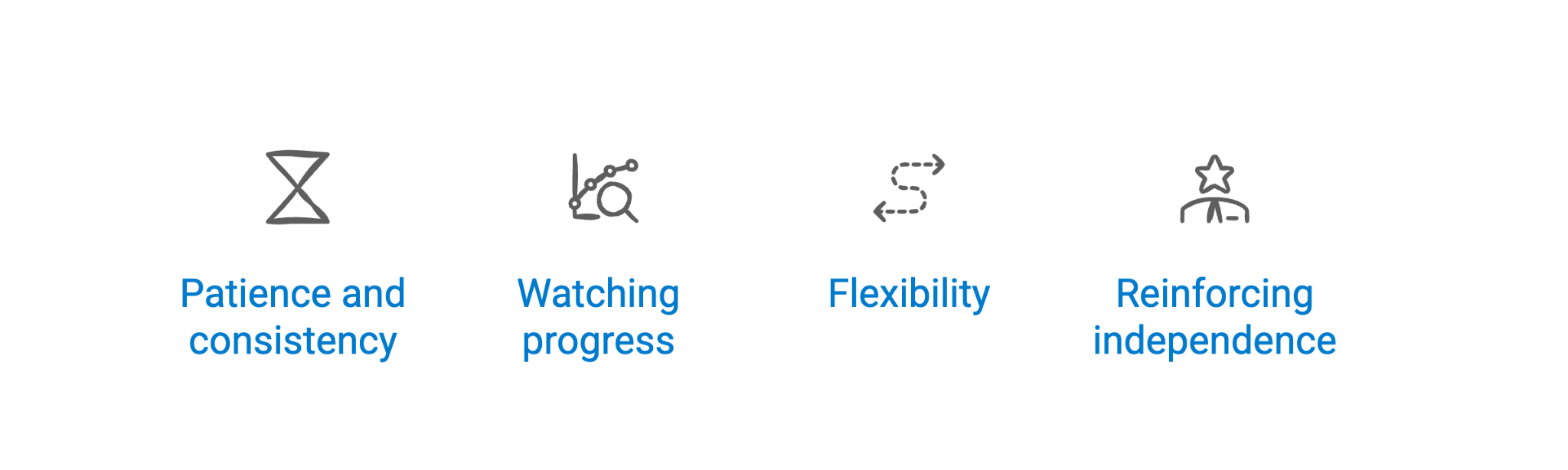
How to make prompt fading work.
What This Looks Like in Your Child's ABA therapy Program
Prompt hierarchies, if used well, can make skills easier to learn with more opportunities for celebration. They remind us that even one step in the right direction is still progress.
They:
- Make learning more efficient
- Reduce frustration
- Build independence
If your child is in ABA therapy right now, they’ve likely already experienced them—whether or not anyone has used the phrase "prompt hierarchy" with you. And, if your child hasn't started ABA therapy yet, we’re here for you.
At Behavior Frontiers, we track prompt hierarchies closely, because your child’s progress should never be a guessing game.
We care deeply about progress and your child reaching their goals, so we track all data through PrioraCare™, our made-from-scratch data tracking platform built to track progress live and keep everyone informed. Because the key to using prompts correctly, consistently, and in alignment with what your child needs is all rooted in data.
Ready to learn more about how ABA therapy can help your child with autism reach their goals? Reach out to us and after a brief conversation, you'll be connected with one of our licensed BCBAs to begin building a treatment plan tailored to your child's unique needs.
Frequently Asked Questions
What is the prompt hierarchy in ABA?
The prompt hierarchy is the range of help levels used to teach a skill, from the most support to the least, along with a plan for fading that help so your child eventually responds on their own.
What are the different types of prompts in ABA?
There are three main categories: physical, verbal, and visual. Physical prompts involve guiding your child’s body, verbal prompts provide spoken cues, and visual prompts use demonstrations, gestures, or changes to materials. The right type depends on the skill being taught, which is why it’s more useful to think in separate categories than a single pyramid.
What is the difference between most-to-least and least-to-most prompting?
Most-to-least starts with substantial help and gradually reduces it. It produces fewer errors, which is why it's associated with errorless learning. Least-to-most gives your child a chance to respond independently first, then adds help only if they need it. It can be faster for some children, but usually with more errors along the way.
Neither is universally better. The right choice depends on your child, the skill, and how consistently the approach can be carried out.
How do I know when to fade a prompt at home?
Ask your BCBA which level your child is currently on and what the criteria are for moving to the next one. They’ll be able to help you recreate the process at home, if they’re ready.