Discrete Trial Training (DTT): How ABA Therapy Builds Skills Step by Step



Watch a few minutes of an ABA therapy session and you might notice a pattern: the therapist gives a clear instruction, your child responds, and there’s a consequence right afterward, whether that's praise or a small reward. Then, there’s a brief pause before starting again. This method has a name: Discrete Trial Training (DTT).
DTT is one of the most well-researched and widely used teaching methods in ABA therapy. It's been around for decades, and while newer, more naturalistic teaching methods have joined the toolbox since then, DTT remains a foundational strategy for building skills that need extra repetition and precision to stick.
Let's walk through what DTT actually looks like, why it works, and where it fits alongside other ABA teaching strategies.
What Is Discrete Trial Training?
Discrete Trial Training is a method that breaks a skill down into small steps to help children on the spectrum learn easily. DTT creates focused, intentional opportunities for your child with autism to practice a skill again and again until the skill becomes reliable.
Each learning opportunity, called a trial, is a self-contained unit with a clear beginning and end. One trial doesn't blend into the next, which gives your child a chance to focus on one skill at a time. This structure also allows their Board Certified Behavior Analyst (BCBA) to track how they’re doing on a specific skill, trial by trial and session by session.
During DTT sessions, your child typically works with a behavior technician (BT), under the supervision of their BCBA.
For example, if your kiddo is learning to identify colors, their behavior technician might place a few colored cards in front of them and ask, “Which one is red?” Your child selects the red card, and the therapist immediately provides feedback or reinforcement. The trial then ends, and they can try again with a new opportunity. With repeated practice, your child can become more confident and consistent at identifying colors.
DTT is especially useful for skills that benefit from repetition and a controlled learning environment, such as:
- Early language skills: imitating sounds, labeling objects, answering simple questions
- Early learner skills: matching, sorting, identifying colors, shapes, and letters
- Imitation: copying gestures, actions, or vocal sounds
- Following instructions: responding to one-step and multi-step directions
- Attending skills: making eye contact, sitting for a task, orienting toward a speaker

Benefits of Discrete Trial Training for Children with Autism
DTT can support your child across several areas of development. A few benefits stand out in particular:
- Communication skills: DTT is often used to build foundational language, from requesting and labeling items to answering questions and having simple back-and-forth exchanges.
- Social skills: DTT's repetition helps skills like eye contact, turn-taking, joint attention, and greeting others become more automatic, which lays the groundwork for more natural social interactions outside of therapy sessions.
- Cognitive skills: Matching, sorting, sequencing, following multi-step instructions, and other pre-academic skills are common DTT targets. It helps your child build attention span and the ability to discriminate between similar stimuli, both of which support later academic learning.
- Adaptive and daily living skills: Beyond the behaviors needed for early learner-readiness, DTT is frequently used to teach self-care routines such as handwashing, dressing, and toileting, which are skills that build independence and reduce reliance on caregivers over time.
For parents, the main and most reassuring benefit is that the progress is measurable. At Behavior Frontiers, every trial is recorded and session data is logged in real time in PrioraCare™, our proprietary clinical outcomes platform. That live data gives clinicians a clear, up-to-the-minute view of what's working and what isn't, so they can adjust your child's strategy on the spot.
The Five Parts of a Discrete Trial Training
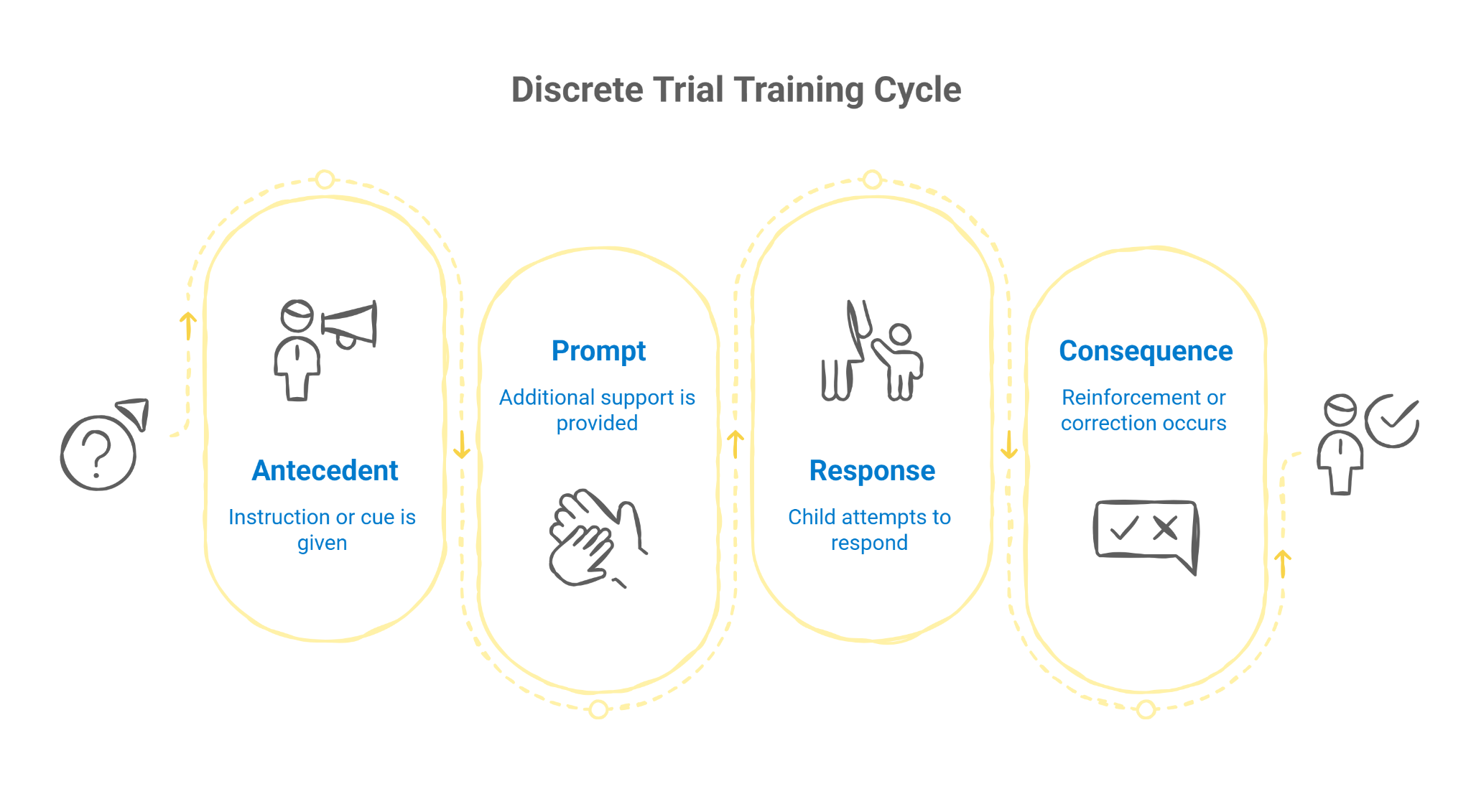
Every discrete trial follows the same five-part sequence, which is what makes DTT so consistent and easy to measure. A single trial includes:
- Antecedent: the instruction, question, or cue that sets the trial in motion, such as “touch red” or “what's this?” This is the discriminative stimulus, the signal that tells your child a specific response is expected right now.
- Prompt: additional support delivered along with, or immediately after, the antecedent to help your child respond correctly. For example, the therapist might point to the red card to help your child choose the correct one. Not every trial includes a prompt. As your child learns or masters a skill and responds independently, the prompts are reduced gradually.
- Response: what your child does after the antecedent and the prompt (if one was given). This could be a correct answer, an incorrect answer, or no response at all.
- Consequence: what happens immediately after the response. A correct response is followed by reinforcement, like praise or a favorite toy. An incorrect response is followed by a neutral correction and the trial starts again.
- Inter-trial interval: a short pause, often a few seconds, between the end of one trial and the start of the next. This brief gap gives the therapist a moment to record data and gives your child a moment to reset before a new trial begins.
This cycle might only take a few seconds per trial, and a single session can include dozens of trials on a single skill. That volume of repetition is intentional. It gives your child many, many chances to practice basic skills that will develop into complex ones.
What DTT Looks Like in Practice
If you’re watching a session for the first time, DTT can look surprisingly fast-paced. A therapist might run through the same instruction, or a rotation of a few instructions, many times in a short span, with brief pauses in between. It can seem repetitive to an outside observer, but that repetition is the entire point.
Things you might notice during a DTT session:
- Clear, consistent language: The same instruction is often used the same way each time, to avoid confusing the child with unnecessary variation.
- Quick pacing: Trials move briskly to maintain engagement and maximize practice opportunities.
- Visible data tracking: Therapists typically mark down each response in real time, whether on paper or a tablet.
- Frequent reinforcement, especially early on: You'll likely see praise, small rewards, or brief breaks delivered often, particularly when a new skill is being introduced.
Here’s what it would look like in practice:
Example 1: Teaching Colors
- Antecedent: The behavior technician holds up a red card and a blue card and says, “touch red,” pointing briefly to the red card as they speak.
- Response: Your child touches the red card.
- Consequence: The therapist immediately responds with "yes, red!" along with a few seconds of access to a favorite toy.
- Inter-trial interval: They mark the trial as prompted-correct, reset the cards, and pauses a few seconds before starting the next one.
Example 2: Teaching Imitation
- Antecedent: The therapist claps their hands and says, “do this,” without offering any additional support, since this is a skill your child has already been practicing successfully.
- Response: Your child claps back right away.
- Consequence: The therapist gives an enthusiastic high-five and specific praise.
- Inter-trial interval: The therapist marks the trial as independent-correct, and moves into the next trial after a brief pause.
Why Discrete Trial Training Works
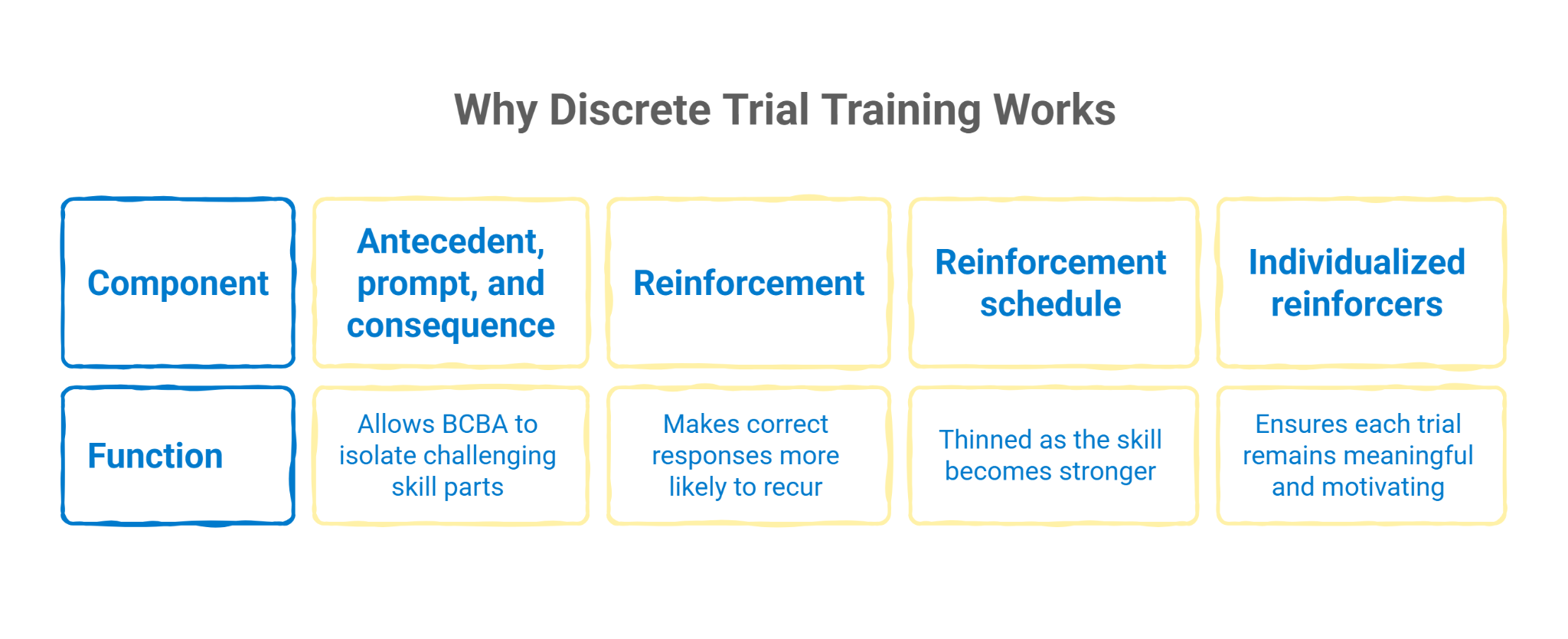
By controlling the antecedent, the prompt, and the consequence, a BCBA can isolate exactly which part of a skill is challenging for your child. If they struggle to label pictures of animals, for example, their therapist can narrow in on which specific animals are difficult, whether the issue is visual discrimination or verbal recall, and adjust the teaching approach accordingly.
The consequence following each response is where a lot of the real teaching happens. When your child responds correctly, reinforcement (something they find motivating) immediately follows. This makes the correct response more likely to happen again in future trials.
Reinforcement in DTT is usually delivered on a fairly frequent, predictable schedule early on, especially when a skill is brand new. As the skill becomes stronger, the schedule of reinforcement is gradually thinned, meaning your child doesn't need reinforcement after every single correct response to maintain the skill.
This is also why DTT sessions are individualized down to the reinforcer itself. What motivates one child might do nothing for another, so part of a BCBA's ongoing work is identifying and adjusting reinforcers so that each trial remains meaningful and motivating.
How DTT Fits Alongside Other ABA Teaching Methods
DTT is powerful, but it isn't the only tool in an ABA therapist's toolbox, and it isn't meant to be used in isolation. At Behavior Frontiers, we blend DTT with Naturalistic Teaching Strategies (NATS), such as Natural Environment Teaching (NET), where skills are practiced during play or daily routines rather than at a table.
A typical ABA therapy session might include structured DTT blocks for building brand-new skills that need repetition and precision, alongside more naturalistic teaching throughout the rest of the session to help those skills generalize to real-life situations, including things like gym time, arts and crafts, meal time, dramatic play time circle time, and more.
This combination matters because a skill truly strengthens when it shows up not just during a structured table task, but also on the playground, at the dinner table, or during a conversation with a sibling.
Generalization, or the ability to use a skill across different people, places, and situations, is always the end goal. DTT is often where a skill starts, but it's rarely where it stays.
What Discrete Trial Training Looks Like at Behavior Frontiers
At Behavior Frontiers, we partner with you to make learning and practicing skills easier for your child. You will know what specific skills are being targeted and how they are expected to generalize beyond the session.
Understanding the “why” behind the structure makes it easier to reinforce the same skills at home, and to recognize the steady, trial-by-trial progress your child is making, even when it isn't always obvious at first.
If you would like to learn more about how we use DTT and other evidence-based ABA strategies to support your child with autism, reach out to us. After a brief conversation, you will be connected with a BCBA who can begin building a plan around your child's unique needs.
Frequently Asked Questions
What are the 5 steps of DTT?
DTT is made up of five steps: the antecedent (the instruction or cue), a prompt if the child needs support to respond correctly, the response itself, the consequence (reinforcement for a correct response or a neutral correction for an incorrect one), and the inter-trial interval, which is a brief pause before the next trial begins.
Can DTT be done at home?
Yes! It’s possible to incorporate simplified DTT strategies at home under the guidance of your child's BCBA, and through our robust caregiver training program. This might involve practicing a specific skill, like labeling objects or following a one-step instruction, using the same structured format used in therapy. It's best to coordinate with your child's team first, since consistency in language, prompting, and reinforcement makes home practice far more effective.
What age is appropriate for DTT?
DTT is used across a wide age range, but it's especially common with young children, often between about 2 and 6 years old, who are building foundational language, attending, and readiness skills. That said, DTT can be adapted for older children as well, depending on the specific skill being taught and how the child responds to structured teaching.
Is DTT an intervention?
Yes, DTT is considered a specific, evidence-based teaching intervention within the broader field of ABA therapy. It's typically one part of a larger, individualized treatment plan rather than a standalone program, often used alongside more naturalistic teaching strategies to help skills generalize beyond the structured session.
How is progress tracked during DTT?
Every trial is recorded in real time as correct, incorrect, prompted, or independent. This trial-by-trial data lets a BCBA see exactly how a skill is developing, when a child is ready to have prompts faded, and when it's time to introduce a new teaching target.