What Is an Antecedent in ABA? The A-B-C Model Explained



In Applied Behavior Analysis (ABA) therapy, an antecedent is anything that happens immediately before a behavior. In simple terms, it’s what comes right before your child does something and can help you understand what may have led to that behavior.
Let’s say your child is playing with a favorite toy when you tell them, “It’s time to put the toy away.”
Soon after, they start crying and hold onto the toy.
In this scenario, the instruction to put the toy away is the antecedent. It happened immediately before the behavior (the crying and holding onto the toy).
Moments like this are common for all children, and this behavior on its own isn’t necessarily something to worry about. It’s important to note, though, that for children with autism, transitions like this can feel especially hard, and communicating that difficulty can be even harder. That’s why paying attention to what comes right before a behavior can be so helpful.
Your child’s ABA team looks at the antecedent, the behavior, and the consequence (what happens right after) together to better understand the pattern. This three-part sequence is known as the A-B-C model, and it sits at the center of almost everything your child’s ABA therapy team does. Once you can spot what comes before a behavior, you can start to see why that behavior is happening at all.
In this article, we’ll break down what antecedents are, how they fit into the bigger picture of the A-B-C model, and why this framework matters so much in your child’s ABA therapy plan.
What Is The A-B-C Model?
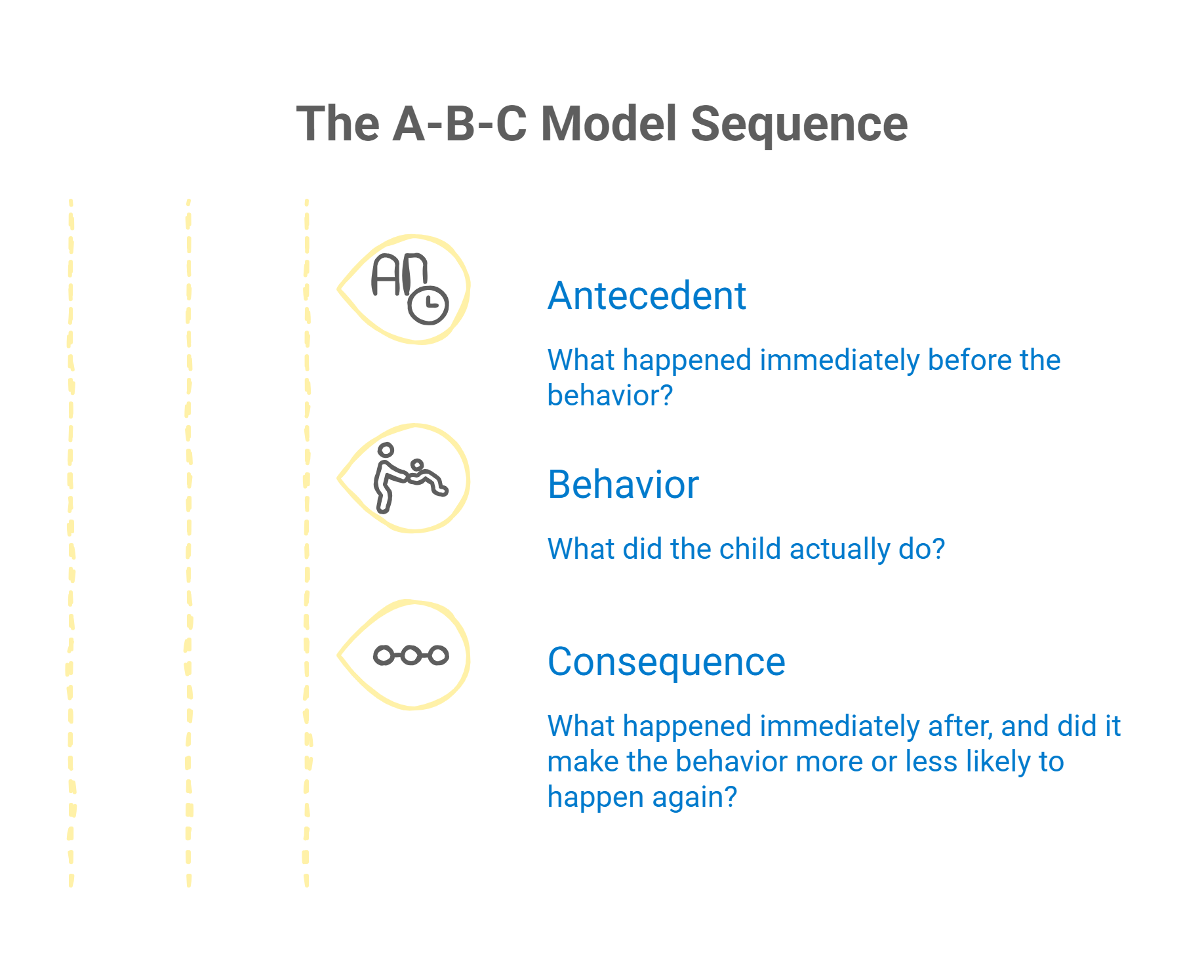
Behavior analysts don't look at behavior in isolation. Whether it’s a tantrum, a refusal, a moment of aggression, none of these happen in a vacuum. They happen in a sequence, which is called the A-B-C model.
- Antecedent: What happened immediately before the behavior?
- Behavior: What did the child actually do?
- Consequence: What happened immediately after, and did it make the behavior more or less likely to happen again?
Let’s go back to the toy example. The antecedent is you saying, “It’s time to put the toy away.” The behavior is your child getting upset and holding onto the toy. The consequence might be that you give them a few more minutes of playtime. In ABA, a consequence isn’t a punishment. It simply means whatever happens right after a behavior.
This three-part sequence is the foundation of applied behavior analysis. It's how Board-Certified Behavior Analysts (BCBAs) make sense of behaviors that might otherwise look random or “out of nowhere.” In reality, very few behaviors are truly random. Most are a response to something in the environment, and that something is the antecedent.
Think of the A-B-C model like a chain. Pull on any single link and you start to see how the whole chain moves. If you only look at the behavior itself, you're seeing one link out of three. To actually understand and change a behavior, you have to look at what came before it and what came after.
What Counts as an Antecedent?
Antecedents can be big or small, obvious or subtle. Some happen in the environment around your child, and some relate to how your child is feeling. Common ones include:
- Specific instruction or demand: being asked to clean up toys, put on shoes, or stop a preferred activity
- Transition: moving from one activity, room, or environment to another
- Change in routine: an unexpected schedule shift, a substitute teacher, a canceled outing
- Social interaction: a peer taking a toy, a sibling getting attention, being told “no”
- Sensory trigger: loud noises, bright lights, crowded spaces, uncomfortable clothing
- An internal state, or how your child is feeling: hunger, fatigue, illness, or overstimulation
Notice that antecedents aren't always dramatic. Sometimes the antecedent is something as simple as a parent saying “five more minutes” before leaving the park. To an outside observer, that might not seem like much. But if that phrase reliably comes right before a meltdown or difficult moment for your child, it's doing important work, and it deserves attention.
It’s important to note that antecedents aren’t anyone’s fault, either. They’re simply clues. Many of them are everyday parts of life that we can’t (or wouldn’t want to) avoid, like transitions, instructions, and a busy world. The goal isn’t to remove them, but to understand them so your child has the support they need to move through them.
Why Do Antecedents Matter in ABA Therapy?
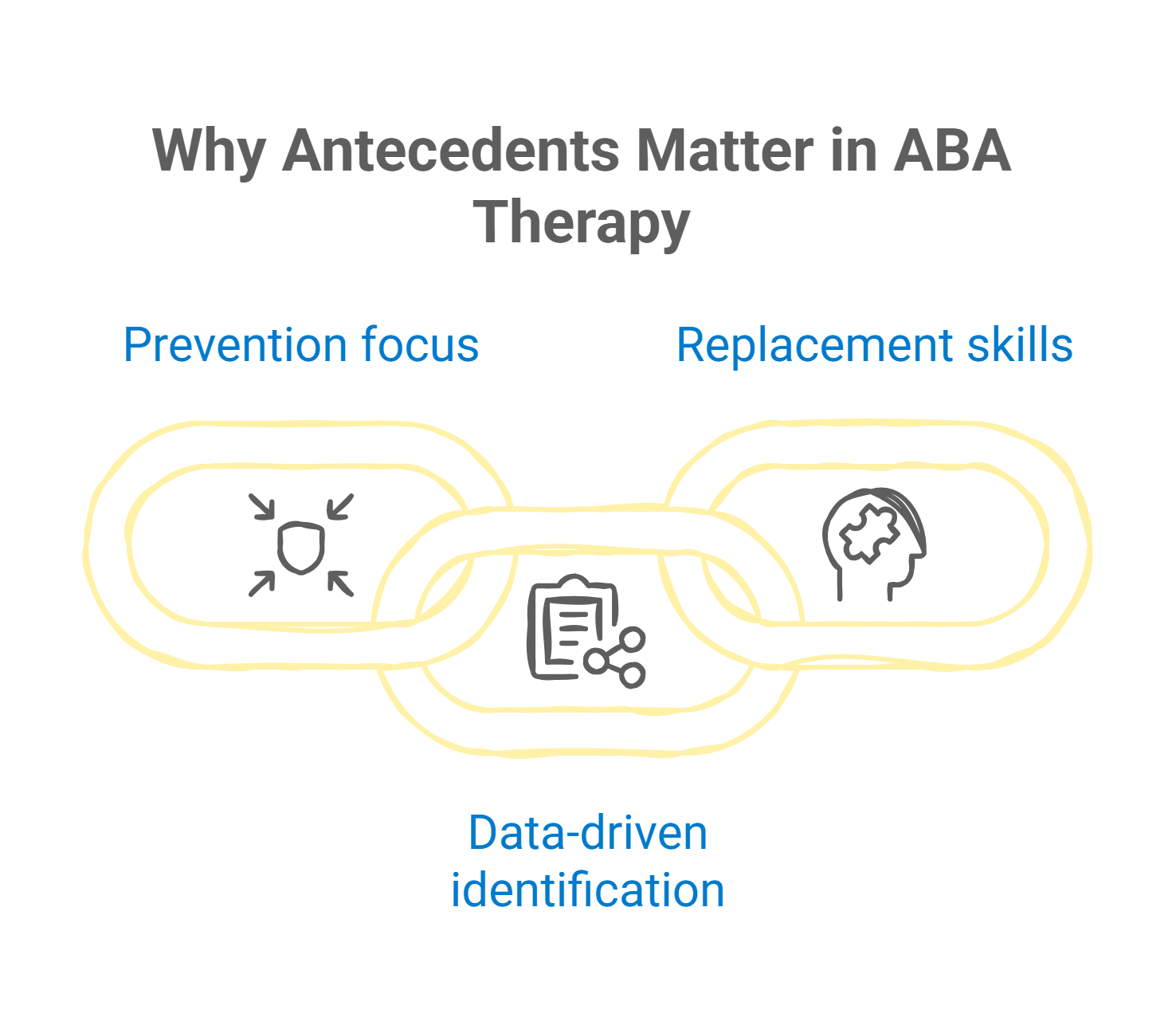
When we think about behavior, it’s natural to focus on what happens after a behavior: how we respond, what we say, what to do next—like a warning, a time-out, or a reward. ABA therapy takes a broader approach. It also pays close attention to what happens before a behavior, which opens up a whole new set of options for supporting your child.
If your child’s BCBA can identify an antecedent that consistently comes before a challenging behavior, they can look for ways to make that situation easier for your child. This is often called antecedent modification or antecedent intervention, and it can be a helpful, proactive way to reduce challenging behavior over time.
For example, if your child consistently becomes upset when it’s time to transition to a new activity without much warning, their support team might introduce a visual timer or a first-then board to give them a little more time to prepare. Instead of an abrupt transition, your child gets a clearer idea of what’s coming next, which may help make the transition feel more predictable and manageable.
This can be a meaningful shift in perspective for you, too. Instead of only asking, “How can we respond after my child has a meltdown?”, you can also start asking, “What can we change beforehand to make this moment easier for my child?”
Antecedents Are Data
Antecedents are identified through careful observation, not guesswork. During a Functional Behavior Assessment (FBA), your child's BCBA collects data across multiple sessions and settings, tracking exactly what happens right before, during, and after target behaviors occur.
Over time, patterns emerge. Maybe a behavior shows up almost every time a certain type of instruction is given. Maybe it clusters around a particular time of day, or a specific person, or a certain kind of task.
These patterns are what allow the team to move from “I wonder why this is happening” to a clear, testable hypothesis about what's triggering the behavior.
This is also why consistent data collection matters so much in ABA. Without it, antecedents can be easy to miss, especially the subtle ones. A behavior technician tracking dozens of small details across a session is often catching triggers that would be nearly impossible to notice otherwise.
Antecedents Lead to Replacement Skills
Once you and your child’s ABA team understand what typically happens before a behavior, you can start thinking about what your child could do instead to get the same need met in a more helpful way. This often means teaching a replacement skill, a new skill your child can use in place of a challenging behavior.
For example, imagine your child is working on a puzzle that’s feeling tricky. When a piece doesn’t fit, they push the puzzle away and walk off. The tricky piece is the antecedent. Instead of removing the puzzle altogether, your child might learn to ask for help by saying “help, please,” using a gesture, or handing over a picture card.
The demand from the puzzle stays the same, but your child now has a more effective way to communicate what they need.
Real-Life Examples of the A-B-C Model
It can help to see the full sequence laid out, rather than antecedents in isolation. Here are a few examples:
Example 1
- Antecedent: You tell your child it’s time to turn off the tablet.
- Behavior: Your child throws the tablet and yells.
- Consequence: You turn the tablet back on to help calm them down.
Example 2
- Antecedent: Your child’s teacher asks everyone to line up for recess.
- Behavior: Your child sits down and refuses to move.
- Consequence: The teacher allows your child to stay seated for a few extra minutes.
Example 3
- Antecedent: Your child’s sibling picks up a toy they were playing with.
- Behavior: Your child grabs the toy back and pushes their sibling.
- Consequence: They get the toy back, and their sibling walks away.
In each case, the consequence may unintentionally reinforce the behavior, which can help explain why it keeps happening. When your child is upset, it’s natural to do whatever you can to calm things down, and that doesn’t mean anyone has done anything wrong.
Instead, these moments can help you spot a pattern. Each sequence starts with a clear antecedent, and that’s often where a BCBA will look first. By changing what happens before the behavior, you can create a more proactive and supportive path forward.
What Does This Look Like at Behavior Frontiers
When your child’s BCBA talks about “antecedent strategies” in a treatment plan or progress note, they're describing specific, intentional changes to the environment or routine designed to set your child up for success before a challenging moment even starts.
At Behavior Frontiers, this might look like:
- Visual schedules that reduce uncertainty around transitions
- Advance notice before ending a preferred activity, such as a visual timer
- Offering choices to give your child a sense of control
- Adjusting the environment to reduce sensory overload
- Pre-teaching expectations before entering a new or unfamiliar setting
None of these strategies require waiting for a behavior to happen first. They're built directly from the antecedent data your child's team has collected during the Functional Behavior Assessment and during sessions, which is exactly why data collection is such a central part of every ABA session. We use PrioraCare™, our own clinical outcomes platform, that is designed for clinicians to log data in real-time rather than after a session ends.
This real-time visibility means clinicians aren't waiting days or weeks to spot what's effective and can fine-tune your child's strategy the moment the data calls for it. We’ll design a therapy plan tailored to their needs, and measure outcomes against nationally recognized tools used across autism care.
Reach out to us if you would like to learn more about how we use the A-B-C model and other evidence-based strategies to support your child’s development.
Frequently Asked Questions
What is an antecedent in ABA?
An antecedent is whatever happens immediately before a behavior occurs. It can be an instruction, an event, a change in environment, or an internal feeling like hunger or fatigue. Antecedents are the first part of the A-B-C model (antecedent, behavior, consequence), and identifying them helps BCBAs understand what's triggering a specific behavior.
What are the three main types of antecedents?
Antecedents are generally grouped into three broad types: environmental antecedents (things like noise, lighting, or a change in setting), social antecedents (interactions with other people, such as a demand, a peer conflict, or being told “no”), and internal antecedents (your child's own physical or emotional state, such as hunger, fatigue, or overstimulation). A BCBA looks across all three categories when trying to understand why a behavior is happening.
What are the common antecedent interventions in ABA?
Common antecedent interventions include visual schedules to reduce uncertainty around transitions, offering choices to give your child a sense of control, providing advance notice before ending a preferred activity, adjusting the environment to reduce sensory triggers, and pre-teaching expectations before a new or unfamiliar situation.
How are antecedents identified for your child?
Antecedents are identified through a Functional Behavior Assessment (FBA), where a BCBA observes your child across multiple settings and collects data on what happens right before target behaviors occur. Over time, patterns emerge that point to specific triggers, which then inform the strategies built into the child's plan.
Can parents help track antecedents at home?
Yes. Parents are often in the best position to notice patterns during daily routines, like mealtimes, transitions, or bedtime. Sharing these observations with your child's BCBA adds valuable context to the data collected during sessions and can help the team fine-tune antecedent strategies for situations outside of therapy.