14 Common ABA Therapy Techniques Every Parent Should Know



Applied Behavior Analysis (ABA) therapy techniques for children with autism often feel and look like play. Mostly because… they kind of are.
If you watched a behavior technician use ABA therapy techniques during a session with your child, you might not think any “professional techniques” were happening at all. But beneath the learning-through-play, there’s life-transforming work happening.
There are many ABA therapy techniques your child’s behavior therapist may use at any given moment of a session. They’re intentional, guided, and rooted in data (far from random or improvised).
And because you might not have your very own ABA therapy techniques glossary, consider this yours.
Included inside is:
- 14 common ABA therapy techniques, plus two bonus techniques that are less common
- Expert advice from a BCBA woven throughout
- How understanding these techniques can help you better support your child with autism
What ABA Techniques Should You Use?
Your child's Board-Certified Behavior Analyst (BCBA) doesn’t jump straight into techniques. There’s intentional, thoughtful work that comes first.
“When building a program for a child, I start by understanding the child,” says Jeremy Roberts, MSE, BCBA, LBA, QSP, Senior Clinical Director for our Minnesota Regions at Behavior Frontiers.
Without knowing your child, techniques mean almost nothing. Effective Applied Behavior Analysis (ABA) therapy leans into your child’s humanness with compassion. And to get there, it starts with relationship building and understanding.
This is why BCBAs first conduct functional behavior assessments to identify your child's strengths, areas of need, interests, communication abilities, and learning style, along with any challenging behaviors to target. Then, they work closely with you (and other caregivers) to deeply understand which goals will have the greatest impact on your child.
After all that irreplaceable prep work, the techniques can begin to come together—tailored specifically to your child.
They often happen in tandem with each other or even woven together inside the same program. And there’s no one “best” ABA technique across the board. “The best approach is the one that aligns with your child’s unique needs, goals, motivation, and learning style,” Roberts says.
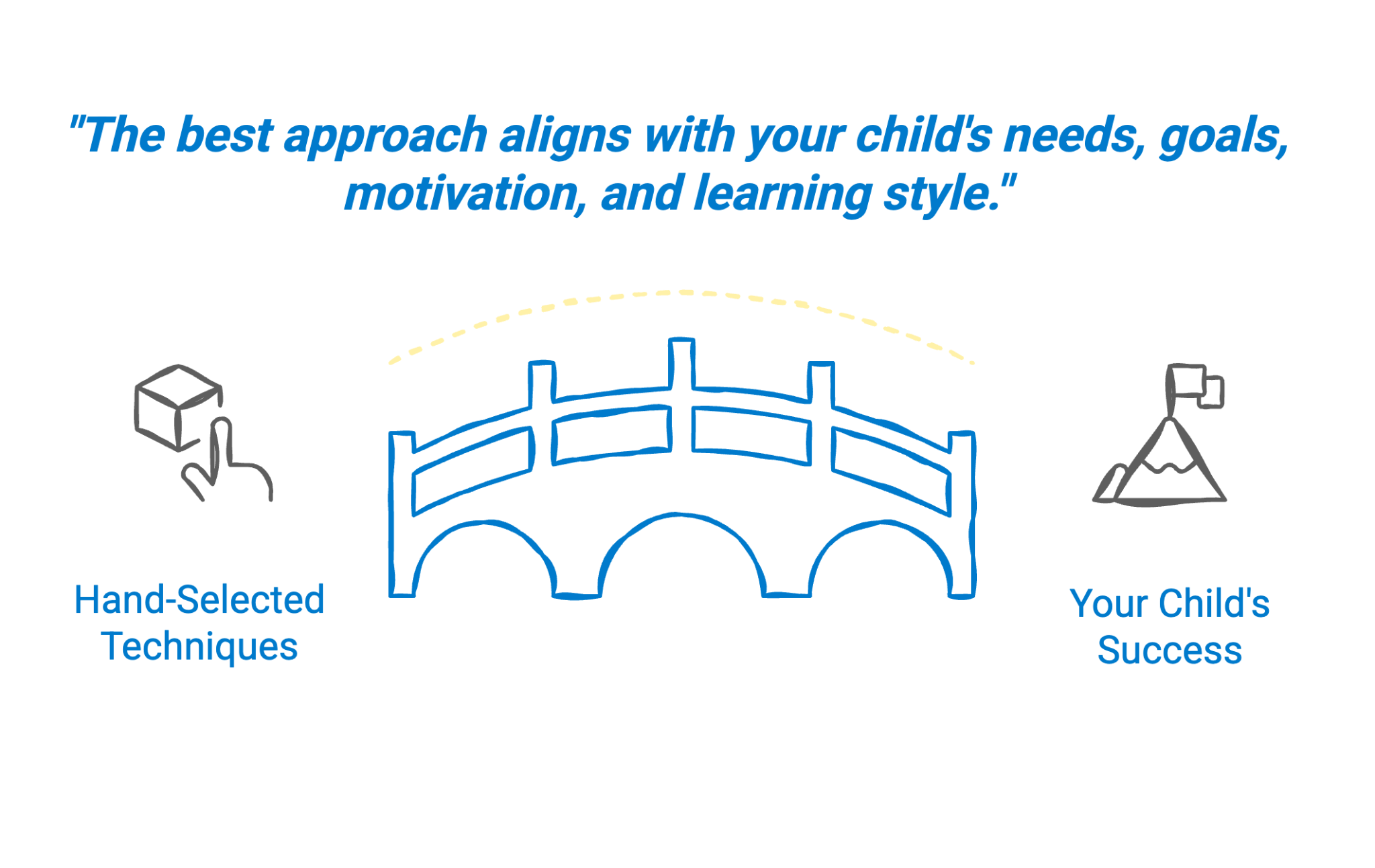
So, really, you can think of ABA techniques as thoughtful, hand-selected tools designed for building new skills. At Behavior Frontiers, we’ve tucked all of these techniques in our toolbox, ready to help your child reach goals and build more independence.
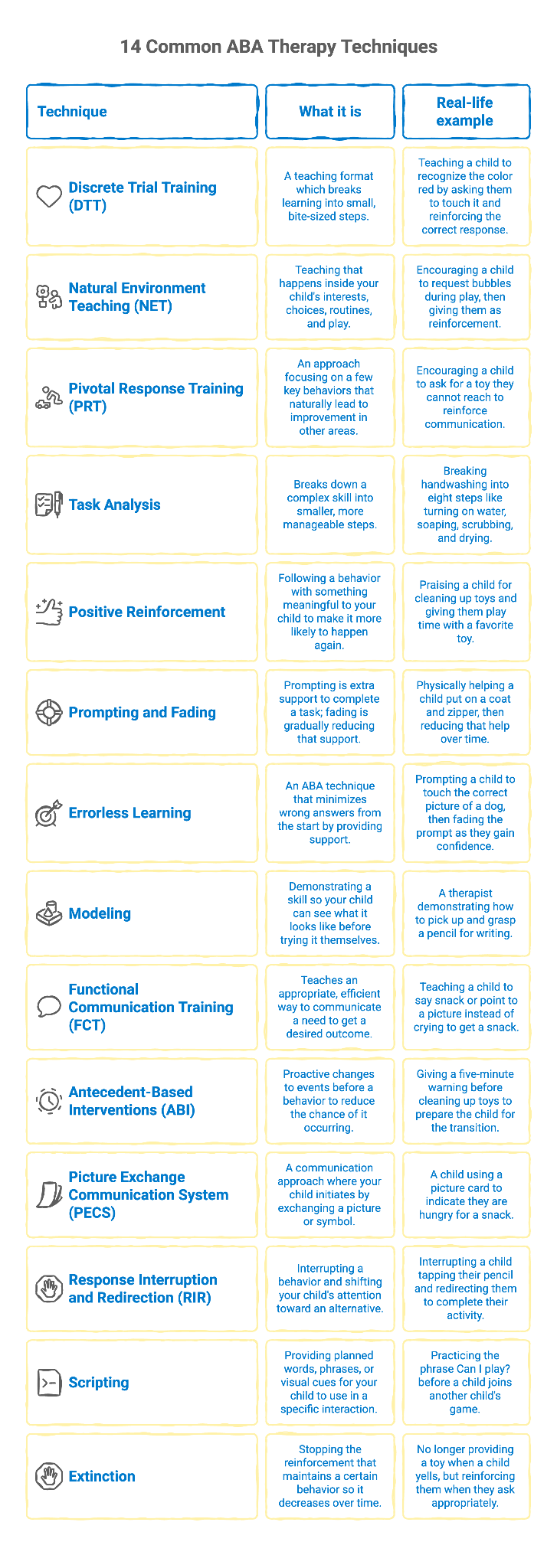
14 Common ABA Therapy Techniques
These techniques will overlap and intermingle with each other, meaning, a single ABA session might include several of these techniques. But for the sake of understanding them, they’re organized in a list.
1. Discrete Trial Training (DTT)
What it is: DTT is a teaching format which breaks learning into small, bite-sized steps. Your child's therapist gives a clear instruction, your child responds, and reinforcement or a correction follows.
Real-life example: Your child is learning colors. Their behavior therapist might teach them to match the color red by asking them to “put with red” or “match red.” When they respond correctly, the therapist reinforces their response and repeats the practice until your child can identify the color independently.
2. Natural Environment Teaching (NET)
What it is: NET is teaching that happens within your child's interests, choices, routines, and play. This means learning happens in relevant moments linked to your child’s everyday life, creating a strong bridge between freshly learned skills and real-life moments. With this technique, skills make it out of the ABA center and into their daily life (at home, at school, and beyond).
Real-life example: During play, your child reaches for a bottle of bubbles, creating a natural opportunity to practice communication. The therapist encourages them to request “bubbles” or use their communication device, then immediately gives them the bubbles as reinforcement.
3. Pivotal Response Training (PRT)
What it is: PRT is an approach focusing on a few key behaviors (like motivation, initiating communication, responding) that naturally lead to improvement in other areas.
Real-life example: Your child is playing with cars but can’t reach their favorite one. Their therapist encourages them to ask for it by saying “car” or pointing. Once the child communicates the request, they get the car, reinforcing communication while they’re already motivated to play.
4. Task Analysis
What it is: Task analysis breaks down a complex skill into smaller, more manageable steps. Using this method makes multi-step skills easier to process, understand, and learn.
Real-life example: Your child needs to learn to wash their hands. Their therapist breaks the handwashing process into eight steps: turn on water, wet hands, pump the soap, rub palms of hands together, wash the tops of hands, rinse, dry, and put the towel away. Then, each step is taught through chaining (either forward or backward).
5. Positive Reinforcement
What it is: With this method, we follow a behavior with something meaningful to your child, which makes that behavior more likely to happen again.
Real-life example: Your child cleans up their toys when asked. Their therapist immediately praises them with, “Great job cleaning up!” and gives them a few minutes of play with their favorite toy.
Positive reinforcement must always be meaningful to your child, because reinforcement is only effective when your child wants what is offered.
6. Prompting and Fading
What it is: Prompting is the extra support given so your child can complete a task or skill with more success. Fading is gradually reducing that support until your child can complete the task on their own. Prompts can be verbal, visual, gestural, a demonstration, or physical guidance.
Real-life example: Your child needs to learn to put a coat on, but they need extra support. Their therapist physically puts their arms through the coat, and puts their hands on the zipper. As your child learns the steps, the prompt will get lighter and eventually fade away.
Learn more in our guide to the prompt hierarchy in ABA.
7. Errorless Learning
What it is: Errorless learning is an ABA technique that minimizes wrong answers from the start. Instead of waiting for mistakes, your child's therapist gives enough support up front that your child is likely to get it right, prompting immediately before an incorrect response can be given, then fades that support. The support might be a spoken cue, a gesture, a visual, a model, or gentle physical guidance, depending on the skill and your child.
Real-life example: Your child is learning to identify a picture of a dog. In teaching them, their therapist immediately prompts them to touch the correct picture when they’re first learning. As your child gets more confident, the therapist gradually reduces the prompt so the child can identify the dog independently.
8. Modeling
What it is: This means demonstrating a skill so your child can see what it looks like before trying it themselves. The “model” might be their behavior technician, a peer, a group, verbal, physical, or a video. Video modeling in particular works well for many children.
Real-life example: Your child is learning to hold a pencil. Their behavior therapist demonstrates how to pick up and grasp a pencil for writing.
9. Functional Communication Training (FCT)
What it is: FCT helps teach your child an appropriate, efficient way to communicate a need, so they can get the same outcome that a challenging behavior used to get them.
Real-life example: Your child often cries when they want a snack. Their therapist teaches them to say “snack,” point to a picture, or use their communication device instead. When your child uses the new communication skill, they immediately receive the snack, reinforcing an appropriate way to communicate their needs.
10. Antecedent-Based Interventions (ABI)
What it is: Antecedent-based interventions are proactive changes to events before a behavior, designed to reduce the chance of it occurring and increase your child's engagement.
Real-life example: Your child has some big emotions when asked to clean up their favorite toy. Their therapist gives a five-minute warning before it’s time to put away the toy and offers a choice of which toy to put away first. By changing what happens before the transition, the child is more prepared and perhaps less likely to have big emotions.
11. Picture Exchange Communication System (PECS)
What it is: PECS is a communication approach where your child initiates by exchanging a picture or symbol with a partner to get something they want.
Real-life example: Your child would like a snack. They use a PECS card which indicates they are hungry for a snack (perhaps a picture of a snack they want).
The progression looks like this:
Phase I - Child is taught to pick up a single picture of a desired item and hand it to an adult in exchange for item
Phase II - Child uses the picture across different distances, rooms, and with various people
Phase III - Child selects the specific picture they want from a variety of PECS
Phase IV - Child uses “I want” sentence strip
Phase V - Child learns to respond to the spoken question “What do you want?” using pictures
Phase VI - Child responds to commenting questions such as “What do you see, what do you hear, what is it, etc.”
Throughout the whole process, your child is encouraged to begin conversations and build foundational skills like joint attention.
12. Response Interruption and Redirection (RIR)
What it is: RIR means we are interrupting a behavior and shifting your child's attention toward an alternative. This may also be called “redirection” in some cases.
Real-life example: During a lesson, your child begins repeatedly tapping their pencil instead of completing the activity. Their therapist briefly interrupts the behavior and redirects them to the next step of the task. When the child engages with the activity appropriately, the therapist provides positive reinforcement.
13. Scripting
What it is: This involves providing planned words, phrases, or visual cues for your child to use in a specific interaction, then gradually removing parts of the script.
Real-life example: Your child’s therapist gives them a simple phrase like “Can I play?” to practice before joining another child’s game. With practice, the child learns to use the phrase more independently during real social situations.
14. Extinction
What it is: Behaviors often continue because they’ve been reinforced in the past, usually without anyone meaning to. Extinction is the process of reducing and eventually eliminating an unwanted behavior by completely withholding the reinforcement that has been maintaining it. When a behavior no longer produces its expected reward or payoff, it gradually decreases and stops
Real-life example: Your child has learned that yelling gets them a favorite toy. This can happen without anyone realizing it, like when a toy is offered just to help a tough moment pass. Using extinction, your child’s care team stops providing the toy after the yelling and instead reinforces communication, like asking for the toy with a word, sign, or gesture. Over time, your child learns that asking is a more effective way to get what they want.
Extra note: A behavior can sometimes briefly increase before it improves, which is part of how extinction works. This is one reason your BCBA plans and supervises it carefully, and why it isn’t a technique to try for the first time on your own. In addition, we should always pair extinction with differential reinforcement (i.e., reinforcing alternative, appropriate, or functionally equivalent replacement behaviors), such as functional communication training, antecedent interventions, or non-contingent reinforcement.
2 Bonus Techniques You Might Not Have Heard About
We also asked Roberts which techniques he uses constantly that parents (like you) may not have heard about.
1 - Mand Training
Manding is a request, like asking for a toy, snack, help, or break. Mand training teaches children with autism to make those requests, often by setting up everyday moments where they’re motivated to ask.
But, here’s why this technique may often be overlooked: Parents often focus on “a child’s vocabulary, labeling skills, or the ability to answer questions,” Roberts says.
However, children having the ability to ask for what they need is a foundational skill. And once they are able to do it, the skill begins to show up in unexpected ways.
"When children learn to effectively communicate their wants, needs, and preferences, they often experience less frustration because they have a reliable way to get their needs met,” he says.
And less frustration welcomes more openness to learning and locking in other skills that fuel your child’s success.
2 - Behavioral Momentum
Behavioral momentum (also called high-probability requests) is a deliberate, evidence-based strategy that allows your child to be successful before being introduced to something difficult.
Here’s a quick example:
Let’s say your child is reluctant to clean up their blocks. So, their therapist starts with a few easy requests, such as “put in the blue block” and “put in the red block,” that your child can complete successfully.
Then, once they are engaged and responding, the therapist gives the harder request, which is “put all the blocks in the bin.” With the already-built momentum, they are more likely to follow through with the task.
“Over time, small approaches like this can make a significant difference in a child's willingness to learn and try new skills," Roberts says.
Within these approaches are fresh skills, confidence built brick-by-brick, and goals met—even within the smallest of moments. They truly make all the difference.
What This Looks Like at Behavior Frontiers
ABA techniques, when truly aligned with your child and their goals, can look and feel like play. Each technique holds small moments that improve your child’s daily life, brick-by-brick.
So, as you learn about these 14 (plus two) ABA techniques, you don’t need to memorize them (although you can!).
Instead, here’s what we hope you’ll do:
Consider partnering with a team that takes the time to understand your child and create a tailored plan that’s 100% unique to them. Because you’re an important part of this, too.
At Behavior Frontiers, each of our programs is carefully planned with your child in mind. And since we care deeply about progress and helping your child reach their goals, we track all data through PrioraCare™, our made-from-scratch data tracking platform built to monitor progress live and keep everyone informed about their progress.
If you're wondering whether ABA is right for your kiddo, reach out to us. After a brief conversation, you'll be connected with a licensed BCBA to begin building a plan designed around your child's needs.
Frequently Asked Questions
What are the most common ABA therapy techniques?
- Discrete Trial Training
- Natural Environment Teaching
- Positive reinforcement
- Prompting and fading
- Task analysis
- Modeling
Most ABA programs combine several rather than relying on any single one. In a typical session, you'd likely see three or four working together.
How does a BCBA decide which ABA techniques to use with my child?
Your child’s ABA journey always starts with assessment, not with the techniques. Your BCBA identifies your child's strengths, needs, interests, communication abilities, and learning style, then works with you to figure out which goals would make the biggest difference in daily life. Only then do they match teaching strategies to the skill and to your child. This plan might change over time. As your child gains skills, more of the learning shifts into natural settings so it carries over to home and school.
Can I use ABA techniques at home?
Yes, and several translate easily. Reinforcement, modeling, and prompting all work well at home. The most useful thing you can do is ask your BCBA which techniques fit your child's current goals, so you're reinforcing the same things they are. Consistency between the center and home helps make skills stick.