
January 30, 2024

Managing Aggressive Behaviors: A Guide for Parents
Managing Aggressive Behaviors: A Guide for Parents — Behavior Frontiers

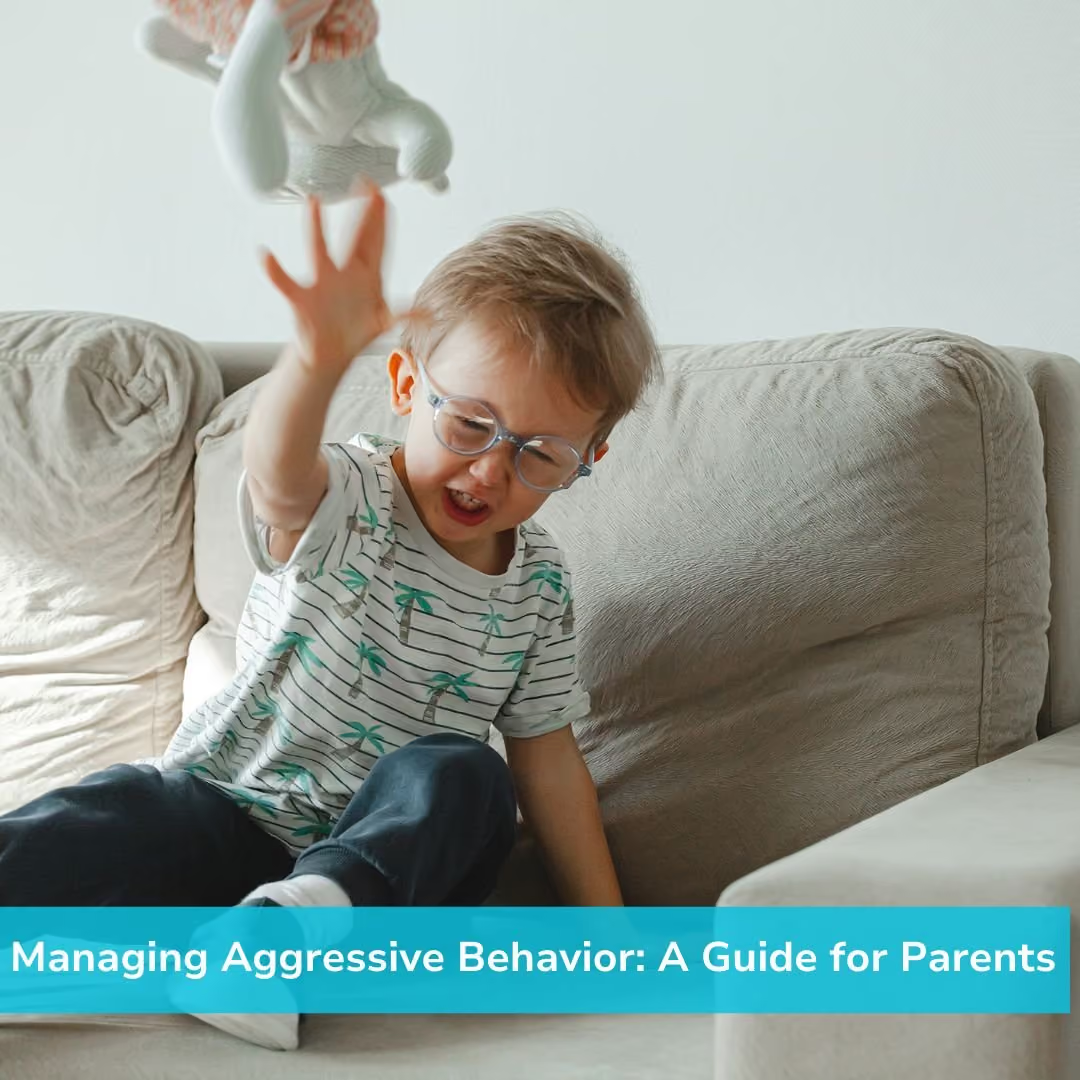
Children with Autism Spectrum Disorder (ASD) face many challenges. One of the most frustrating, for the child and their parents, is a difficulty expressing their wants and needs. This can lead to the child using aggressive behavior.

It’s important to try to understand why your child might be acting out. A Functional Behavior Assessment (FBA) conducted by a qualified professional is one of the ways to determine for sure why your child might be engaging in aggression. Learning more about the functions of behavior can help you, as the parent, begin to narrow down the possible reasons.

Here are some general strategies you can use when your child displays aggressive behaviors:

Ignore the behavior: This doesn’t mean to ignore your child, just their negative behavior. If your child begins hitting you, don’t engage. You can look in another direction, or walk into another room. You want to teach your child that this behavior won’t yield the results that they want.

Try to communicate: Once the behavior appears to be winding down, work with your child to try to determine their wants and needs using the way that is most comfortable to them. You are showing that when they communicate what they need in an appropriate way, they will receive the attention that they need.

Redirect your child to a different activity: This is most effective when your child is upset over something like a toy being taken away, or being told no. However, it’s important to remember that this is not a good strategy if your child became aggressive to escape something they didn’t want to do, such as bathtime, chores, etc.

Reward positive behavior: It is incredibly important to reward your child when they engage in behaviors other than aggression, such as communication. This can be something like a snack they enjoy, or a certain amount of playtime.

There are some strategies that a parent or caregiver can use in order to try to prevent the behavior from happening in the first place. These proactive strategies can include:

  • Allowing your child to make choices about what they would like to do, eat, etc.
  • Following a set schedule
  • Using a reward system for good behavior
  • Setting up your environment for success: if something is off limits, put it out of your child’s sight. If you can do something to make a task your child doesn’t enjoy more comfortable, try to do that.
  • Using functional communication strategies: work with your child to communicate effectively in the way that is most comfortable to them. This might include words, signs, pictures, or adaptive technology.

The most important thing to remember is to not give in when your child shows aggression. An autism specialist, such as a BCBA, can help to determine what is causing this behavior and come up with strategies to stop it. Behavior Frontiers' ABA program targets the behaviors that worry your family the most, including aggression.

In the meantime, the best thing a caregiver can do is to remain consistent and use these strategies each time your child engages in aggression. As challenging as this might be, it will get better!

View Our Previous Blog Posts

7 Famous People with Autism Who've Shared Their Diagnosis
September 8, 2026

7 Famous People with Autism Who've Shared Their Diagnosis

An autism diagnosis never determines your success. For many of the most creative, driven, and groundbreaking minds in history, it may have been the very thing that fueled it. An intense focus, pattern recognition, and a willingness to see the world differently are not limitations. They're superpowers. And when a person with autism is given the right support and space to grow, truly incredible things can happen.
What Is DRA in ABA Therapy? (Differential Reinforcement of Alternative Behavior)
September 8, 2026

What Is DRA in ABA Therapy? (Differential Reinforcement of Alternative Behavior)

Every time your child wants to play with a toy, they have big emotions until they get it. At school, when presented with difficult work, they might run away. These are all examples of behaviors your child might exhibit to serve a communicative purpose. They might need something or want your attention. Or maybe they just want access to an opportunity. Whatever the behavior might be—it works, so it continues. Sometimes, we as adults may reinforce these behaviors without realizing it.
The 7 Dimensions of ABA Therapy (Baer, Wolf & Risley, 1968)
September 8, 2026

The 7 Dimensions of ABA Therapy (Baer, Wolf & Risley, 1968)

What guides every intervention in Applied Behavior Analysis (ABA) therapy?The 7 dimensions of ABA.Think of ABA therapy like a multi-dimensional figure. It has many angles, perspectives, and ways to evaluate it. That is exactly what the dimensions do. They give clinicians and families a complete way to see how well an intervention is working, from every angle.
Errorless Learning in ABA: How and Why Behavior Therapists Use It
September 8, 2026

Errorless Learning in ABA: How and Why Behavior Therapists Use It

In Applied Behavior Analysis (ABA) therapy, errorless learning is a way to teach new skills by giving the right amount of support from the very beginning.When your child with autism is learning something new, mistakes are part of the process. But for some kiddos, too many mistakes too quickly can feel uncomfortable, frustrating, or discouraging. The last thing we want is for your child to shut down, guess, avoid the task, or lose confidence before the skill has a chance to grow. That's where errorless learning can help.
Stimming and Autism: What It Is, Why It Happens, and When to Support It
September 8, 2026

Stimming and Autism: What It Is, Why It Happens, and When to Support It

Have you noticed your child rocking, flapping their hands, or making the same sounds on repeat?What you’re observing is called stimming. Stimming (short for self-stimulating behavior) refers to repetitive motions, sounds, or interactions with objects, and it’s far more common than you may think. In fact, close to 44% of people with autism engage in some form of stimming.
What Are the Benefits of Center-Based ABA Therapy? What Parents Should Know
September 3, 2026

What Are the Benefits of Center-Based ABA Therapy? What Parents Should Know

If your child recently received an autism diagnosis, the next steps can feel exciting in some ways. Now, your child has access to all the support they need. But after that diagnosis comes a fresh set of questions, one of them being: what's the right next step? To help you understand if your kiddo is a good fit for center-based ABA therapy, we'll cover: the definition of center-based ABA, the benefits of center-based ABA, and the key differences between center-based and in-home ABA.
Find ABA Therapy Near Me