

A Brief History of Behavior Analysis
%2013.avif)

The field of behavior analysis may have a short history compared to other disciplines, but even during this small time, there have been many significant researchers who were involved in creating the future for ABA.
Major Researchers in the History of ABA
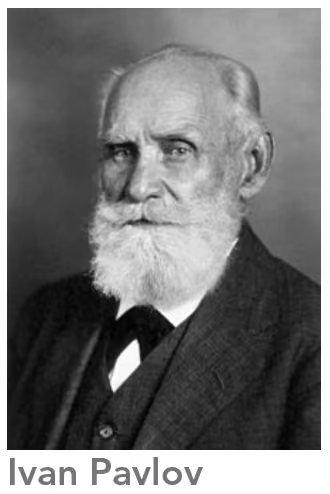
Ivan Pavlov – Ivan Pavlov was a Russian psychologist known primarily for his work in classical conditioning, which is a way in which a stimulus in the environment can influence a behavior. Ivan Pavlov is most well-known for teaching dogs to salivate at the sound of an arbitrary stimulus. His research began with studying the salivation in dogs in response to being fed. He achieved this by inserting a small test tube into the cheek of each dog to measure saliva when the dogs were fed (with a powder made from meat). He predicted that the dogs would salivate in response to the food placed in front of them, but he then noticed that his dogs would begin to salivate whenever they heard the footsteps of his assistant who was bringing them the food. Pavlov hypothesized that dogs could predict what was going to happen after hearing the sound of the footsteps. He continued to research the way in which environmental stimuli can occur prior to behavior to elicit a reflexive response. A reflexive response is any response that an organism does not choose to emit, but rather, is naturally drawn out against the person’s control (i.e., leg kicking forward when doctor taps a small hammer on knee, blinking in response to someone blowing on one’s face, etc.).

Edward Thorndike – Another major researcher in the history of ABA was Edward Thorndike. Thorndike’s research led to the advancement of operant conditioning, which is often described as behavior repeating following pleasant consequences, and behavior ceasing when followed by an unpleasant consequence. Thorndike conducted his research by gathering stray animals from the community and put them into a puzzle box to measure how long it took the animal to get out of the puzzle box and to gain access to a preferred stimulus. He discovered that the animal in the box eventually figured out that the lever to get out gave them immediate access to food. From this discovery, Thorndike hypothesized that if behavior produces pleasant consequences, then the behavior will repeat in the future. The same is true for the contrary – if behavior produces an unpleasant consequence, then the behavior will not repeat in the future. In other words, good things make behavior happen more and bad things make behavior happen less often. Nowadays, we refer to this as reinforcement and punishment. Additionally, Thorndike also discovered that there were voluntary and involuntary responses in behavior. Voluntary responses refer to the operant behaviors and involuntary refers to the respondent behaviors that are governed by consequences rather than by the stimuli.
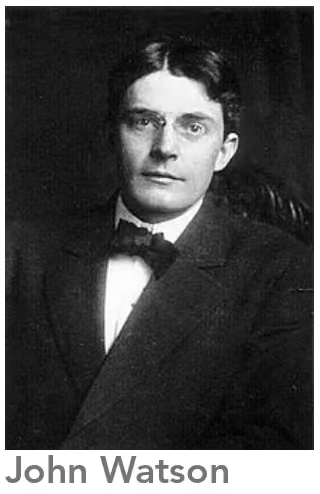
John Watson – The third person of significance was John Watson, who was the first person to actually label himself as a behaviorist. However, his behaviorism was controversial for a number of reasons. First, he was a methodological behaviorist, which is different than any modern behaviorists in our world now because they have different opinions about what causes a person to behave in a certain way. John Watson is known for his “Little Albert” study, which worked with classical conditioning to determine if he could condition fear. His study was very similar to Pavlov’s study in terms of looking at which behaviors he could elicit or “draw out.” However, unlike Pavlov, he discovered that little Albert’s response was a voluntary response versus a reflexive response. In other words, his research findings suggested that fear and emotions were a result of the environment and not private events. He drew conclusions that if we could understand the environment well enough, then we could determine where fear developed. He stated that behaviors, such as emotions, were all learned through the manipulation of one’s environment.

B.F. Skinner – Lastly, the most popular researcher and behaviorist in the field of ABA is B.F. Skinner, who was known as the “father” of Behavior Analysis. Skinner’s work changed behavior analysis for the better because he introduced a new concept to the field: Radical Behaviorism. He focused on the idea that a person’s behavior and the environmental factors that influence the behavior are much more crucial to the fundamental understanding of a person’s psychological state. In other words, he was the first person to suggest that private events (in addition to public events) are also behavior.
An In-Depth Look at Skinner and How His Research Applies to ABA Today
B.F. Skinner’s work focused on the view that classical conditioning was not enough to explain the complexity of human behavior. He believed that the best way to understand behavior was to figure out the relationship between the causes of behavior and the consequences of that behavior, also known as operant conditioning. Skinner did a lot of work in the early 1940-1950s, and discovered most of the basic concepts that we use today, such as reinforcement, shaping, punishment, etc.
B.F. Skinner was not only interested in lab work, but also in applying these basic concepts to everyday life. Skinner’s principles were first applied in the late 1960s and early 1970s to help patients in a psychiatric institution. The purpose of the treatment was to decrease undesirable behaviors that the patients engaged in: their maladaptive behavior towards the staff. Skinner found ways to find enrichment and reinforcement for behaviors that did not involve creating unsafe conditions. The results of applying his basic principles to these situations proved to be effective, and therefore they continued to implement these behavioral principles with the public. We refer to this as the “applied” part in Applied Behavior Analysis. Behavior analysis is the science, but we apply the principles to solve a particular issue. Skinner found interest in how to apply behavior analysis in society and cemented the understanding of why people engage in certain behavior under specific circumstances.
Increase in the Use of ABA for Autism
Through the 1970s behavior analysis continued to be researched and applied, but it was not until the early 2000s that behavior analysis was more recognized as a treatment method for autism spectrum disorder and other pervasive developmental disorders. The use of ABA principles has also expanded into other populations. It is now common to see ABA being widely used, through positive behavior supports in school, animal training, staff training, and beyond.
Annie Prchal, M.S. BCBA
Minneapolis, MN
Tuesday, November 17, 2020