
March 13, 2024

Cutting Through the Challenges: Haircuts with Autism
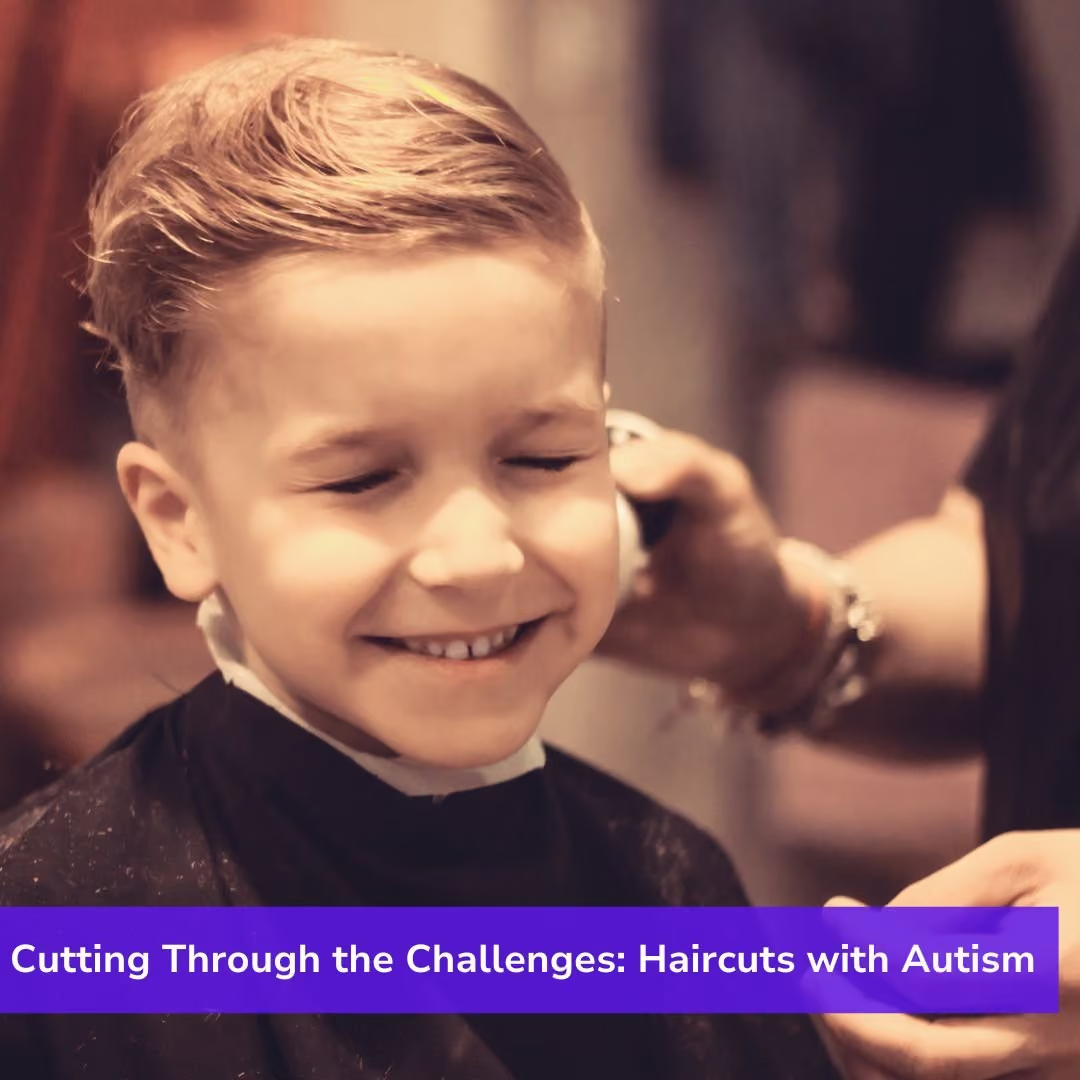
Cutting Through the Challenges: Haircuts with Autism — Behavior Frontiers

Children with Autism Spectrum Disorder (ASD) can struggle with a number of sensory issues. One of the most common areas that children struggle with is getting their hair cut. It’s an unfamiliar environment, filled with strange sounds and uncomfortable sensations – no wonder it can be so overwhelming!

However, with these helpful tips and strategies, you can help make your child’s haircutting experience less stressful for both you and your child.

  • Make a plan: Know where you are going to take your child. Let the stylist or barber know in advance if there is anything they can do to make your child more comfortable.
  • Talk to your child: Explain in advance what will happen at their appointment. Always meet your child at their developmental level. If you can simply talk to your child, and they are able to understand the concepts, that’s great. However, don’t be afraid to use pictures or other visual aids to help prepare your child!
  • Use other resources: There are many autism resources available to help your child prepare for this process. We love this social story from Autism Little Learners, or this video resource from educator Audra Kahne. You might also use picture books, such as “I’m Not Scared No Way: I’m Getting My Haircut Today”, by Kimberley Pattison.
  • Roleplay the haircut process: You can use dolls for this, acting out all the steps of getting a haircut. Alternately, you can act it out yourself, and then have your child imitate you! Some steps to consider including are: walking into the salon or barber, sitting in the chair, wearing a smock, having water sprayed on their hair, and having their hair combed. If the barber is going to use clippers, you might use something that buzzes (like an electric toothbrush) to get your child used to the feeling.
  • Reward your child for a job well done!: On the big day, make sure to reward your child for being good throughout the process. Acknowledge that they have faced their fears and have done a good job!

By following these steps and preparing your child in advance, you can help your child be more ready for an uncomfortable situation and avoid those big feelings!


View Our Previous Blog Posts

The 4 Functions of Behavior in ABA Therapy: Understanding Your Child’s Behavior
October 7, 2026

The 4 Functions of Behavior in ABA Therapy: Understanding Your Child’s Behavior

In ABA therapy, understanding the functions of behavior helps clinicians (and you) uncover what your child is trying to communicate through their behavior. And once we unlock the “why,” we also reveal the pathway to teaching new ways to communicate that same need (thus reducing challenging behaviors like tantrums, aggression, or throwing things) and setting up your child for success.
Differential Reinforcement in ABA: The Most Powerful Tool Behavior Therapists Use
October 7, 2026

Differential Reinforcement in ABA: The Most Powerful Tool Behavior Therapists Use

Differential reinforcement is a behavior-support strategy that strengthens one response while reducing another. It has two moving parts: reinforcing the behavior you want to see more of, and reducing reinforcement for the challenging behavior that isn’t meeting your child’s needs in the best way.
7 Famous People with Autism Who've Shared Their Diagnosis
September 8, 2026

7 Famous People with Autism Who've Shared Their Diagnosis

An autism diagnosis never determines your success. For many of the most creative, driven, and groundbreaking minds in history, it may have been the very thing that fueled it. An intense focus, pattern recognition, and a willingness to see the world differently are not limitations. They're superpowers. And when a person with autism is given the right support and space to grow, truly incredible things can happen.
What Is DRA in ABA Therapy? (Differential Reinforcement of Alternative Behavior)
September 8, 2026

What Is DRA in ABA Therapy? (Differential Reinforcement of Alternative Behavior)

Every time your child wants to play with a toy, they have big emotions until they get it. At school, when presented with difficult work, they might run away. These are all examples of behaviors your child might exhibit to serve a communicative purpose. They might need something or want your attention. Or maybe they just want access to an opportunity. Whatever the behavior might be—it works, so it continues. Sometimes, we as adults may reinforce these behaviors without realizing it.
The 7 Dimensions of ABA Therapy (Baer, Wolf & Risley, 1968)
September 8, 2026

The 7 Dimensions of ABA Therapy (Baer, Wolf & Risley, 1968)

What guides every intervention in Applied Behavior Analysis (ABA) therapy?The 7 dimensions of ABA.Think of ABA therapy like a multi-dimensional figure. It has many angles, perspectives, and ways to evaluate it. That is exactly what the dimensions do. They give clinicians and families a complete way to see how well an intervention is working, from every angle.
Errorless Learning in ABA: How and Why Behavior Therapists Use It
September 8, 2026

Errorless Learning in ABA: How and Why Behavior Therapists Use It

In Applied Behavior Analysis (ABA) therapy, errorless learning is a way to teach new skills by giving the right amount of support from the very beginning.When your child with autism is learning something new, mistakes are part of the process. But for some kiddos, too many mistakes too quickly can feel uncomfortable, frustrating, or discouraging. The last thing we want is for your child to shut down, guess, avoid the task, or lose confidence before the skill has a chance to grow. That's where errorless learning can help.
Find ABA Therapy Near Me