

The 7 Dimensions of ABA Therapy (Baer, Wolf & Risley, 1968)

%2013.avif)

What guides every intervention in Applied Behavior Analysis (ABA) therapy?
The 7 dimensions of ABA.
Think of ABA therapy like a multi-dimensional figure. It has many angles, perspectives, and ways to evaluate it. That is exactly what the dimensions do. They give clinicians and families a complete way to see how well an intervention is working, from every angle.
In 1968, three behavioral science researchers, Baer, Wolf, and Risley, published a foundational paper in the Journal of Applied Behavior Analysis that defined these dimensions. Decades later, their framework still shapes how ABA therapy is practiced today.
What makes the dimensions remarkable is how they keep ABA both measurable and meaningful. Together, they help guide progress, connection, and genuine care into your child's everyday life.
Where Did the 7 Dimensions of ABA Originate?
In 1968, Baer, Wolf, and Risley introduced the 7 dimensions of ABA. They appeared in the inaugural issue of the Journal of Applied Behavior Analysis to describe the important characteristics of effective applied behavior analytic interventions.
The paper was as foundational as it was influential. It finally gave the behavioral science field shared language to define ABA and its mission.
These same dimensions remain central to how ABA is conceptualized in both research and practice today. Built on decades of clinical work and peer-reviewed research, they continue to stand the test of time.
The dimensions keep ABA focused, effective, and grounded in meaningful outcomes. That’s exactly why, at Behavior Frontiers, we follow them to a tee. We hold them close to every intervention and bake them into every step taken with your child (even in the smallest moments).
What Are the 7 Dimensions of ABA?
Each dimension of ABA plays a role in providing excellent support for your child. They work together, brick by brick, to build a path of success for your child.
1. Applied
Focus of this dimension: socially important, real-world behavior
Applied means interventions that target behaviors that matter to your child and society. These can include communication, daily living skills, safety, and social skills. The goal is to focus on behaviors with clear practical significance—things that can support independence, participation, and quality of life.
Applied interventions open the door to tangible goals. For your kiddo, that might mean seeing direct changes in their daily life, like requesting a preferred item, navigating a hard transition, or greeting a peer. All those ins and outs and tiny moments can add up to real change. Working on these skills can make daily life a little easier, more connected, and it all belongs to them.
2. Behavioral
Focus of this dimension: observable and measurable actions
This dimension of ABA answers the question: “Can it be measured?”
ABA focuses on behavior that can be seen, counted, or otherwise objectively measured. Any change should occur in the behavior of the person receiving treatment and be verified by reliable measurement procedures.
At Behavior Frontiers, this is why we collect data live during every session. We see real progress when it’s visible and measurable. Feelings alone can’t show you how your child’s behavior is changing over time. We use real-time data tracking through PrioraCare™, which is a direct expression of this dimension of ABA. Every session produces data, and each data point helps inform the next decision.
3. Analytic
Focus of this dimension: whether the intervention caused the change
The Analytic dimension of ABA refers to showing a functional relationship. In other words, we need evidence that a specific intervention is responsible for producing a meaningful change in behavior.
Typically, this is achieved through single-case experimental designs, where behavior is measured across different conditions. It helps us determine whether changes in behavior are linked to the intervention rather than other factors.
For example, if tantrums decrease once we introduce a visual schedule, and increase again if we remove it, that pattern tells us the schedule itself is driving the change, not chance or coincidence.
This dimension is why we adjust ABA programs regularly rather than running on the same path regardless of results. If the data does not show progress, something needs to change. The goal is to use the evidence to understand what is working, what isn’t, and what adjustments may help.
4. Technological
Focus of this dimension: procedures are described clearly and completely
This means an intervention is written in enough detail that a trained person could replicate it from the description. That way, no matter who steps in to support your child, they’ll know exactly what to do.
This dimension keeps everything specific and consistent. It guards against vague instructions that can leave everyone feeling confused. It calls for step-by-step documentation of prompts, reinforcement schedules, data collection methods, and mastery criteria.
If a new behavior technician joins your child’s care team, detailed instructions can lead the way. There’s no reinventing the wheel or scrambling to make sense of an intervention. All the information is on the table, clear as can be for everyone involved (including caregivers).
5. Conceptually Systematic
Focus of this dimension: grounded in behavior-analytic principles
Conceptually Systematic means procedures are grounded in principles such as reinforcement, extinction, and stimulus control. In this way, procedures aren’t presented as disconnected “tricks of the trade,” but as applications of established behavioral concepts.
For example, if a child grabs items because doing so has always gotten a reaction (attention, a laugh, the item handed over) and that reaction stops happening, the grabbing naturally fades over time. That's extinction: a specific, deliberate principle at work.
This dimension helps organize interventions under a coherent theoretical framework, making ABA more cumulative and scientifically unified.
6. Effective
Focus of this dimension: meaningful, practical impact
Behavior change should be impactful enough to make a difference in your child’s everyday life. If their life isn’t changing, it doesn’t matter what is reflected on paper. There must be evidence.
At home.
At the center.
At school.
Or anywhere else your child goes.
This dimension of ABA therapy boldly answers the question: “Is the intervention effective?” In this way, it acts as a gut check when all other dimensions are in place.
If everything else is working properly, we should be able to prove effectiveness. If the data do not show adequate change, clinicians need to adjust procedures. In a way, it ties everything together with a neatly tied bow.
7. Generality
Focus of this dimension: change that lasts and transfers
This dimension answers the question: “Does the skill stick, and does it travel?”
Generality means behavior change persists over time, shows up in different environments, and spreads to related behaviors beyond what was directly taught.
Interventions should be designed from the very start to promote generalization across multiple settings, people, and situations, not limited to one clinician or one room.
The goal is never for a skill to only work in one place. It should follow your child home, to school, to the grocery store, and into every corner of their life. That’s what helps make a skill truly theirs.
How Social Validity Connects to the 7 Dimensions of ABA
While social validity isn’t specifically one of the original 7 dimensions, it acts as an irreplaceable reality check across each of them.
Social validity asks whether the goals, procedures, and outcomes of an intervention are meaningful, acceptable, and valued by the people it affects. In short, it bakes warmth and humanness into ABA therapy.
Social validity connects particularly closely with three of the 7 dimensions: Applied, Effective, and Generality.
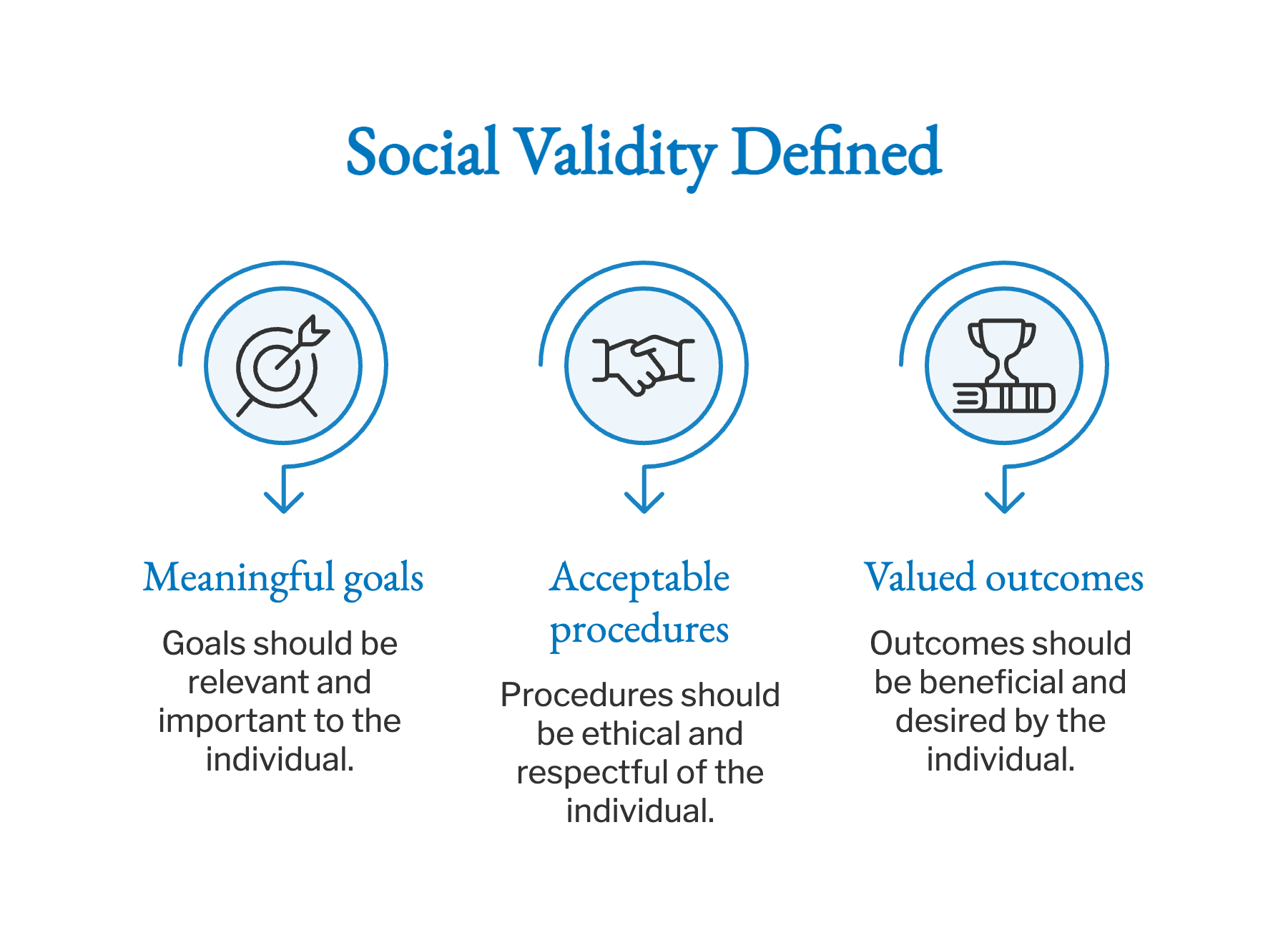
The Applied dimension says targets must be socially important. Social validity helps verify that importance from the family's perspective, not just the clinician's. Wolf argued that consumers, not clinicians, ultimately decide whether goals are meaningful. In this way, social validity serves as an important gut check on whether interventions positively impact those they are meant to serve.
Social validity also connects closely with the Effective dimension. An intervention should do more than produce measurable change; it should create meaningful progress in your child’s everyday life.
The same principle applies to Generality. Programs that generalize but do not align with social validity standards may “technically” meet the dimension’s requirements but still fail when applied to real life. For example, if a skill is practiced in a new setting, like greeting peers at school rather than at the center, but is unwelcome in that setting, the change might not stick.
Together, these connections highlight an important question: Are ABA interventions not only effective, but meaningful to the child and family they are designed to serve?
Because, ultimately, that’s really the whole point of ABA therapy in the first place.
What the 7 Dimensions Look Like at Behavior Frontiers
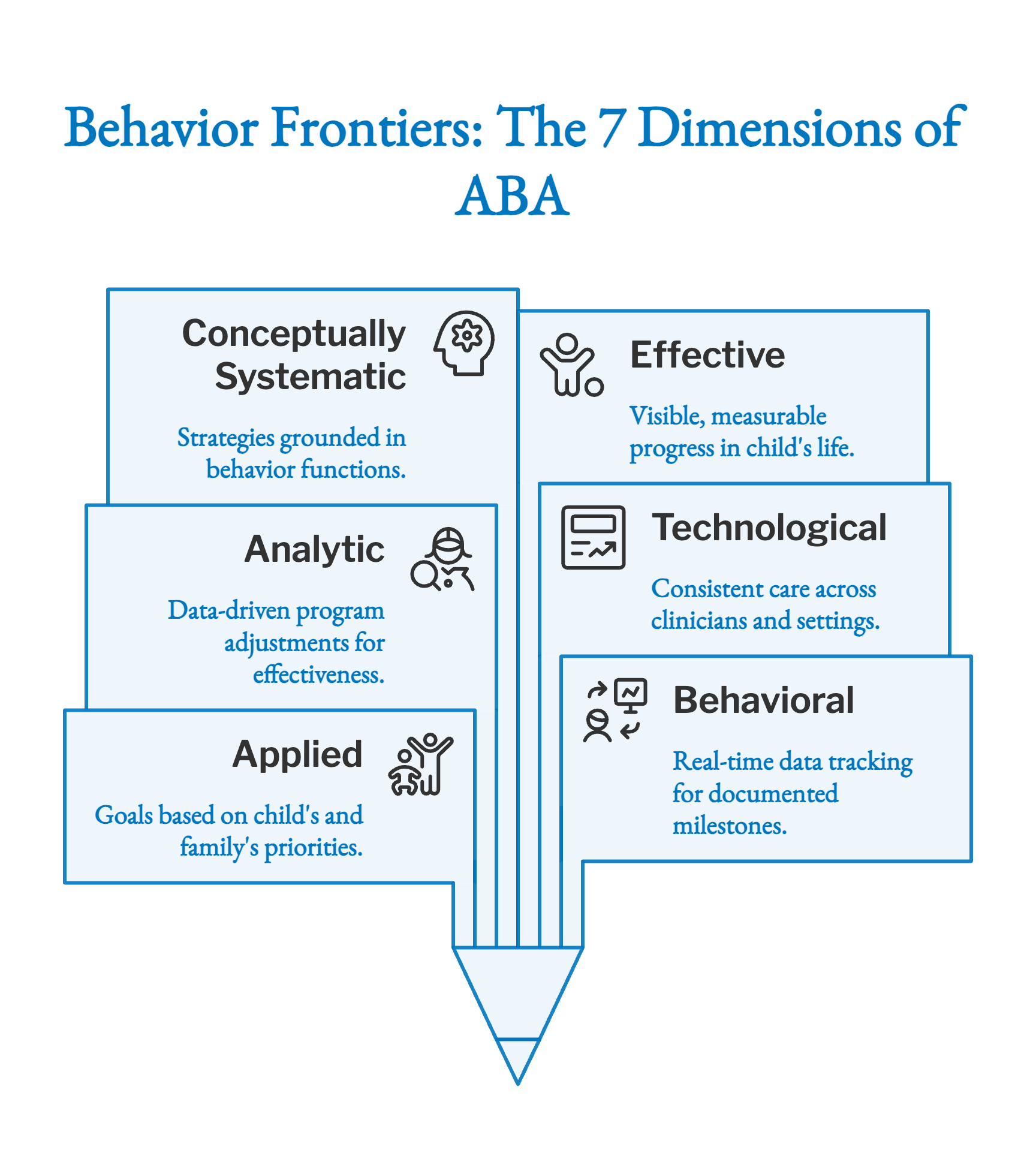
The 7 dimensions of ABA fuel our desire to support your kiddo in all possible ways. They are truly baked into everything we do:
- Applied: We build goals around what matters most to your child and family (not what’s easiest to measure or teach).
- Behavioral: We track progress in real time through PrioraCare™, our made-from-scratch data platform, so every milestone is documented and all goals are meticulously tracked.
- Analytic: Board Certified Behavior Analysts (BCBAs) review data regularly and adjust programs when the evidence calls for it. If something is not working, we do not wait.
- Technological: Programs are documented clearly enough that your child receives consistent care across every clinician, every setting, and every stage of their plan.
- Conceptually Systematic: Every strategy we use is grounded in the functions of behavior (the “why” behind behavior).
- Effective: Our standard is meaningful, measurable progress that is visible in your child’s life.
- Generality: Caregiver training and home support are built into every plan because skills need to live outside the center too.
Ready to learn more about ABA therapy? Reach out to us, and after a brief intake, you'll be connected with a BCBA to begin building a plan tailored to your child's unique needs.
Frequently Asked Questions
What are the 7 dimensions of ABA?
The 7 dimensions of ABA are Applied, which focuses on goals that matter in real life; Behavioral, where progress is measured; Analytic, which ensures interventions are shown to cause change; Technological, where procedures are clear enough to replicate; Conceptually Systematic, where interventions are grounded in behavioral science principles; Effective, where the change is meaningful; and Generality, which ensures skills last and transfer to other environments.
Who created the 7 dimensions of ABA?
Donald Baer, Montrose Wolf, and Todd Risley introduced the seven dimensions in the inaugural issue of the Journal of Applied Behavior Analysis in 1968. Their paper, "Some Current Dimensions of Applied Behavior Analysis," remains one of the most cited in the field and continues to shape how ABA is practiced and evaluated today.
Why are the 7 dimensions of ABA important?
The seven dimensions define what separates evidence-based ABA from other interventions. They protect clients by setting clear standards for what good practice looks like. For families, they are a framework for evaluating the quality of the care their child receives. For clinicians, they are the foundation every program should be built on.
What is the difference between the 7 dimensions of ABA and social validity?
Social validity is not one of the original seven dimensions, but it acts as an important check on them. It asks whether the goals, procedures, and outcomes of an intervention are meaningful and acceptable to the people they directly impact.