

Errorless Learning in ABA: How and Why Behavior Therapists Use It

%2013.avif)

In Applied Behavior Analysis (ABA) therapy, errorless learning is a way to teach new skills by giving the right amount of support from the very beginning.
When your child with autism is learning something new, mistakes are part of the process. But for some kiddos, too many mistakes too quickly can feel uncomfortable, frustrating, or discouraging. The last thing we want is for your child to shut down, guess, avoid the task, or lose confidence before the skill has a chance to grow. That's where errorless learning can help.
The idea is simple: just as scaffolding supports a new building, your child’s behavior therapist supports the learning of a new skill with guided prompts and encouragement. Then, as your child’s confidence grows (just as a building grows taller and stronger during construction), the support gradually fades as they become more independent.
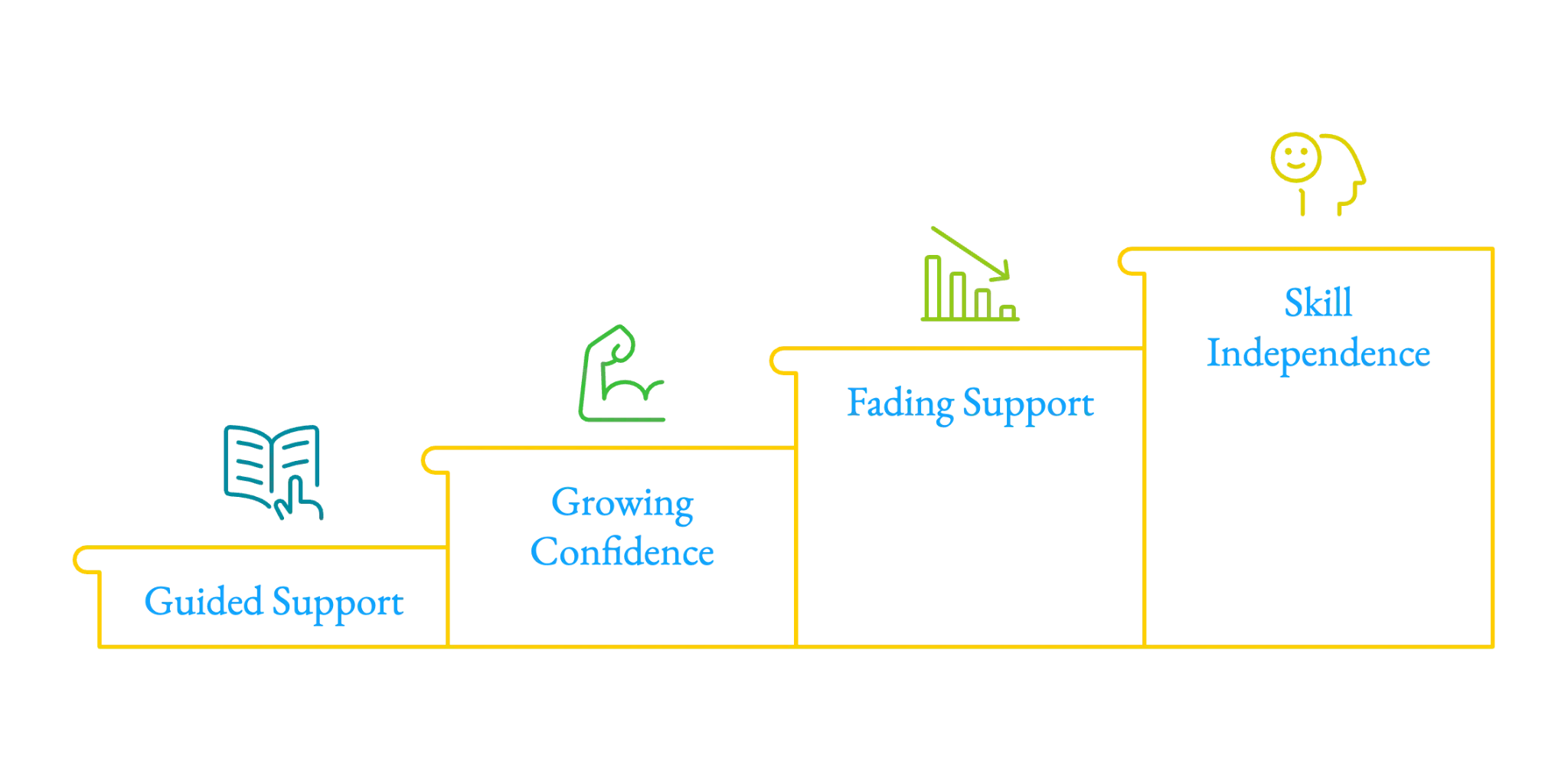
This approach makes big goals feel within arm’s reach. Being both positive and encouraging, errorless learning allows your child to pick up new skills and build confidence higher than the skyscrapers.
In this guide, we’ll go over what errorless learning is, share specific examples of how it works, and explain how ABA therapy uses it to support your child’s development.
What Is Errorless Learning in ABA?
Errorless learning is a teaching strategy used in ABA therapy to help children with autism build new skills successfully from the very start. Instead of waiting for a mistake to happen and stepping in afterward, the behavior technician or therapist gives enough support up front so your child is more likely to be successful.
That support might be a spoken cue, a gesture, a visual, a model, or gentle physical guidance. It all depends on the skill being taught and your child's individual needs.
We understand the word “errorless” can sound a little misleading. It doesn't mean your child has to be perfect or that mistakes never happen. It means your child’s therapist sets up the learning experience so your child has a better chance of getting it right, feeling successful, and practicing the skill in a meaningful way.
Over time, support fades out and your child does more of the skill on their own. The goal is more independence, not always arriving at the correct answer.
How Errorless Learning Works
Errorless learning usually follows a simple pattern:
- The behavior tech or therapist gives an instruction. For example: “Point to red.”
- They provide a prompt right away. That might mean pointing to the red card, modeling the answer, giving a verbal cue, or using another kind of support. The goal is to help your child succeed before they have a chance to get stuck or frustrated.
- Your child succeeds. The therapist provides reinforcement to the response with praise, encouragement, or another reinforcer they enjoy.
- The prompt fades over time (this is called prompt fading). As your child starts to understand the skill, the therapist slowly removes support until independent responding is possible.
Errorless Learning Examples
In real ABA sessions, errorless learning can look different depending on your child and the new skill. Sometimes the prompt is obvious. Other times, it's small enough that you might blink and miss it.
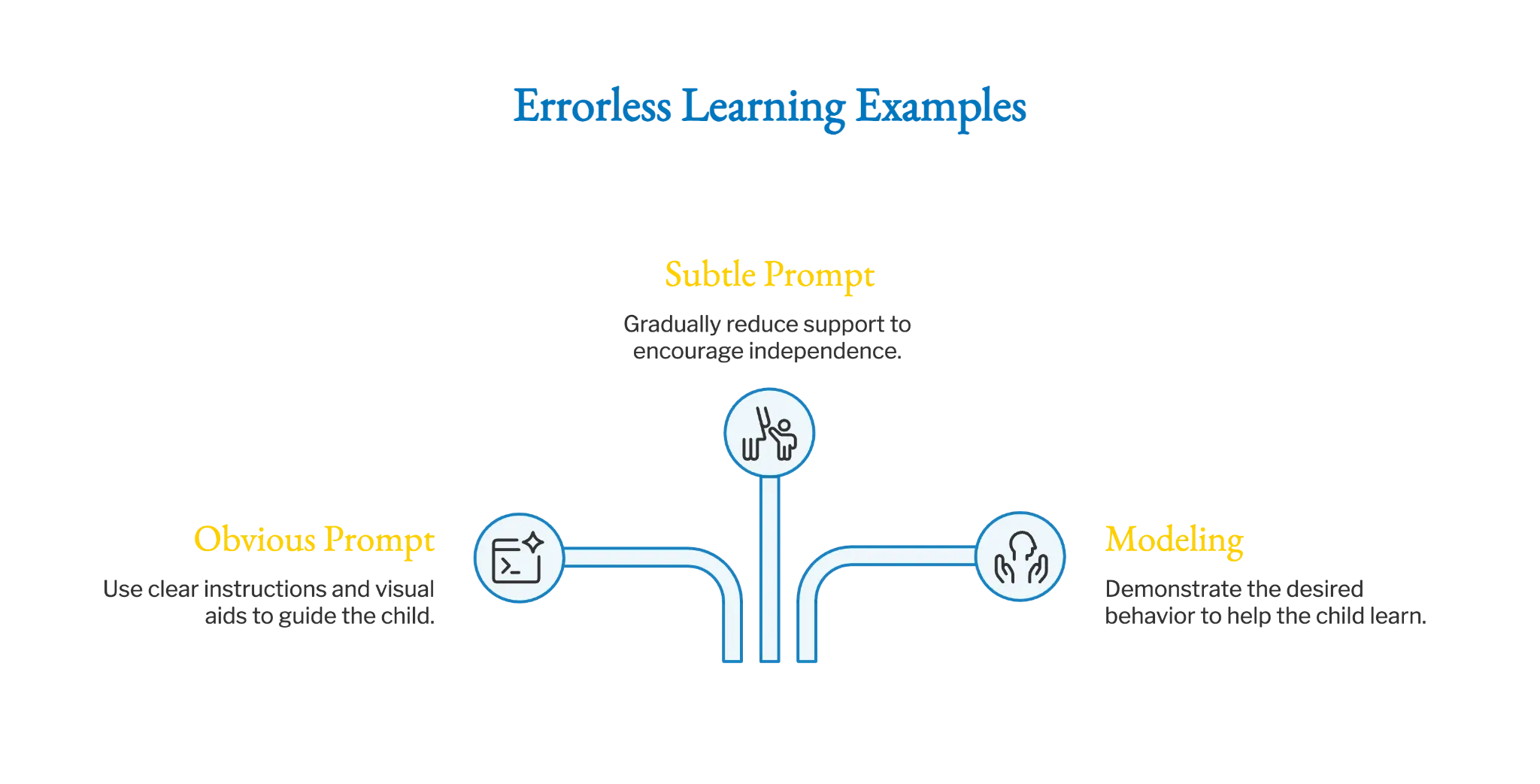
Here are a few simple examples:
- Identifying an object: If your child is learning the word “juice,” the therapist might show a picture and say, “This is juice. Say juice.” Later, the prompt may become “This is…” before moving toward the question, “What is it?”
- Learning a routine: If your child is learning to wash their hands, the therapist may guide the first step. As your child learns the sequence, their behavior technician or therapist fades support one step at a time.
- Asking for help: If your child needs assistance, the therapist might model “help me” or point to a visual. Over time, your child gets more chances to ask independently, with less support along the way.
The point of this is to slowly build up your kiddo’s independence. True confidence is never rushed. That’s why errorless learning gives your child a strong start, then opens the door for more independent practice when they're ready.
Why ABA Therapists Use Errorless Learning
Behavior techs often use errorless learning when a child is learning something new. Learning a new skill can feel like a lot without the right tools. With every mistake or frustration in the learning process, your kiddo may feel their goal getting bigger and bigger (and thus harder to reach).
It’s also important to note that some children are unfazed by errors, while others may get frustrated or shut down. Every child responds differently.
Errorless learning works to lower that pressure.
Because the behavior therapist provides early support, your child has more opportunities to practice the skill successfully. That can make learning feel safer, more encouraging, and the goal feel less daunting. It also helps build momentum when a skill is brand new.
Behavior technicians may use errorless learning to support skills like:
- Communication: Errorless learning can help your child learn to make requests, respond to questions, or use words and phrases to express their needs.
- Labeling objects, colors, or people: When a child is learning to identify and name things in their world, errorless learning helps them practice the correct label right away rather than guessing their way there.
- Following directions: For children learning to respond to one- or two-step instructions, errorless learning helps pair the direction with a prompt so your child knows what the expected response looks like from the start.
- Self-care routines: Skills like brushing teeth, washing hands, toileting, or getting dressed involve multiple steps in a specific order. Errorless learning guides your child through each step with support, then gradually fades that help as the routine becomes familiar.
- Safety skills: Some skills are too important to leave to trial and error. Errorless learning ensures your child successfully responds to safety situations, like stopping at a curb or responding to their name, from the very beginning.
- Early academic skills: For children working on foundational skills like matching, sorting, or recognizing letters and numbers, errorless learning builds a strong foundation before independence.
- Daily living skills: Errorless learning helps your child build everyday skills like setting the table, putting on shoes, or unpacking a backpack.
Errorless learning provides the right amount of help at the right time, so your child stays engaged and keeps moving forward.
What Parents Should Know About Errorless Learning
Errorless learning is a powerful strategy, but it isn't meant to do the work for your child. The support should always have a purpose, and there should be a clear plan for fading it over time.
If prompts stay in place for too long, a child may start waiting for help rather than responding on their own. Your child's therapist pays close attention to when and how prompts are reduced, so the path toward independence stays on track.
Errorless learning also isn't the right fit for every skill. Some learning needs exploration, problem-solving, and yes, even the chance to make mistakes. A good ABA team will know which strategy fits best for each situation and each child.
For parents, here's the most important thing to hold onto: errorless learning helps your child start off with success. Then, little by little, the support steps back.
Errorless Learning Helps Us Support Your Child Better
Consider errorless learning a starting point for your kiddo to succeed. It’s one of the many strategies we use to help children with autism build new skills with confidence, one supported step at a time.
At Behavior Frontiers, we provide autism care that is personalized to your child's strengths, needs, and learning style. Progress is always tracked in real time through PrioraCare™, our made-from-scratch data platform, so that every goal, every milestone, and every shift in support is intentional and data-driven.
With the right support, your child can reach goals as tall as skyscrapers.
Ready to learn how ABA therapy can help your child reach goals? Reach out to us and after a brief intake, you'll be connected with a Board Certified Behavior Analyst (BCBA) to begin building a plan tailored to your child's unique needs.
Frequently Asked Questions
What is errorless learning and why is it effective for children with autism?
Errorless learning is a teaching strategy used in ABA therapy. A behavior therapist provides enough support upfront so your child can succeed from the very beginning. Instead of waiting for a mistake to happen and then correcting it, the therapist helps first, then gradually fades that support as your child builds confidence and independence.
It's effective for a few reasons:
First, it gives your child more opportunities to practice the skill. The more a child practices something correctly, the stronger that skill becomes.
Second, it keeps learning positive. When a child experiences success early and often, they are more likely to stay engaged and keep trying.
Third, it reduces the frustration that comes with repeated errors, which is especially meaningful for children who may shut down or disengage when a task feels too hard.
What is the difference between errorless learning and error correction?
Errorless learning and error correction are two different approaches to teaching, and both have a place in ABA therapy, depending on the skill and the child.
Errorless learning focuses on preventing mistakes from the start. The therapist provides support right away so your child has the best chance of responding successfully before an error can occur. The idea is that practicing the right response from the beginning builds a stronger foundation for that skill.
Error correction, on the other hand, allows your child to attempt a response on their own first. If they make a mistake, the therapist steps in to correct it and give them another opportunity to practice the right answer. This approach can be useful for skills your child is already familiar with or when a child is ready to work more independently.
The key difference comes down to timing. Errorless learning provides support before a response. Error correction provides support after one.
Neither approach is better across the board. A skilled ABA therapist will know when each strategy is the right fit, and your child's program may use both, depending on what is being taught and where your child is in their learning.
Is errorless learning the same as giving the answer?
Not exactly. Errorless learning does give your child support right away, but the goal isn't to keep giving the answer. The goal is to help your child practice the correct response at first, then fade that help as they learn. It's a starting point, not a shortcut.
Does errorless learning make children with autism dependent on prompts?
It can, if prompts aren't faded carefully. That's why prompt fading is such a crucial part of errorless learning. A good behavior therapist is always watching for signs that your child is ready for reduced support, so independence can grow naturally over time.
What skills can errorless learning be used for in ABA?
Errorless learning can be used for learning many new skills through ABA therapy, including:
- Communication
- Labeling
- Self-care routines
- Following directions
- Safety skills
- Daily living skills
The right fit depends on your child and their individualized treatment plan and goals.