

How to Become a Behavior Technician (And Help People Every Day)

%2013.avif)

To become a behavior technician, you don’t need a master’s degree. In fact, you don’t even need years upon years of experience to enter the field. What you do need is a genuine desire to help (which is a different kind of rarity).
Many people (maybe like yourself) talk themselves out of pursuing a behavior technician role before even looking into the details. You may have assumed this role requires much more than it actually does. In reality, the bar of entry is lower than you might expect, and the reward, much higher than you could ever imagine.
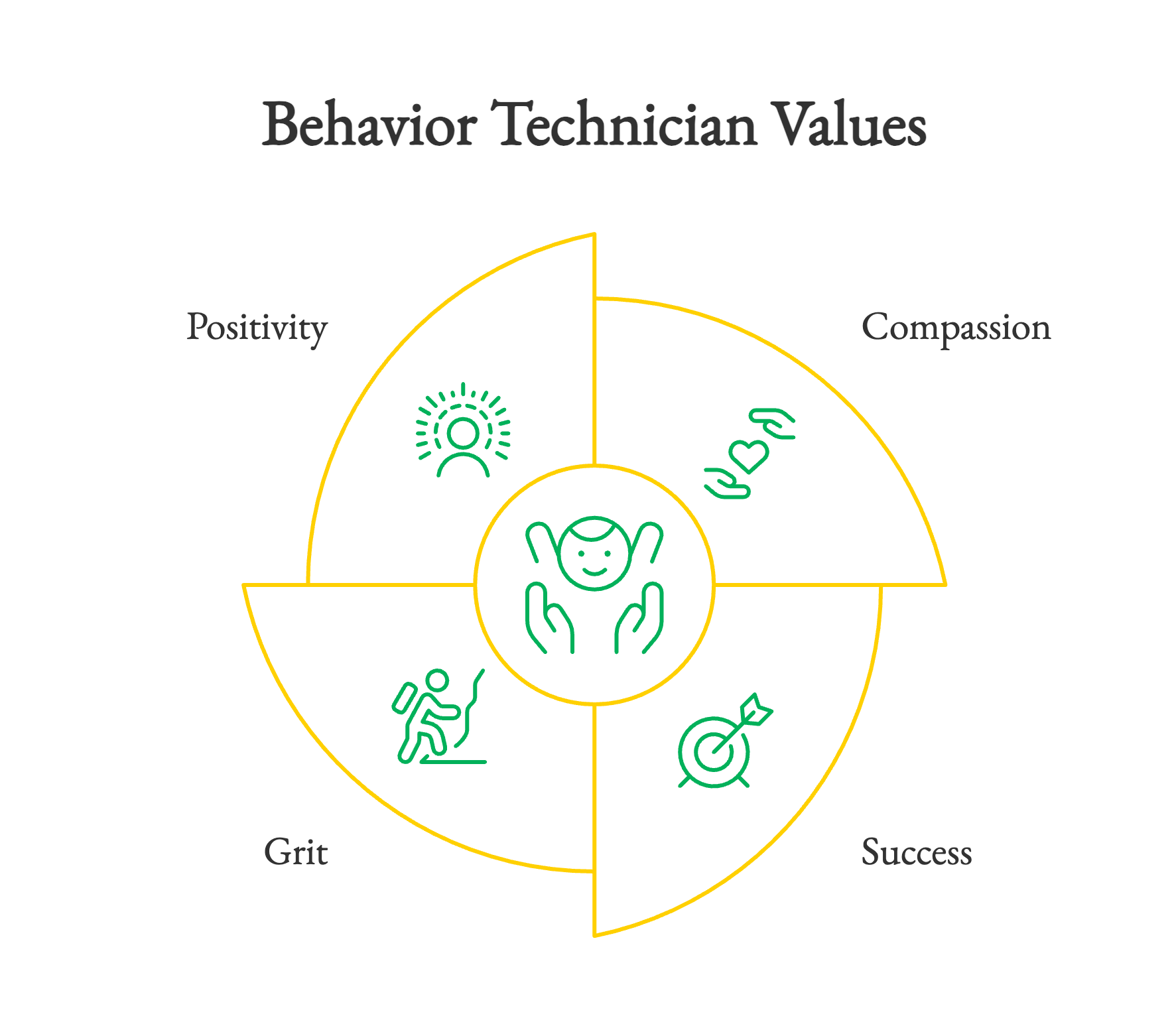
You likely already have more of the right qualities than you give yourself credit for: compassion baked into your bones, patience, and a real drive to see others succeed. Goals are your lifeblood, and you love seeing them through to the end (then creating new ones to achieve).
Sound like you? If so, you'd make an excellent behavior technician. And that's a good thing, because supporting children with autism has never been more important. As a behavior technician, you're on the front lines of that support. You're a go-to resource, safe space, and kind ally for the children and families you work with.
There's a continual, growing need for people like you. Being a behavior technician is a great way to start your career in behavioral health. It's flexible, rewarding, and at Behavior Frontiers, contains clear paths to advancement so you can reach your goals too.
Understanding the Role
Behavior technicians are the heartbeat of Applied Behavior Analysis (ABA) therapy programs. Your days are filled with hands-on work implementing individualized behavior plans, collecting detailed data to track progress, and providing one-on-one support to your clients.
In this field, you can work in diverse settings (clinics, homes, schools, community environments), wherever children, teens, and young adults with autism need behavioral support. You'll collaborate closely with a Board Certified Behavior Analyst (BCBA) who provides supervision, guidance, and ongoing support. You’ll never work on an island and always have expert backup when you need it.
Basic Requirements to Become a Behavior Technician
Getting started as a behavior technician is straightforward and doesn't require years of college or advanced degrees. This career path is accessible to most people who are passionate about helping others.
Here are the basic requirements to start:
- You must be 18 years or older.
- You should have a high school diploma or GED before considering it.
- You need to be able to pass a criminal background check.
While a college degree isn't always required for entry-level positions, some employers prefer candidates with coursework or experience in psychology, special education, or related fields. However, don't let the lack of a degree hold you back. Many successful behavior technicians start with just their high school diploma and a desire to help.
The RBT Certification Path: What You Need to Know
First off, it’s important to know you don’t necessarily need an RBT certification to work as a behavior technician. Needing a certification depends on the state you work in and the specific insurance plans your employer works with. Some states require it, and others don’t.
At Behavior Frontiers, if your state or insurance plan requires RBT certification, we'll support you through that process once you pass field training. So all RBTs are BTs, but not all BTs are RBTs, and that's completely okay.
For those who do need to pursue an RBT certification, here’s how the process works.
Step 1: Complete 40-Hour Training Program
Your path begins with a 40-hour training program that covers information you need to get started. This comprehensive training dives into ABA fundamentals, professional ethics, data collection methods, skill acquisition techniques, and behavior reduction strategies.
At Behavior Frontiers, we provide comprehensive and thorough training to all new technicians. Our new Behavior Technicians complete a series of training consisting of about 40 hours, followed by an exam.
Our onboarding program and the RBT certification training are two separate things (they just happen to be the same length). After completing onboarding, new technicians begin field training by shadowing an experienced behavior technician in our state-of-the-art centers or in client homes. If RBT certification is required based on your state or insurance plan, we'll walk you through that process after you pass field training.
Step 2: Pass Competency Assessment
While book learning sets the foundation, eventually, the real test is applying those skills in real-world settings. So, after completing in-class training, a competency assessment is the next step.
A BACB-certified supervisor will conduct this initial assessment, observing performance with clients and evaluating the ability to implement ABA techniques correctly and ethically. This hands-on evaluation ensures readiness to work independently (though still under supervision) with the children and families who depend on their technician.
Step 3: Apply Through BACB
After completing your training and passing your competency assessment, it's time to make it official. You'll submit your application through your BACB account, providing documentation of your completed training and competency assessment.
Once submitted, you'll wait for BACB approval to schedule your exam. This administrative step ensures all your paperwork is in order before you sit for the certification test.
Step 4: Pass the RBT Exam
The final hurdle is the RBT exam itself. This test evaluates your understanding of ABA principles, ethics, and practical application of behavior intervention techniques.
Once you pass, you become a certified Registered Behavior Technician. This certification allows you to work in autism and ABA settings under the supervision of a BCBA, and many employers recognize it across the country.
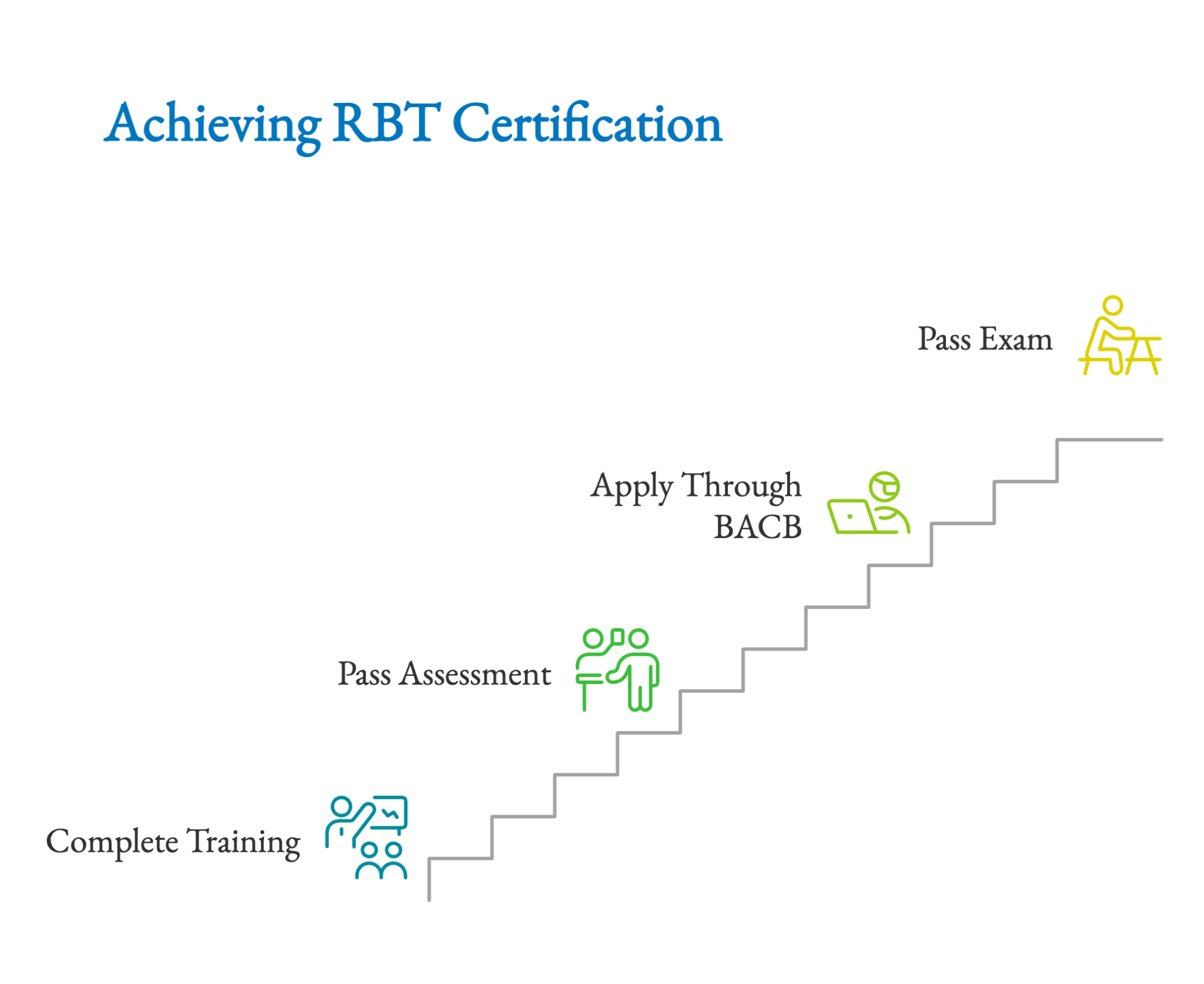
From starting the 40-hour training to receiving RBT certification, the entire process typically takes anywhere from a few weeks to a couple of months. It all depends on scheduling, employer support, and how quickly the BACB processes the application. For many, it's one of the fastest routes for starting your career in behavioral health.
Finding Employment
The behavioral health field continues to grow. In fact, the Bureau of Labor Statistics projects 17% employment growth from 2024 to 2034 for behavioral and mental health counselors, with about 48,300 annual openings on average. ABA therapist roles are included within this broader behavioral-health demand, which means opportunities are plentiful for qualified candidates.
You'll also notice this role goes by several names. It could be called a Behavior Technician (BT), Behavior Therapist, or ABA Therapist. But don't let the different titles confuse you, they all describe the same role.
As you build your resume, highlight any experience or strengths you have that relates to this work:
- Working with people with disabilities (even volunteer work or informal caregiving)
- Working with children in general
- Having flexibility
- Active listening
- Attention to detail
- Consistency
- Empathy and patience
Many companies (like Behavior Frontiers) also actively hire college students, offering flexible scheduling that works around classes. This makes it an ideal job for students pursuing degrees in psychology, special education, or related fields.
On-the-Job Training
Even after you complete your formal training and certification, your education is ongoing. Field training is where you'll truly develop your skills and confidence.
Most employers have you shadow experienced behavior technicians when you first start. You'll observe how they interact with clients, implement behavior plans, collect data, and handle challenging situations. A classroom setting could never replace this hands-on experience with a real client. No book can fully prepare you for the nuanced dynamic of working with children and families.
The good news is that ongoing support makes it easier to start even if you're completely new to the field. You'll have experienced colleagues and BCBA supervisors available to answer questions, provide feedback, and guide you as you grow into your role.
If you want to see what a typical day looks like, check out our article describing a day in the life of a behavior technician.
Career Growth and Advancement
Starting as a behavior technician doesn't mean you'll stay in that role forever (unless you want to). The ABA field offers pathways for advancement if you're interested in growing your career. Also, maintaining your RBT certification will be important, as you must stay current with the latest research and best practices in the field.
Take Daniela Torres, who started her journey with Behavior Frontiers five years ago as a behavior technician. "I remember feeling so excited learning all about ABA—it was a whole new world to me," says Torres. Like many new hires, she felt the nerves of early field training, but found her footing quickly: "Behavior Frontiers has a community of strong and committed clinicians and administrative staff to help guide, train, and support me at every turn."
As you gain experience and build your skills, you might decide to pursue more advanced credentials. Many behavior technicians eventually pursue BCBA certification, which requires a master's degree and supervised fieldwork hours.
Others pursue related degrees in psychology, special education, or social work. Daniela lived that out, moving from BT to Senior BT, then Training Coordinator, then Case Manager, before earning her Master's of Education with an emphasis in ABA from Arizona State University. "Behavior Frontiers stood behind me as I set lofty educational and career advancement goals," she says, "and the company made it possible for me to balance my work, school, and supervision hours."
The long-term opportunities are yours for the taking. The ABA field offers a clear pathway from entry-level positions all the way to leadership roles, clinical director positions, or private practice. Your career can grow as much as your ambition and dedication allow.
Start Your Path Towards Becoming a Behavior Technician Today
If you see yourself in between the words of this article, take a moment to pause and think. Do you see yourself taking that first step? The children and families who need your support are waiting.
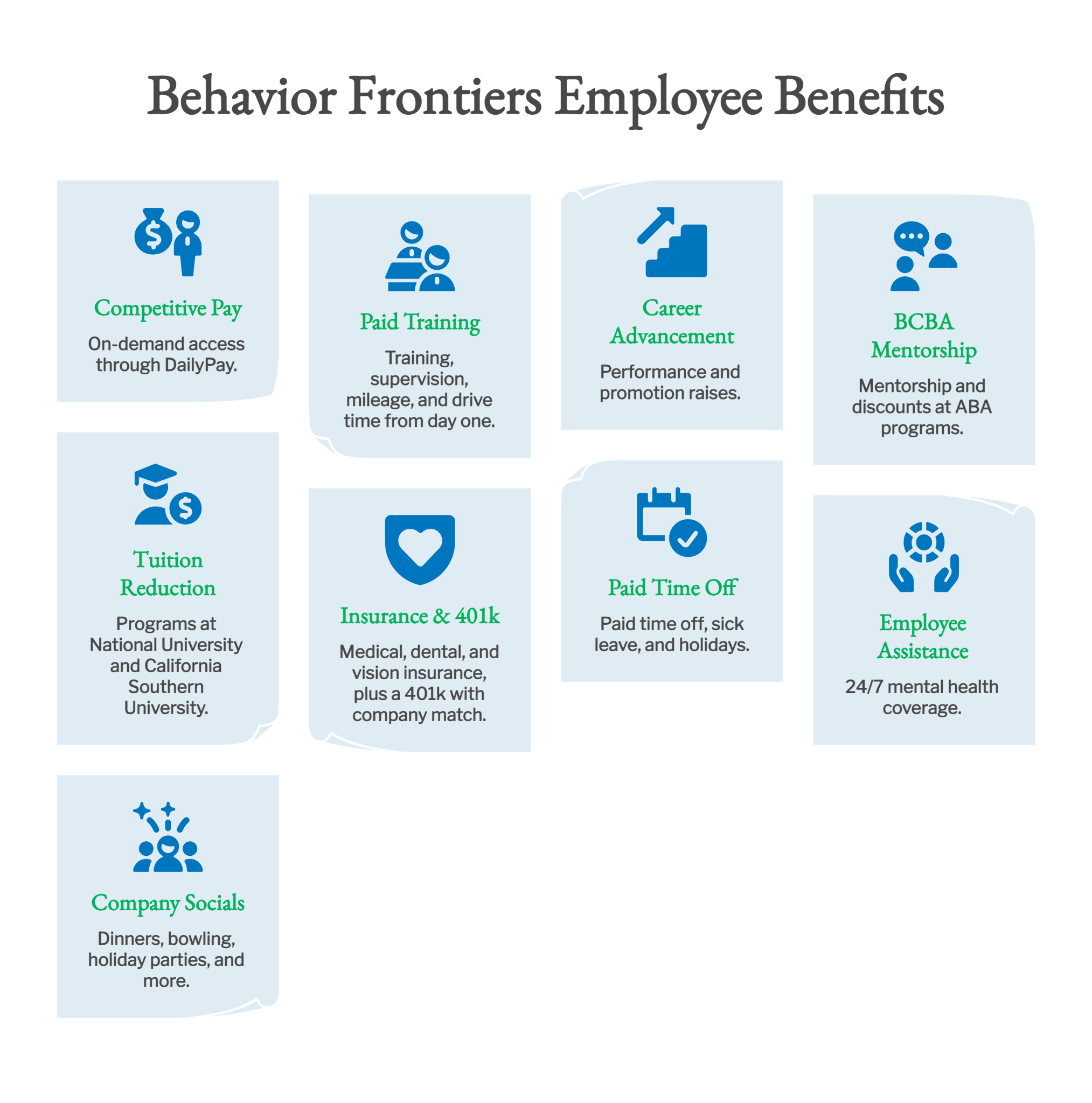
At Behavior Frontiers, we always take care of our people. Here's what you can expect:
- Career advancement opportunities with performance and promotion raises through our Behavior Analyst Fellowship Program
- Competitive pay with on-demand access through DailyPay
- Paid training, supervision, mileage, and drive time from day one
- BCBA mentorship and discounts at select ABA master's and certificate programs
- Tuition reduction and graduate school support at universities like National University and Drexel University
- Medical, dental, and vision insurance, plus a 401k with company match (full-time employees)
- Paid time off, sick leave, and holidays (full-time employees)
- Employee Assistance Program with 24/7 mental health coverage
- Regional company socials with dinners, bowling, holiday parties, and more
Ready to make it happen? Contact Behavior Frontiers to learn more about joining our team and starting your career as a behavior technician.
Frequently Asked Questions: About How to Become a Behavior Technician
“Do I need a degree to become a behavior technician?”
No degree is required to get started. Most entry-level positions only require a high school diploma or GED, a background check, and the drive to help. Some employers may prefer coursework in psychology or special education, but it's never a hard requirement.
How long does it take to get RBT certified?
From starting the 40-hour training to receiving certification, the process typically takes a few weeks to a couple of months depending on scheduling and BACB processing time. It's one of the faster routes into a full-time career in behavioral health.
What's the difference between a Behavior Technician, ABA Therapist, and Behavior Therapist?
There is little difference between these titles. They are often used interchangeably across employers and regions, but they typically describe the same role, which is implementing ABA therapy under the supervision of a BCBA.
Is there room to grow as a behavior technician?
Absolutely. Many behavior technicians go on to become Senior BTs, Case Managers, Supervisors, and BCBAs. Behavior Frontiers offers a clear advancement path through its Behavior Analyst Fellowship Program, actively supporting growth through mentorship, tuition programs, and flexible scheduling.
“What if I've never worked in healthcare or behavioral health before?”
That's completely okay. Most employers like Behavior Frontiers provide comprehensive paid training from day one, and field training pairs new technicians with experienced colleagues before working independently.