

Does My Child Have Autism? How to Get an Autism Diagnosis

%2013.avif)

Researching autism diagnosis is heavy with importance, worry, and anticipation—almost every emotion imaginable. And because your child sparkles with originality, their path to diagnosis will be just as unique as they are.
The process can be complicated and traditionally take a long time. But, there are many options to consider as you walk this road (and ways to accelerate it). We're here to help clear the fog and provide the support you need while navigating this.
Always remember, the path towards an autism diagnosis is only the vehicle. Once you arrive at your destination (the diagnosis), you'll unlock all the care and support your child deserves.
When to Seek an Autism Diagnosis
The first whisper of concern might come from you, your pediatrician, a teacher, or someone else in your child’s life. Wherever it originates, trust it. Early recognition opens the door to early support, and it can make all the difference for your child.
Early Signs and Developmental Concerns
Autism shows up differently in every child, but there are common patterns and early signs worth watching for.
Communication differences you might notice:
- Delayed speech: Developmentally, their speech and language may be behind.
- Difficulty with back-and-forth conversation: Whenever you attempt to have a conversation with them, they may struggle to produce replies.
- Unusual speech patterns: Maybe your child speaks fluently but struggles with the natural rhythm of dialogue.
- Communication regression: Your child was hitting speech milestones, but stopped or lost skills they already developed (like words they used to say all the time).
Social interaction differences:
- Limited eye contact: They may not be able to maintain eye contact with anyone.
- Difficulty forming peer relationships: They don’t understand how to build peer relationships, and may avoid it.
- Reduced social engagement: They seem content playing alone as opposed to seeking out playmates.
- Social behavior regression: They were once warm and engaged with familiar people but now seem withdrawn or indifferent. They also may have loved to initiate play, but now show little or no interest.
Behavioral patterns:
- Repetitive movements or behaviors: This could be hand flapping, vocal sounds, or anything else repetitive.
- Intensely focused interests: Some children have intense interest in certain subjects like trains, literature, shapes, animals, etc.
- Strict adherence to routines: They may have big emotions when a daily routine needs to change on a dime.
Sensory sensitivities:
- Bright colors or lights: Some children find bright lights or colors overstimulating.
- Certain textures: Others may find specific clothing fabrics, tags, or foods unbearable.
- Loud spaces: Overly noisy or crowded areas may cause them to elope or have big emotions.
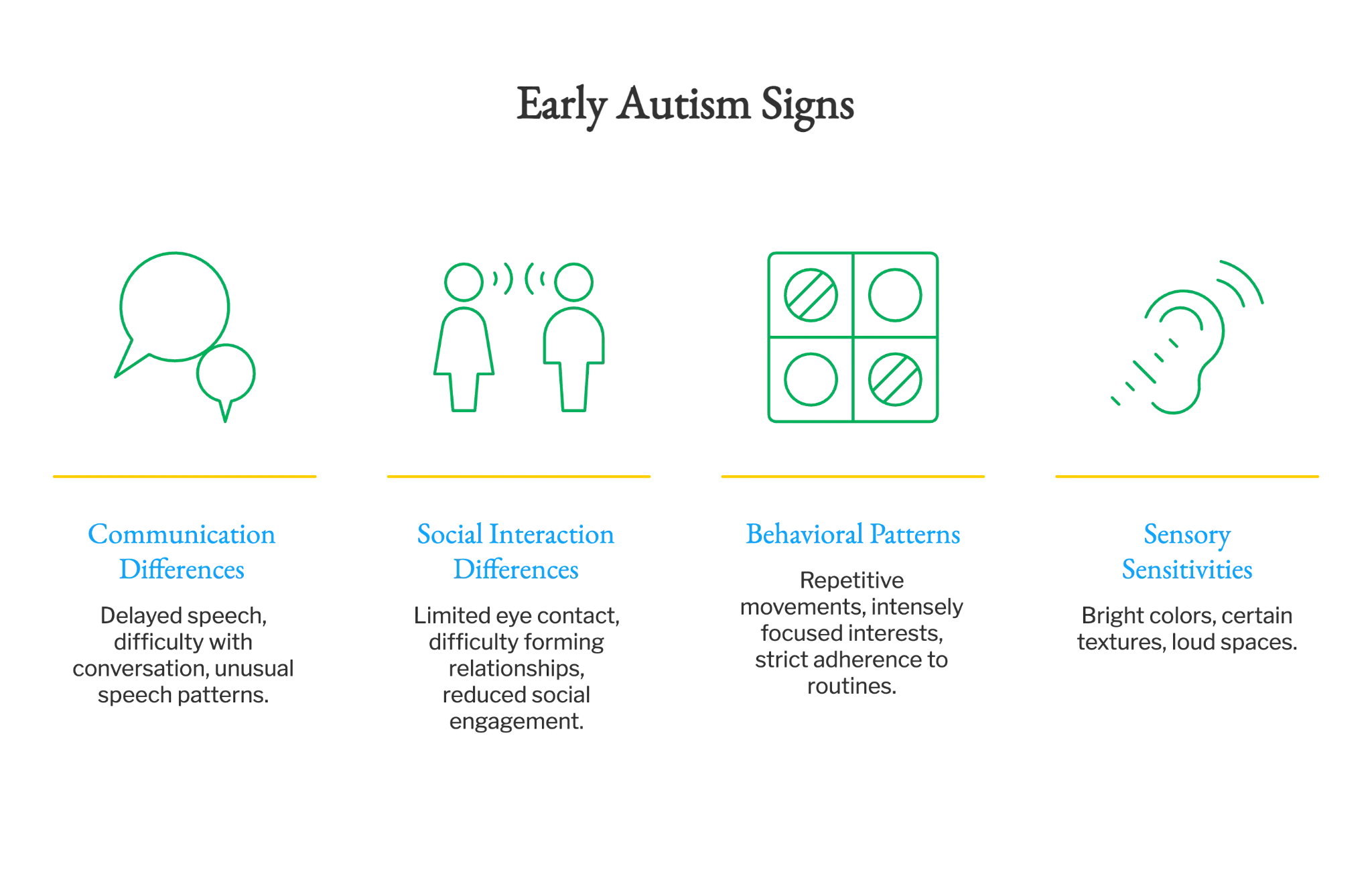
Early autism signs.
Ongoing, long-term research supports the benefits of early autism diagnosis. A child’s brain plasticity is highest at younger ages (2-5 years old). So, taking advantage of this critical window produces better outcomes for your child. During these years, their brain is incredibly responsive to learning and forming new pathways. So, earlier access to support like Applied Behavior Analysis (ABA) therapy means more hope for progress.
That said, if your child is older and you’re looking into a diagnosis, it’s not too late. Many older children (even adults) receive their diagnosis later in life and make meaningful progress with the right support. The window may look different, but it’s never closed.
Understanding the Autism Assessment Process
A thorough autism assessment examines multiple areas of your child's development through observations, parent interviews, standardized testing, and review of medical and developmental history. The evaluation looks at communication skills, social interactions, behavioral patterns, and sensory processing.
Only certain qualified professionals can provide an official autism diagnosis. These include licensed psychologists, neuropsychologists, developmental pediatricians, and psychiatrists.
They will likely use (but not limited to) these diagnostic tools:
- The ADOS-2 (Autism Diagnostic Observation Schedule)
- CARS-2 (Childhood Autism Rating Scale)
- ADI-R (Autism Diagnostic Interview-Revised)
The traditional route through the healthcare system often takes six months to one year from initial concern to official diagnosis. Some families wait even longer.
These long delays aren't ideal. High demand for evaluations, limited numbers of qualified specialists, and complex insurance authorization processes all contribute to this issue. And unfortunately, these delays postpone access to early intervention.
If you’re at a loss, we may be able to help. If you’re committed to starting ABA therapy following a diagnosis, you may qualify for a referral to Behavior Frontiers’, partner network of licensed diagnosticians, so you can get access to an autism diagnosis in as little as four weeks.
How to Get an Autism Diagnosis for Your Child: Step by Step
Let’s make the autism diagnosis process a bit more digestable, and break it apart step by step.
Step 1: Document Your Concerns
Before your first appointment, it’s helpful to collect information. Diagnosticians can only work with what they can see. So, a single visit rarely gives them all the information they need to make a diagnosis. The more concrete evidence you can gather, the more likely you’ll receive an accurate diagnosis.
Here’s a little detective work that may help:
- Keep detailed notes. Capture specific behaviors, developmental differences, and when they occur. Write down what you observe, the context, and how often it happens.
- Record short videos. This can show patterns to professionals. Sometimes behaviors that happen frequently at home don't show up during a brief office visit. Videos provide concrete evidence of your concerns.
- Gather feedback from teachers, daycare providers, or other caregivers. They might notice patterns you haven't seen or confirm your observations.
- Review developmental milestone checklists for your child's age. This helps you identify specific areas where your child might be developing differently.
Step 2: Talk to Your Pediatrician
Your pediatrician is typically your first official stop. Share your documented concerns and ask for a developmental screening. Common screening tools include the M-CHAT (Modified Checklist for Autism in Toddlers) and ASQ (Ages and Stages Questionnaire).
Request referrals to specialists who can conduct comprehensive evaluations. This step is often required by insurance companies before they'll authorize further testing, so don't skip it even if you're planning to pursue other diagnostic routes.
Step 3: Verify Insurance Coverage
Before scheduling evaluations, call your insurance company to understand your coverage. Most major insurance plans include autism diagnosis as a medically necessary service, but the specifics may vary.
Step 4: Choose Your Diagnostic Path
You have options. Each comes with different timelines, costs, and processes.
Option A: Traditional Route Through Healthcare System
This path involves a referral to a developmental pediatrician or hospital-based autism clinic. Insurance usually covers this, and you're working within an established healthcare system with coordinated care.
A significant drawback is wait time. Six months to one year is common, and some areas have even longer waits.
Option B: Private Practice Diagnosticians
Licensed psychologists or neuropsychologists who specialize in autism often have private practices. They sometimes offer faster appointments than traditional or hospital-based clinics.
However, they may be out-of-network with your insurance, leading to potentially higher out-of-pocket costs.
Option C: Fast-Track Through ABA Provider Partnerships
Some ABA therapy providers have partnered with diagnostic specialists specifically to reduce wait times. Behavior Frontiers, for example, partners with licensed diagnosticians who can often provide comprehensive evaluations much faster, if you are ready to start ABA therapy following a diagnosis.
Step 5: Schedule and Prepare for the Evaluation
Once you've chosen your path and scheduled the evaluation, these preparation tips help everything go smoothly.
- Bring documents. These include medical records, school reports, and any completed questionnaires the evaluator requested. The assessment typically takes 2-4 hours and may be split across multiple appointments depending on your child's age and needs.
- Prepare your child in age-appropriate terms. For example, for younger children, you might say they're going to “play some games with a new friend.”
- Bring comfort items. A favorite toy, snack, or blanket can help your child feel secure in an unfamiliar environment.
- Be ready for questions. You know your child best. The evaluator will have you discuss your child's history, current concerns, family medical history, and day-to-day routines. The more specific and honest you can be, the more accurate the evaluation.
Step 6: Receive the Diagnosis and Report
After the evaluation, you'll receive a comprehensive written report detailing the evaluator's findings. This report includes a clear diagnosis based on your child's unique strengths and challenges and specific recommendations for next steps.
This document is the key which unlocks the services your child needs. Make sure to keep multiple copies. You may need them for insurance authorization, school IEP meetings, and coordinating various therapies.
Step 7: Understand Your Next Steps After Diagnosis
An autism diagnosis is just the beginning. And, honestly, this is good news!
After that confirmed diagnosis, you can start stirring up all the support:
- Therapy services: ABA therapy may be recommended for skill building and meaningful progress. This is where your child will work on communication, social interaction, emotional regulation, and independence. It builds a strong foundation over time that they will carry with them.
- Educational support: An autism diagnosis often makes children eligible for an IEP (Individualized Education Program) or a 504, which provides accommodations in school settings.
- Support resources: Join parent support groups, local and national autism organizations, and online communities.
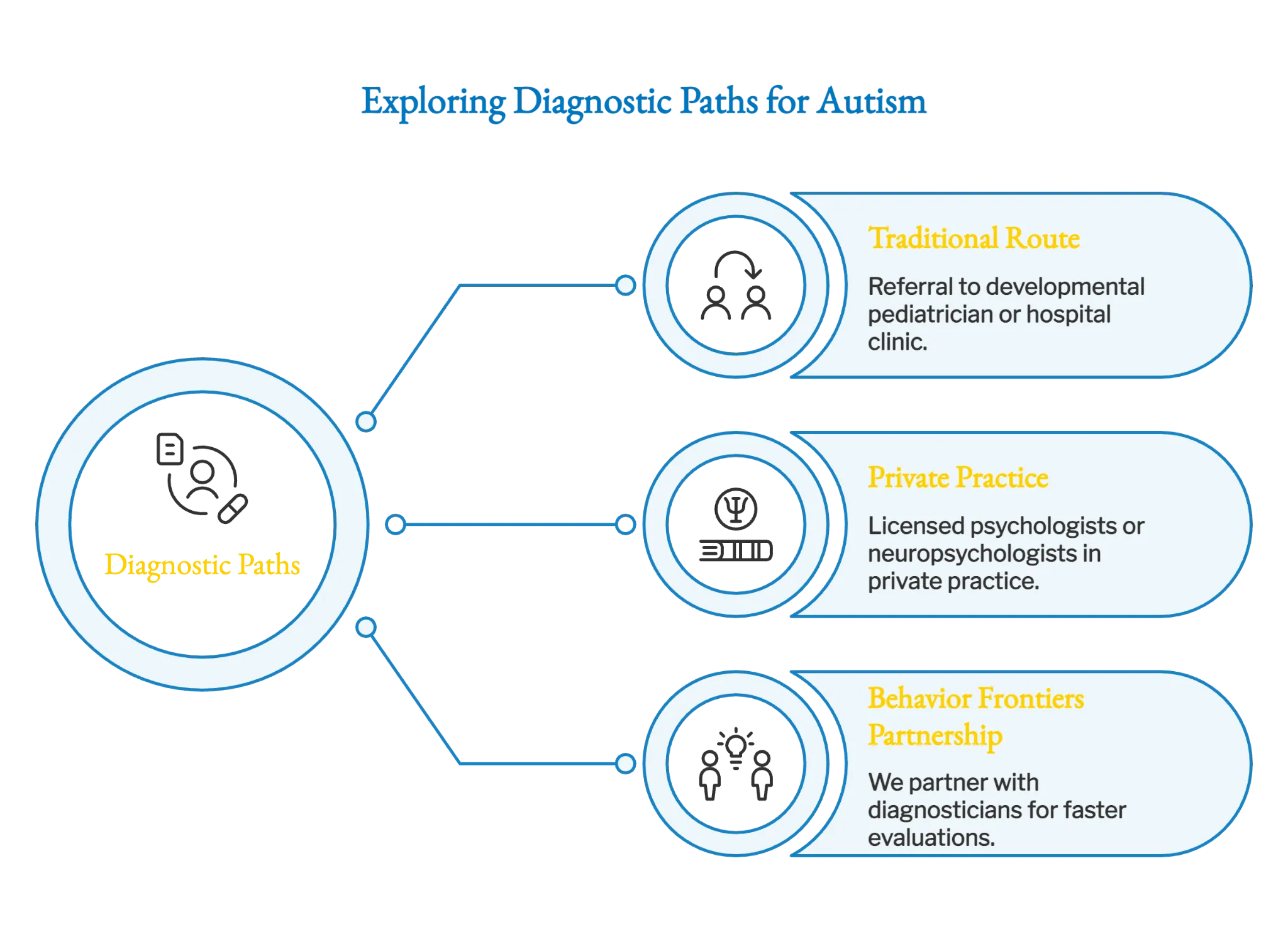
Three autism diagnosis paths.
Behavior Frontiers Can Help You Take Steps Towards Autism Diagnosis
You’re not imagining the obstacles that come with autism diagnosis. Long wait times delay care when every week counts. Insurance navigation is genuinely complex, and finding qualified diagnosticians in your area can be challenging. And uncertainty about next steps after diagnosis leaves many families feeling stuck.
But these barriers aren't impossible to climb. Knowing they exist helps you plan around them and find the fastest, most effective path forward for your unique situation.
Ready to take the first step towards an autism diagnosis? At Behavior Frontiers, we can help.

Behavior Frontiers partners with diagnosticians.
We offer:
- Fast-track diagnosis: We partner with diagnosticians who can provide evaluations in as little as 4 weeks, if you’re ready to start ABA therapy following a diagnosis.
- Seamless transition: We handle insurance submissions and FBA authorization.
- Comprehensive care: From diagnosis through treatment, we walk alongside your family with one coordinated team.
Get started with our diagnostic services today!