

The Levels of Autism: Understanding ASD Severity Levels
%2013.avif)

An autism diagnosis is never one-size-fits-all.
When your child receives an autism spectrum disorder (ASD) diagnosis, it means two things:
First, their brain is wired differently in its own remarkable way, marked by social-communication differences and restrictive or repetitive behaviors.
Second, your family now has a clearer path to the support they may need.
Part of that path includes understanding autism levels, which help describe how much support your child may need day-to-day. These levels exist to help you, your child's care team, and schools understand what kind of support your child needs, and how much. They're not a ceiling on what your child can achieve. They're simply a starting point for building the right plan around them.
There are three levels:
- Level 1 - Requiring support
- Level 2 - Substantial support
- Level 3 - Very substantial support
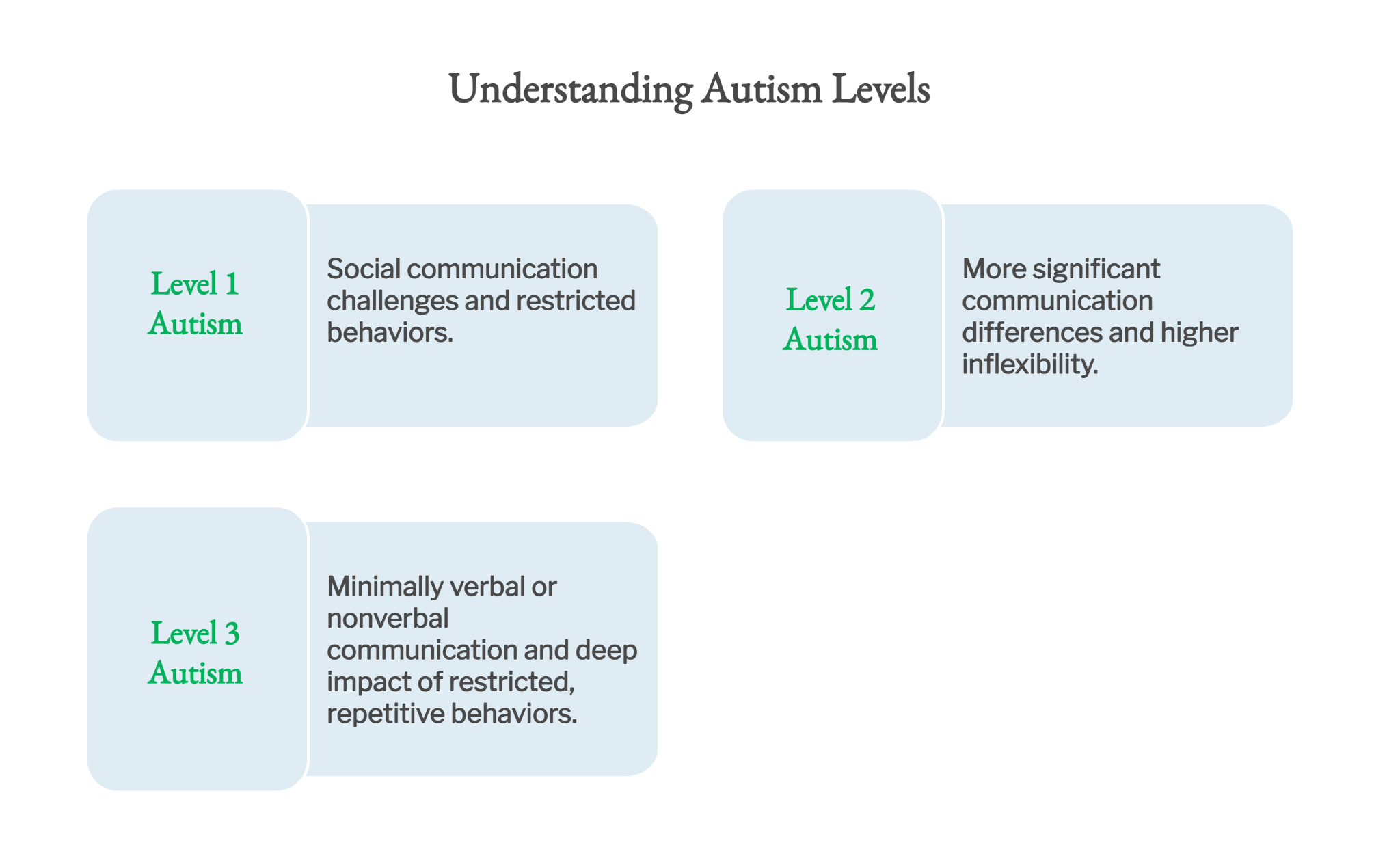
Understanding the three autism levels.
Levels of Autism: Blueprint for the Right Support
Determining which level of support your child needs is a guided, intentional process. The American Psychiatric Association (APA) released the Diagnostic and Statistical Manual of Mental Disorders (DSM-5), which is the handbook clinicians use to diagnose autism and determine support levels.
Included in the manual are three Autism Spectrum Disorder levels of severity. Each level is analyzed under two lenses: social communication and restricted, repetitive behaviors.
Where your child lies within these levels is unique to them. Just because two children are on the same level doesn’t mean they have the same goals, strengths, or even behaviors. Autism is wildly specific to the individual, which is why levels are used in the first place. They allow clinicians to be flexible, responsive, and thorough in understanding your child completely.
Level 1 Autism: Requiring Support
Social communication: If your child is at this level, they may speak in full sentences and engage in communication, but back and forth conversation might be uncomfortable and difficult to sustain. They may struggle to start interactions the way peers do, and forming ongoing friendships is challenging, even when the desire to connect is there.
Restricted, repetitive behaviors: At this level, your child may be rigid when it comes to transitions. For example, your kiddo may struggle to change plans at the last minute or switch from a preferred activity to an undesirable one. Organization and planning difficulties may also limit independence (i.e. - being unable to maintain a clean space to locate clothes).
What this looks like in ABA therapy: For children at Level 1, ABA therapy often focuses on building social communication skills, increasing flexibility around routines and transitions, and developing independence. Sessions may be less intensive in hours, but highly targeted. For example, your child may work on skills such as initiating conversation, navigating peer relationships, or managing unexpected changes. Every child’s plan is built around their unique needs and goals, not just their autism support level.
Level 2 Autism: Requiring Substantial Support
Social communication: At this level, your child will likely have more significant communication differences. They may use simple sentences, initiate social interactions far less frequently, and communicate primarily about specific interests. For example, your child may talk at length about animals, like the speed of a cheetah, but is unable to answer a question like, “How do you feel today?” Verbal responses to others may seem limited.
Restricted, repetitive behaviors: Inflexibility is higher at this level, and difficulty with change can derail the entire day. Repetitive behaviors are more frequent and likely to impact all of your child’s environments (home, school, community).
What this looks like in ABA therapy: For children at Level 2, ABA programs usually involve more hours per week and a broader range of goals. This could mean building greater tolerance for change, reducing repetitive behaviors that interfere with daily life, or navigating school and community settings. At this level, additional caregiver training may be recommended to help your child’s skills grow across all environments.
Level 3 Autism: Requiring Very Substantial Support
Social communication: At this level, your child may be minimally verbal or nonverbal. Meaning, they might have a few words (or intelligible speech), and almost never start a social interaction. Responses to direct social approaches (like a familiar adult saying their name or offering a favorite toy) may be short and limited. Communication at this level may require alternative or augmentative support to be most effective.
Restricted, repetitive behaviors: Transitions, changes in environment, and unexpected disruptions deeply impact each routine and moment of the day. These behaviors impact your child’s ability to function across many aspects of their life.
What this looks like in ABA therapy: Children at Level 3 might have more hours of ABA therapy to help them reach specific goals. They may have more goals to reach or need more time to develop certain skills. For example, if they are assessed as Level 3 for both social communication and restricted, repetitive behaviors, their care plan will be built to accommodate that. They might work on foundational communication skills (perhaps using AAC devices), daily living skills (such as toileting and brushing teeth), safety skills, and strategies for managing sensory challenges.
Why The Levels of Autism Can Be Misunderstood
The levels of autism are easy to misread. Many parents see them as a straight line. But, we’d like you to rethink it. Because, really, the levels of autism are descriptors of support needed to allow your child to reach goals. And these needs will likely change over time.
Here are a few examples:
- A child may need Level 2 support at age four, but only Level 1 support by age 10
- A child may need support throughout their life, with the level of support changing across different stages of life
- A child may need Level 1 support for social communication, but Level 3 support for repetitive, restrictive behaviors
No two children have the exact same strengths and challenges. Which is why these levels operate in shades of gray, allowing for flexibility. Two children at the same level across both criteria may still have completely different goals. The relationship between autism severity and day-to-day life is layered and deeply individualized.
The levels of autism mirror the true nature of autism: wildly specific to the person experiencing it.

Levels of autism mirror the nuanced nature of the person experiencing autism.
Common “Levels of Autism” Myths
Myth: Level 1 means “mild autism” and therefore doesn’t require much attention.
Children requiring Level 1 support still receive life-altering interventions that improve their social life, academic experience, and emotional well-being. So, “requiring some support” doesn’t equal “barely needs anything.” It means they receive the right amount of support consistently.
Myth: Level 3 means your child cannot learn, communicate, or improve.
Children with Level 3 autism make meaningful progress every day with the right support. While their behaviors may look different than children on Level 1 or 2, it doesn’t mean they are unable to make progress..
Myth: Autism severity levels are permanent or fixed for life.
Levels of autism are a starting point for your child’s current support needs. The levels aren’t a forecast into your child’s future. In fact, as children grow, receive intervention, and develop new skills, their support needs evolve.
Myth: Language ability and autism severity are the same thing.
Severity levels account for the full scope of social communication and behavioral patterns, not just whether your child is verbal or nonverbal. Many factors, such as the frequency and intensity of behaviors or the effectiveness of their communication, go into making this decision.
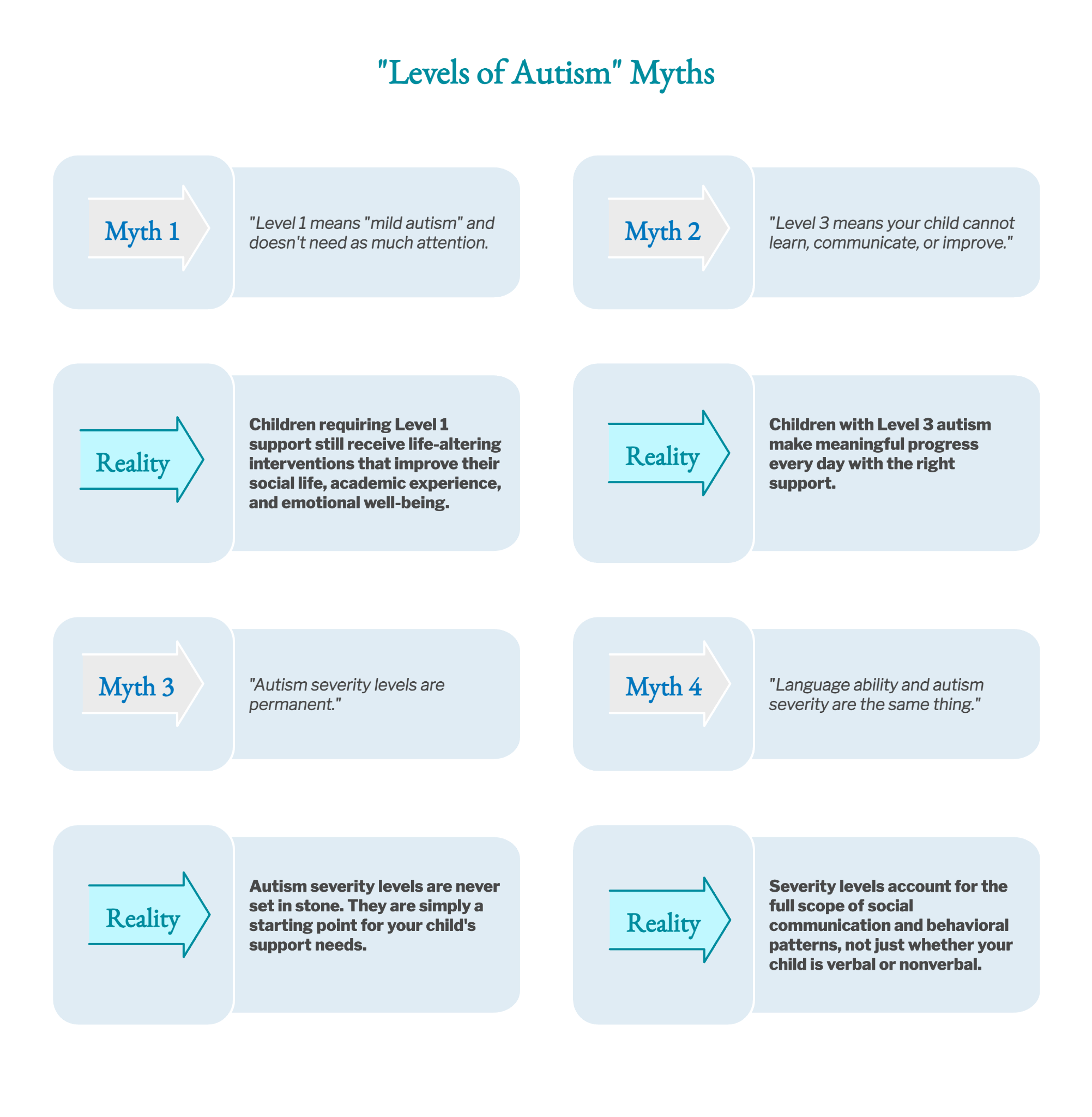
There are a few myths when it comes to levels of autism.
Levels of Autism Help Us Support Your Child Better
Autism severity levels help clinicians describe your child’s support needs. However, they do not define your child’s abilities, worth, or future.
Autism is different for each person experiencing it. The levels simply give clinicians a way to mirror that individuality and adjust support as your child learns and grows.
At Behavior Frontiers, we use these levels as a compass to guide the support your child receives. Progress is always tracked in real time through PrioraCare™, our made-from-scratch data platform, so that every goal, every milestone, and every shift in support is intentional and data-driven.
With the right support, your child’s future belongs to them.
Ready to learn more? Reach out to us and after a brief intake, you'll be connected with a Board Certified Behavior Analyst (BCBA) to begin building a plan tailored to your child's unique needs.
Frequently Asked Questions
What are the three levels of autism?
The three levels of autism are defined by the DSM-5 and reflect the amount of support a person needs. Level 1 requires support, Level 2 requires substantial support, and Level 3 requires very substantial support. Each level is assessed across two areas: social communication and restricted, repetitive behaviors.
Can a child's autism level change over time?
Yes. Autism levels reflect current support needs, not a permanent diagnosis. As children grow, develop new skills, and receive consistent support like Applied Behavior Analysis (ABA) therapy, their support needs can shift. A child who starts at Level 3 may require significantly less support later in life.
What is the difference between Level 1 and Level 2 autism?
Level 1 involves challenges that become noticeable without support, particularly around back-and-forth conversation and social flexibility. Level 2 involves more significant communication differences and more frequent, disruptive repetitive behaviors that are visible even with support in place.
Does a higher autism level mean a child is less capable?
No. Autism levels describe support needs, not ability, intelligence, or potential. Two children at the same level can have completely different strengths and challenges. A level is a tool for building the right support plan, nothing more.
How is an autism level determined?
A licensed diagnostician or psychologist determines your child’s level of autism. The evaluation looks at social communication skills and the presence and impact of restricted, repetitive behaviors, and uses the DSM-5 criteria as the framework for diagnosis.