

What No One Talks About: The Link Between Autism and Depression

%2013.avif)

Most people know that autism affects how someone communicates and experiences the world — how they connect with others, process their surroundings, and move through daily life. But what fewer people know is that individuals with autism are significantly more likely to experience depression than their neurotypical peers. It's one of the most important connections in autism care (and one of the least discussed).
To understand why, it helps to step into what that daily experience can actually feel like.
Imagine playing a board game without knowing any of the rules. Naturally, you're curious about them, but no one takes the time to explain. So there you sit — unsure of yourself and a bit uncomfortable.
What if that happened to you every day?
For many children and adults with autism, navigating social interactions, sensory environments, and daily expectations can feel exactly like this (a game where everyone else seems to know the rules). And that daily reality helps explain why the connection between autism and depression is far more common than most people realize. Though they're often discussed separately, they're deeply intertwined. So let's bring them together and make sense of it.
The Connection Between Autism and Depression
Ongoing research shows the clear link between autism and mental health. The statistics are impossible to ignore:
- Up to 70% of individuals with autism experience at least one co-occurring mental health condition.
- Depression rates in teens and adults with autism are 2–3 times higher than in the general population.
- Over 40% may experience anxiety disorders alongside their autism diagnosis.
So, why does depression and autism commonly walk side-by-side?
Why Individuals with Autism Are More Vulnerable to Depression
Individuals with autism don’t fit what society calls “the typical mold.” They sparkle with individuality. At times, it’s clear that social rules, sensory environments, and communication expectations weren't built with them in mind.
So, can autism cause depression? Well, a direct answer to that doesn’t exist. But here’s what we do know:
Living this day-in-day-out reality can become emotionally uncomfortable, which may lead to depression and other mental disorders.
Sensory Overload and Chronic Stress
Everyday environments that most people find merely annoying can be genuinely overwhelming for individuals with autism. Loud sounds, bright fluorescent lights, crowded spaces, and unexpected touches can be more than a little uncomfortable.
Maybe the grocery store noise bothers them. Or the bright lights in the lunch room cause big emotions. That chronic sensory stress may contribute to anxiety and depression over time, however, receiving the right support can help teach them the skills needed to overcome this.
Social Communication Challenges
The game continues with social interactions. Individuals with autism often have different communication styles and social preferences. What comes naturally to most people (reading subtle facial expressions, understanding implied meanings, navigating the unspoken rules of conversation) can feel foreign.
Masking
Many people with autism naturally learn to “mask” (which is consciously or subconsciously suppressing your natural tendencies). For example, this might look like forcing eye contact even when they’re uncomfortable, mimicking social behaviors to “fit in” at school, or holding in big emotions until they get home.
On the surface, masking can look like your kiddo is progressing and reaching goals. But, underneath, they’re really exhausted. Spending the majority of the day “putting on a show” is emotionally taxing, and overtime could contribute to depression.
Emotional Expression Differences
Some individuals with autism have difficulty identifying or communicating their emotions, such as how to identify sadness or anger. Because of this, their feelings may go unrecognized or misunderstood. But with the right support in place, amazing progress can happen. Over time, your child can learn how to communicate their emotions, allowing them to feel heard and supported.
Recognizing Depression in Someone with Autism
Depression and anxiety show up differently alongside autism.
Typical depression symptoms may look something like this:
- Persistent sadness
- Verbal expressions of hopelessness
- Feeling emotionally flat
- Losing interest in hobbies
- General apathy
So, if you’re looking for the “typical” symptoms, you might miss identifying depression entirely. While some symptoms may be similar, emotional experiences and expressions can follow different patterns in autistic people.
Signs of Depression in Children and Teens with Autism
So what should you actually watch for?
Changes in Behavior Patterns
Behavioral changes can sometimes be subtle, but still show something is off. Knowing your child’s baseline behavioral patterns will help you understand if you need to dig deeper.
Look for:
- Increased withdrawal or isolation beyond their typical autism-related social preferences: For example, if a child who usually enjoys parallel play suddenly wants no interaction at all, that's worth noting.
- Increased “masking”: They are working harder to suppress their emotions or other traits to “fit in.”
- Loss of interest in previously enjoyed special interests or routines: For example, a child who obsessively collected facts about insects suddenly doesn’t want to anymore.
- Increased irritability, aggression, or self-injurious behaviors: Sometimes, this is their only way to tell you something feels wrong on the inside.
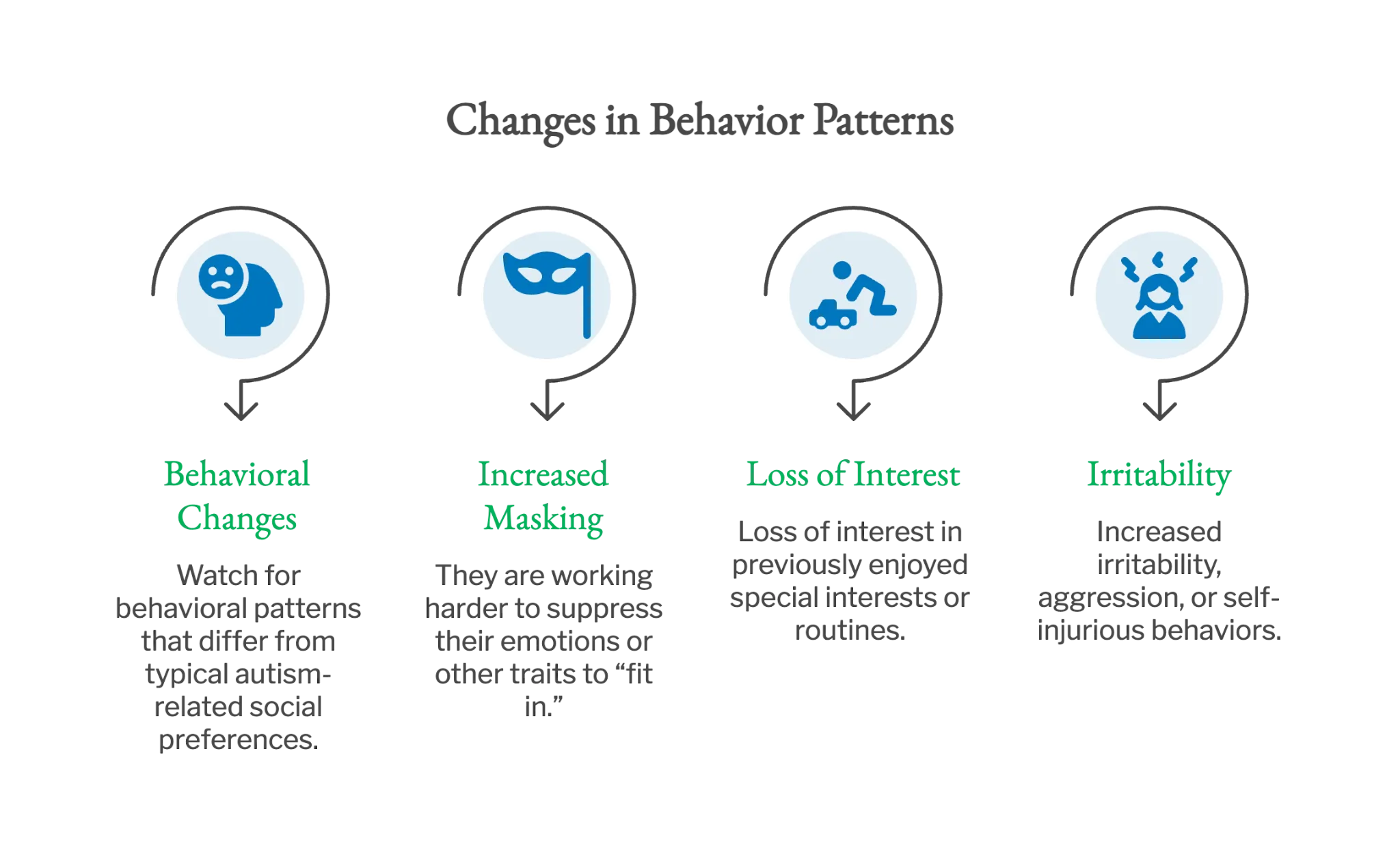
Changes in behavior patterns that may signify depression symptoms in children with autism.
Physical and Routine Changes
Depression shows up in the body, too. For those with autism, these physical symptoms can be easily overlooked. Sometimes, these issues may seem autism-related, not signs of depression. So, again, watch for changes that deviate from your child’s personal baseline.
Look for:
- Sleep disturbances: They may be sleeping far more than usual or having new difficulty falling or staying asleep.
- Appetite changes or eating difficulties: Having this may seem to stand alone and feel disconnected from sensory issues.
- Regression in skills they previously mastered: For example, your child learned and mastered self-care tasks and now doesn’t do them.
- Increased rigidity or resistance to changes in routine: This would be beyond what’s normal for your child’s baseline.
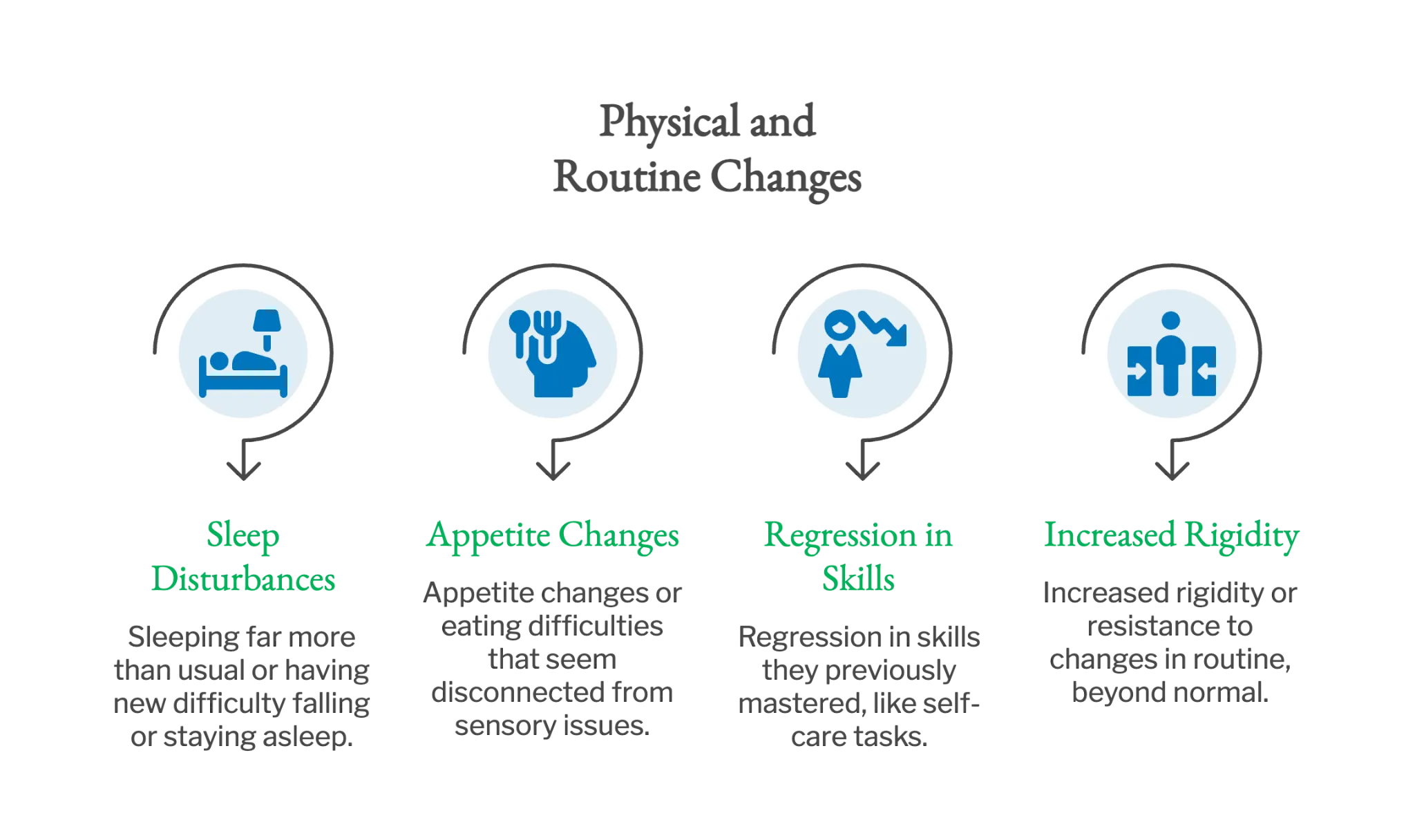
Physical and routine changes that may signify depression symptoms in children with autism.
Emotional Indicators
Since emotions may already be difficult to identify for your kiddo, sometimes, depression can hide beneath the surface.
Look for:
- Increased “big emotions” or lack of: This could include crying, sadness, or flat affect where emotional expression becomes even more limited than usual.
- Expressions of hopelessness or negative self-talk: For verbal children, listen for them saying things like this out loud.
- Increased anxiety or fearfulness: For nonverbal children, watch for this through body language and behavior.
Supporting Your Child's Mental Health at Home
As a parent, you are your child’s first layer of support. You are their safe space. The routines you keep, the spaces you create, and the atmosphere you curate reminds them they are loved, safe, and held.
Build a Supportive Environment
You can't eliminate all sensory stressors, but you can minimize them where possible.
Try these out:
- Create calm, quiet spaces. Use dimmer switches, provide noise-canceling headphones, and respect your child's sensory needs.
- Maintain predictable routines with visual support whenever possible. Keeping routines normal and visual tools readily available sets them up for success.
- Create designated safe spaces for emotional regulation. These are places your child can retreat to when overwhelmed. You can fill these spaces with some of your child’s favorite things, like toys, books, blankets, pillows, etc. .
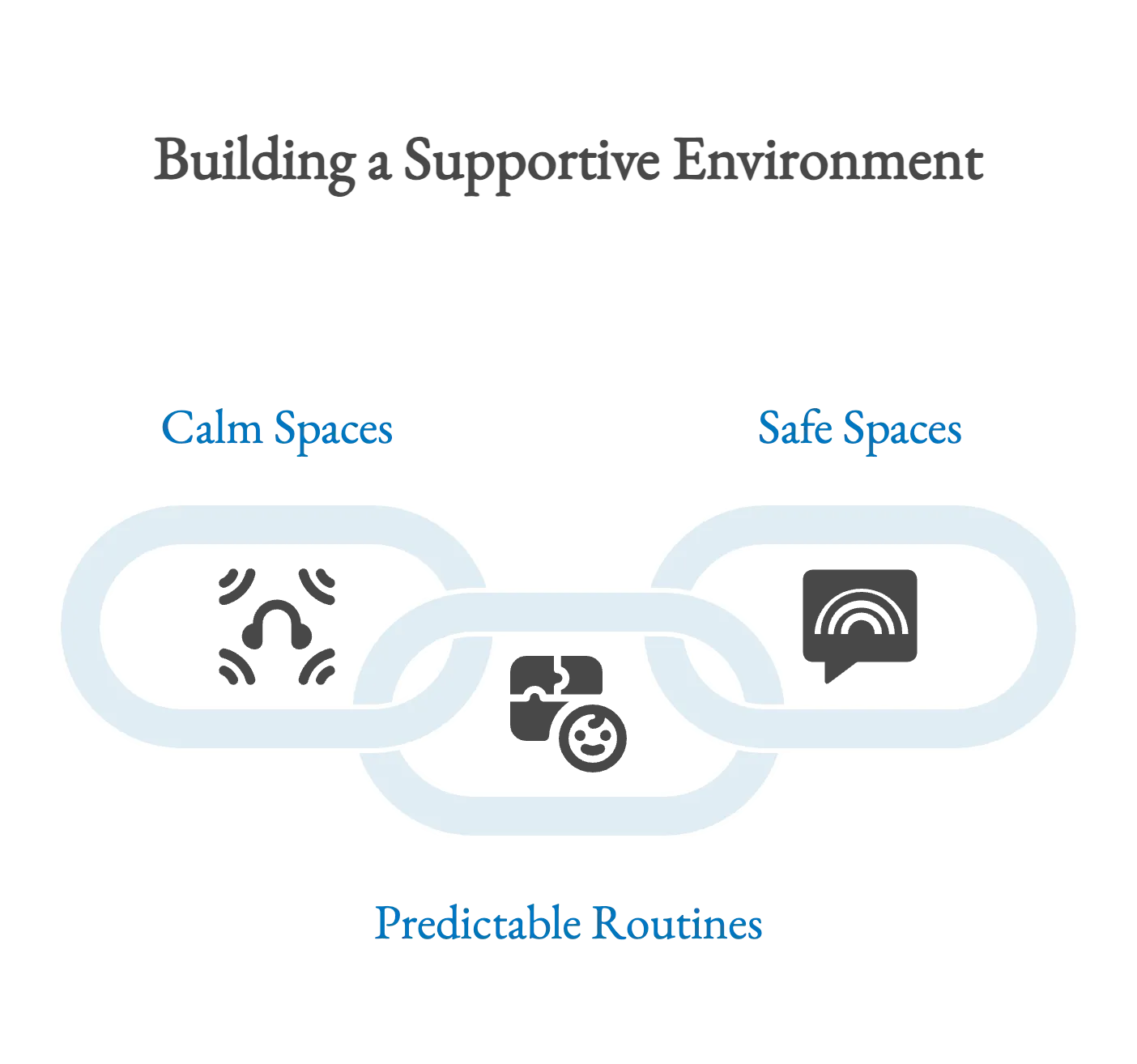
Building a supportive environment.
Foster Emotional Awareness and Communication
Building emotional awareness takes time for any child. Here are a few ways to help them build it:
- Teach emotion identification. You can give them visual tools like emotion charts or feelings scales. Try doing a daily emotional check-in as a routine.
- Model healthy emotional expression. Show your child what it looks like to identify, name, and appropriately express emotions.
- Allow your child to communicate feelings in their way. Let them choose how they want to communicate their emotions. Through words, pictures, typing, pointing, or other communication methods.
Consider ABA Therapy
You’re building the foundation of mental health support at home. Think of Applied Behavior Analysis (ABA) therapy as another vein extending from the heart of support (you). It’s a consistent and reliable current that keeps your kiddo on track for reaching goals—diving into the “why” behind their behaviors and aligning support with data.
At Behavior Frontiers, we provide compassionate, personalized care (whether that’s at the center or in-home) that meets each child exactly where they are. We’re dedicated to helping children with autism build skills they need for everyday life (which includes tending to their mental health).
Thousands of families have partnered with us to achieve meaningful milestones and lasting progress. We understand that supporting your child means addressing their whole experience, including their mental health.
Compassion is baked into every session with data as our guidepost. Our data-tracking platform PrioraCare™ ensures we keep measurable progress and adjust sessions as needed.
The Importance of Early Identification
It isn’t always possible to catch every sign the moment it appears. But, it’s also important not to wait until a crisis happens to do something. Within that space between “I notice something is off” and “we’re in a crisis” is exactly where the right support makes the biggest difference.
When depression goes unaddressed, it doesn’t typically stay contained. It will start to seep into the crevices of daily life.
It might look like this:
- Your child was progressing and reaching communication goals, but now lacks motivation and drive to keep going.
- Your child was thriving in school with new accommodations, but now refuses to go and continues to withdraw.
- Your child was sleeping and eating well, but now skips meals and has interrupted sleep every night.
Patterns like this tend to compound and make autism-related issues feel heavier and more difficult to manage. This is why detecting these patterns early-on helps in many ways.
That said, it's never too late. ABA therapy proves effective at any age for building coping skills and emotional regulation. Meaningful progress is always possible with the right support.
Support is Available for Autism and Depression
Depression is significantly more common in individuals with autism than in the general population. But, with enough support for your kiddo in all directions, they will always have someone to lean on.
Interested in starting ABA therapy? Reach out to us to get started! After a brief intake, you'll be connected with a Board Certified Behavior Analyst (BCBA) to begin your child's ABA journey and build a growth plan tailored to their unique needs.
Resources for Families
Mental Health and Autism Resources
- Autism Speaks Toolkits – Resources covering various topics to support individuals with autism and their families
- Child Mind Institute – Expert articles on anxiety, emotional regulation, and child development
- The Autism Society – Community support, education, and advocacy
- National Institute of Mental Health (NIMH) – Research and insights on co-occurring conditions
- Behavior Frontiers ABA Therapy – Compassionate ABA services supporting both emotional and developmental progress
Support for Parents and Caregivers
- Autism Speaks Resource Guide – Searchable directory of local and national services
- Autism Speaks: Grants for Families – Grant opportunities for accessing therapies
- Autism Speaks: Financial Support Guide – Navigate insurance, state programs, and nonprofit funding
- Parent to Parent USA – One-on-one emotional support from trained volunteer parents
- Family Caregiver Alliance (FCA) – Caregiver education, online support groups, and planning tools
- National Alliance on Mental Illness (NAMI) – Educational programs and peer support, including NAMI Basics course
- The Arc's Family Support Programs – Nationwide advocacy and family-centered resources
- National Autism Association (NAA) – Toolkits, safety resources, and caregiver guidance
- Autistic Self Advocacy Network (ASAN) – Resources and advocacy developed by and for the autistic community
- Caregiver Action Network (CAN) – Free resources, peer support, and caregiver help desk