
“Does My Child With Autism Need Speech Therapy?” Here’s What to Know

%2013.avif)

Have you ever wondered: “Does my child need speech therapy?”
If so, you’ve likely jumped down more rabbit holes than you can count. This question comes up a lot because families want to be sure their child is getting all the support needed to reach goals (like being able to verbally ask for needs or socialize with peers).
Thankfully, we can always tell parents (like yourself) that communication is already a core part of Applied Behavior Analysis (ABA) therapy, and for your child, it’s where communication support can begin.
Speech therapy and occupational therapy have their place, but all of these services work together like a full-course meal. Some services have larger portions, while others are more supplemental, and only some kiddos need them. So, if you still have questions, let us walk you through a few answers.
Does ABA Support Communication?
ABA therapy is the “gold standard” for autism care, and is endorsed at the governmental level in both the U.S. and Canada. It’s the most thoroughly researched evidence-based intervention available.
Turns out, a scoping review spanning 770 study records found beneficial effects of ABA for children with ASD across seven outcome measures, which include language and social communication.
So, when you ask if your child needs speech therapy, the first thing you need to realize is this:
Speech, language, and communication support are already baked into ABA therapy.
How ABA Builds Communication Skills
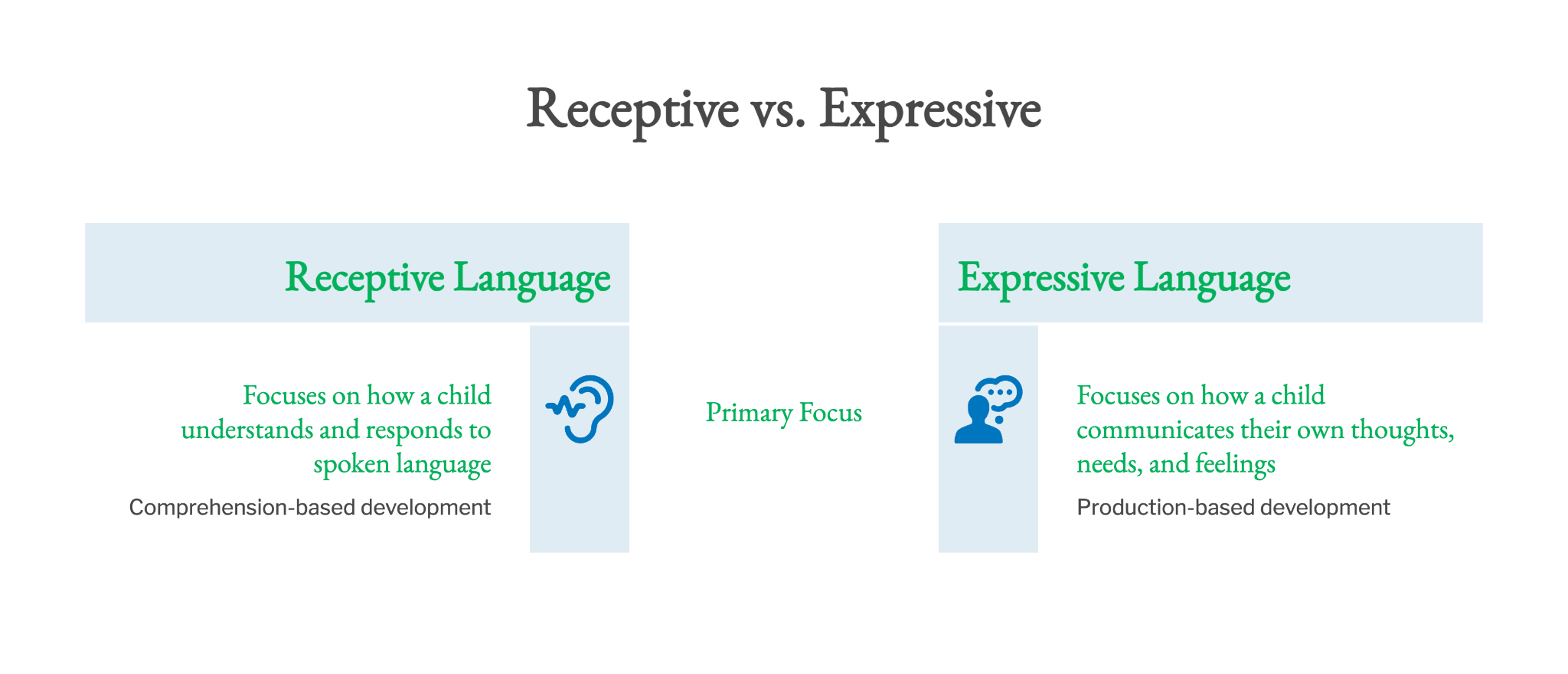
Communication development weaves itself into ABA sessions, and includes working on both receptive and expressive language.
Receptive language is how your child understands and responds to spoken language (for example: responding to their own name).
Expressive language is how they communicate their own thoughts, needs, and feelings (for example: starting a conversation without prompting).
Research shows that ABA interventions consistently help children reach communication goals.
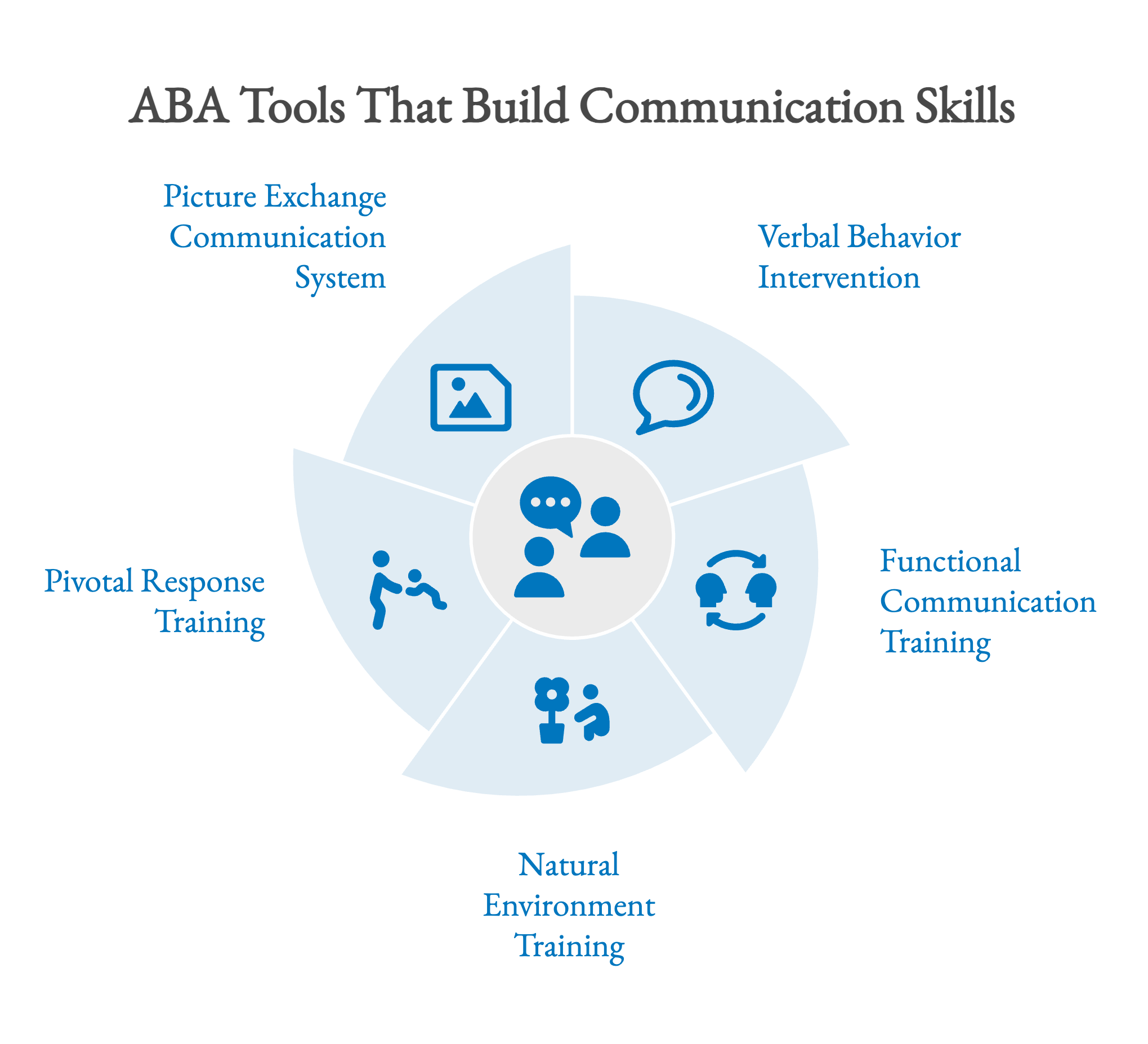
Here are a few ways that can happen in ABA:
Verbal Behavior Intervention (VBI)
VBI focuses on the function of language (why we communicate), and how to build that motivation. It’s firmly rooted in the belief that language is a learned behavior. This might begin with a child learning to request an item, and then gradually building towards more complex communication (like commenting, asking questions, and having full-on conversations).
Functional Communication Training (FCT)
For children who use physical behaviors (like hitting, screaming, or throwing) to communicate an unmet need, FCT teaches them to use a better tool. For example, instead of having a tantrum at the grocery store, your child learns to hand over a “break card.” Using this replaces the behavior with a communicative response that meets the same need.
Natural Environment Training (NET)
This method simply brings language skills into real-world situations. For example, during snack time, a therapist may hold back a favorite drink (like orange juice) and prompt the child to say “more” or “juice” before giving it to them.
Pivotal Response Training (PRT)
PRT uses your child’s interests and favorite activities to teach them communication.
A few examples could be:
- Building a block tower together, then prompting your child to request a block before handing it to them
- Blowing bubbles and stopping to wait for your child to ask for “more” or “blow”
- Playing with a favorite puzzle and waiting with a piece in hand until they ask for the piece
- Pausing a favorite song and waiting for your child to request to continue
This way, learning communication strategies feels less like therapy and more like play.
Picture Exchange Communication System (PECS)
PECS uses pictures to help children communicate. It begins with the basics (how to exchange a picture) and builds all the way to spontaneous comments and requests.
The 6-phase process looks like this:
- Phase 1: How to Communicate – Kiddos learn to exchange single pictures for items they want.
- Phase 2: Distance and Persistence – Using single pictures, they learn to use the new skill in different places and situations.
- Phase 3: Picture Discrimination – Children learn to select from two or more pictures to ask for favorite things.
- Phase 4: Sentence Structure – Kiddos learn to construct simple sentences with detachable sentence strips.
- Phase 5: Responsive Requesting – Eventually, they learn to use PECS to answer questions like “What do you want?”
- Phase 6: Commenting – Children are taught to comment in response to questions like “What do you see?” or “What is it?”
This method is especially helpful for non-verbal children that need a bridge to cross into spoken language. And for some children, the bridge is built alongside an Augmentative and Alternative Communication (AAC) device. AAC devices give your child a reliable voice while they continue working on their spoken language abilities.
When Speech Therapy or OT May Be Recommended
Now, the next part you might be wondering about is whether or not an SLP (Speech-Language Pathologist) or OT (Occupational Therapist) needs to get involved.
Here’s how the process typically works:
Speech and occupational therapy services are often prescribed alongside ABA therapy, if your child’s pediatrician sees a need. So, if that happens, your child’s SLP or OT will become part of your child’s support team, and we all work together.
ABA therapy sets the foundation while speech therapy and occupational therapy are supplemental support. And everyone works toward the same goals.
Your Parent Role
Family involvement is at the core of what we do. The more connected you are to your child’s plan, the more they’ll learn and grow. You’re never going to be on the outside looking in. That’s why caregiver training and guidance is a core part of each child’s ABA therapy plan.
In your training program, you’ll learn that in day-to-day practice, that involvement shows up in the small moments of everyday life. Here’s what that can look like:
- Reinforcing skills at home: When your child learns a new skill (like requesting a preferred item with a new communication strategy), you practice the same skill at home.
- Sharing what you see at home: You notice things no one else does. Sharing this information (like, “They hit a new milestone over the weekend” or they slept poorly last night) is like providing nuggets of gold for your child’s care team.
- Participating in goal reviews: You’ll often meet with your child’s team to review progress, revisit priorities, and ensure the treatment plan still reflects what matters most to your family.
- Carrying strategies out of the house: Practice new skills in the real world (on a grocery run, a birthday party, or a trip to the dentist).
You should never feel like a bystander when it comes to your child’s care. You are an irreplaceable part of their ABA therapy treatment plan.
Communication Is a Core Part of ABA Therapy
If your child goes to ABA therapy, communication support is already baked in. It shows up every day during sessions and tracked with intentional, data-driven precision.
You’ll never have to wonder if your child’s treatment plan is “missing something.” That’s what we’re here for. A full ABA assessment gives you a clear picture of what your child needs and where they are going (communication goals and all). You don’t need to figure it all out at once.
If you’ve ever wondered if your child needs speech therapy, start here. Reach out to us and after a brief intake, you’ll be connected with a BCBA to begin building a plan tailored to your kiddo’s needs.
Frequently Asked Questions
What are the most effective speech therapy methods for children with autism?
Some of the most effective methods are grounded in ABA therapy. These include:
- Verbal Behavior Intervention (VBI)
- Functional Communication Training (FCT)
- Natural Environment Training (NET)
- Pivotal Response Training (PRT)
- Picture Exchange Communication System (PECS)
How to find qualified speech therapists specializing in autism near me?
Start by talking to your pediatrician. They will evaluate your child’s communication strengths and needs and be able to determine if services like speech-language pathology are needed alongside ABA therapy.
What does communication support look like for children who are minimally verbal or nonverbal?
For nonverbal or minimally verbal kiddos, ABA offers a few useful tools. PECS teaches functional communication through picture or object exchanges. Your child will always start at a basic level and move up to more complex communication levels. Augmentative and Alternative Communication (AAC) devices can also help here.