

Echolalia: What It Is, Why It Happens, and How to Support Your Child with Autism

%2013.avif)

Hearing your child repeat the same phrase again and again, echo a question you’ve just asked, or recite a line from a favorite show in an ordinary moment can leave you wondering what it means. This is called echolalia.
Echolalia is actually quite common, and while it can feel confusing at first, it isn’t necessarily a cause for concern. It can be part of typical language development, and for many children with autism, it often continues longer and can take on a wider role in how they communicate and experience the world.
The key is learning to look beyond the repetition and ask, "What is my child trying to tell me?"
In this guide, we'll walk through what echolalia is, why it happens, and how you can respond in ways that support your child's communication with patience, curiosity, and care.
What Is Echolalia?
Echolalia is the repetition of words, phrases, sounds, or sentences your child has heard before.
For many toddlers, echolalia is simply part of learning how language works, and it tends to fade as they build more of their own words – often by around age 3. But for children with autism, it often continues longer, and tends to serve more purposes: as a way to communicate a need, process information, express emotion, self-regulate, or simply take part in the world around them.
For example, your child might echo your question by saying, “Do you want juice?” instead of answering yes or no. They might repeat a favorite line from a show while playing, or say a familiar phrase like “time to go” when they recognize a routine is about to change.
Repeated speech almost always means something. Your child may be using familiar words to ask for something, respond to a situation, express a feeling, or feel more comfortable.
So if you notice your child repeating words or phrases, a helpful question to hold onto is, 'What might this phrase mean for my child right now?' That curiosity is often the first step toward understanding what your child needs.
Types of Echolalia
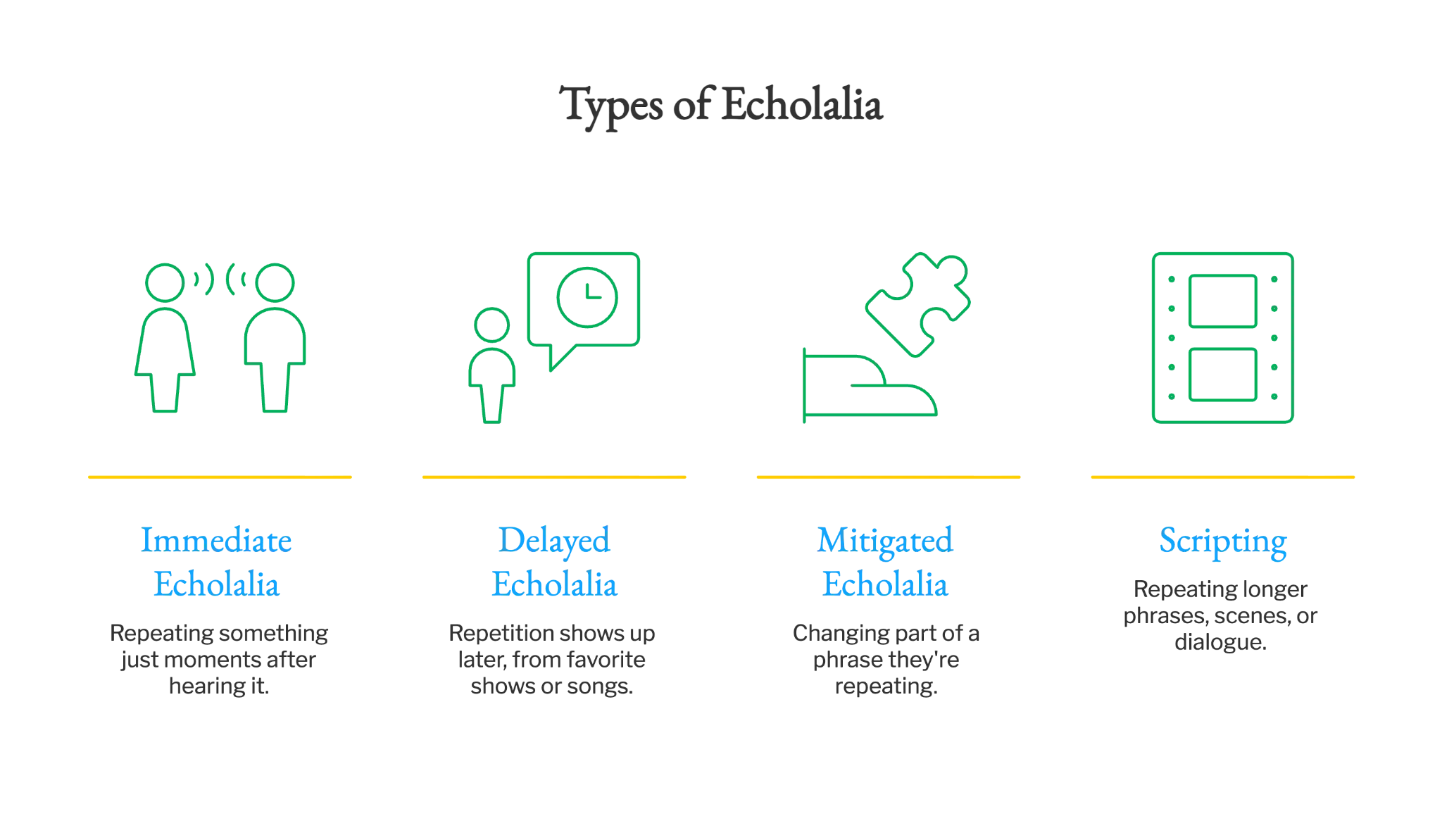
There are several types of echolalia you may notice: immediate echolalia, delayed echolalia, mitigated echolalia, and scripting. Each one can give you clues about how your child is processing language, communicating, or using familiar words in their own way.
Immediate Echolalia
This is when your child repeats something just moments after hearing it. You might ask, “Do you want juice?” and they say, “Want juice?” right back.
They may be processing a question, practicing words, or actually telling you they want juice.
Delayed Echolalia
Sometimes the repetition shows up later. This could be a phrase from a favorite show, a song, a book, a game, or a conversation from another day.
Your child might shout, “Ready, set, go!” when they feel excited, or repeat a familiar line during a transition because the phrase feels comforting or connected to that moment.
Mitigated Echolalia
This happens when your child changes part of a phrase they're repeating, like shifting it from a question to their own words, or adjusting a word or two.
After hearing “Do you want a snack?” they might later say, “I want snack.” Unlike immediate echolalia, where the words are repeated pretty much as heard, these small changes can be signs your child is starting to play with language and use it more on their own terms.
Scripting
Scripting is a form of delayed echolalia where your child repeats longer phrases, scenes, songs, or dialogue. Scripts may come from shows, books, videos, or familiar routines.
For some kiddos, scripting is playful. For others, it's calming or a way to communicate. Like other forms of echolalia, the meaning often comes down to the child and the moment.
Why Children with Autism May Use Echolalia
Echolalia can happen for different reasons, and the same phrase may not mean the same thing every time, so pay close attention to context.
Sometimes your child is still processing what they heard. Language moves fast, and repeating a phrase can give them a little extra time to take it in. Other times, they may be using familiar words to ask for something. For example, if your child says, “Do you want crackers?” they might actually be requesting crackers because that phrase has become connected with snack time.
Emotion can also fuel repeated language. Your child might use an excited line from a show when they're happy, or fall back on a familiar phrase when they're unsure. For many kiddos with autism, it's also a way to self-regulate. Familiar words, rhythms, or scripts can feel predictable and calming, especially during transitions, busy environments, or moments that feel hard to manage.
Sometimes, scripting is your child's way of joining in. A favorite line from a show or book may be how they enter play, respond to others, or connect with what's happening around them.
The words may not always match the moment in an obvious way, but they often hold a clue. When you notice what happened right before, how your child is acting, and what they might need next, the repeated phrase can start to make more sense.
How to Respond When Your Child Uses Echolalia
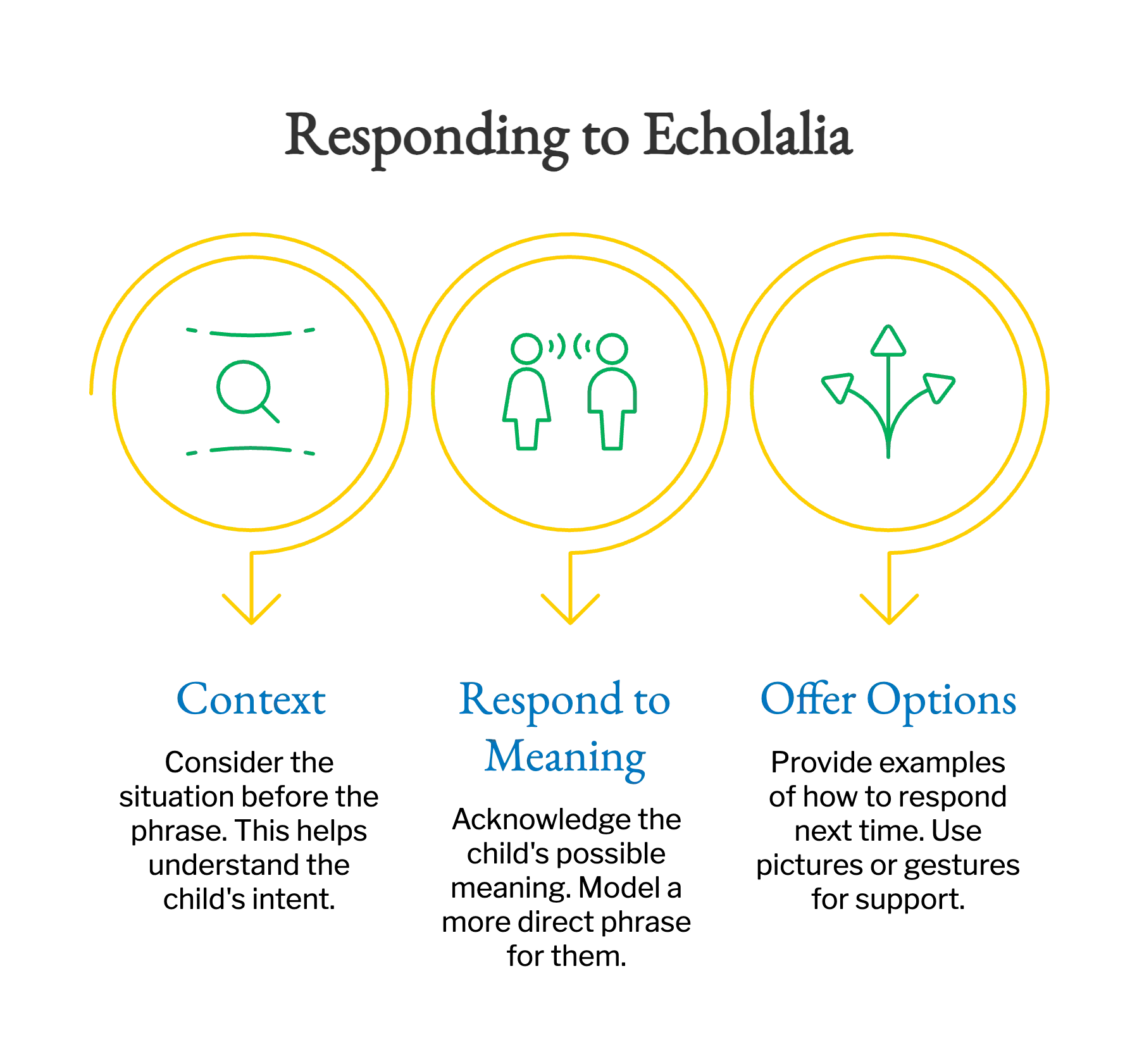
When your child uses echolalia, try to pause before jumping in with a different phrase. The goal is to understand what they might be communicating. From there, you can offer language to build on.
Here are a few ways to do that:
- Start with context first. What happened right before the phrase? Someone may have asked a question and slightly changed a routine. These details can help you understand whether they may be requesting, refusing, processing, playing, or needing support.
- Respond to the possible meaning. If your child says, “Do you want crackers?” while standing near the pantry, you might say, “You want crackers. I can help.” This lets them know you understood, while modeling a more direct phrase.
- Offer options for next time. Give them a few examples of how to respond next time, like: “I want juice,” “help me,” “all done,” or “I need a break.” Pictures, gestures, first/then boards, or visual schedules can also make communication easier.
Most of all, respond with warmth and patience. Echolalia may be your child's best way to communicate at that moment. When you acknowledge the attempt, model useful language, and give them time, you create more room for communication to grow.
When to Seek Extra Support
Echolalia by itself is common and often doesn't call for extra support. It may help to check in with your child's care team if repeated phrases seem to be their main way of communicating, or if they often seem frustrated when trying to express what they need.
You may also want guidance if there is difficulty answering simple questions, making requests, or using language during everyday routines. Support can also be helpful if echolalia seems connected to distress, overwhelm, or moments that are hard for your child to move through.
Support can help you better understand what your child may be communicating, and what kinds of language, visuals, or strategies may help. Depending on your concerns, this might include talking with your pediatrician, a speech-language pathologist, or your child's ABA care team.
How ABA Therapy for Autism Can Support Your Child’s Communication
Applied Behavior Analysis (ABA) therapy can help you understand what your child is communicating through repeated language. The goal isn’t to erase echolalia or take away your child's way of expressing themselves – it’s to help them build more flexible communication skills over time.
In ABA therapy, we look at what happens before and after repeated phrases. We may notice patterns around requests, transitions, emotions, sensory needs, or social moments. From there, we can teach new ways to express needs, make choices, ask for help, or take part in daily routines.
At Behavior Frontiers, communication – including echolalia – is one part of comprehensive autism care built around your child's unique needs, from social skills to daily living to emotional regulation. Progress is always tracked in real time through PrioraCare™, our made-from-scratch data platform, so that every goal, every milestone, and every shift in support is intentional and data-driven.
With the right support, your child's voice belongs to them.
Ready to learn more about ABA therapy? Reach out to us and after a brief intake, you'll be connected with a Board Certified Behavior Analyst (BCBA) to begin building a plan tailored to your child's unique needs.
Frequently Asked Questions About Echolalia
Is echolalia always a sign of autism?
Not always. Echolalia is often part of typical language development, especially for young children who are learning how words work. It's also common among children with autism and may continue as part of how they process language, communicate, or make sense of familiar routines.
Why is echolalia common in autism?
Echolalia is common in children with autism for a few reasons.
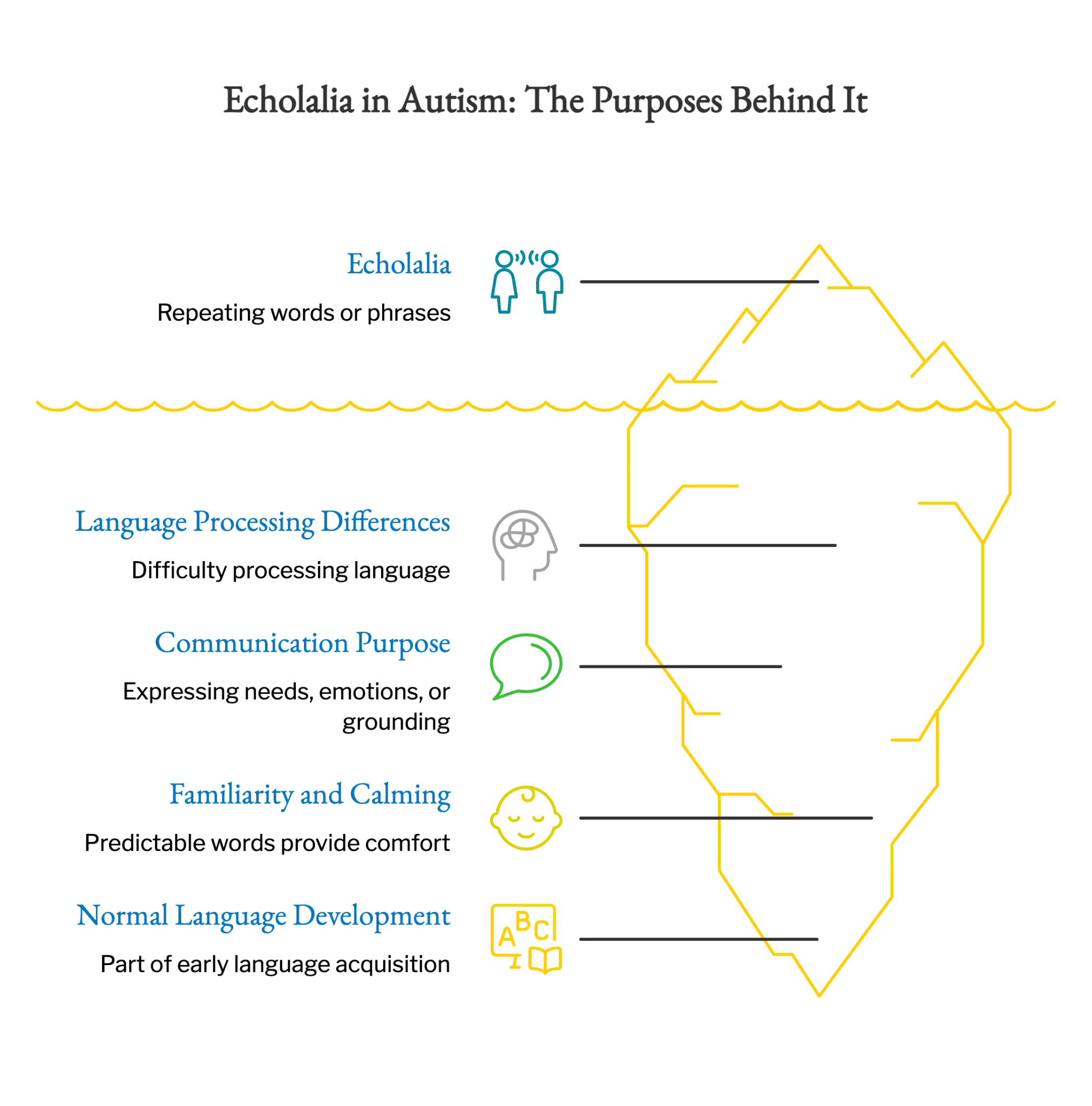
For many children with autism, language processing works differently. Repeating words or phrases can be a way of holding onto language that feels familiar and manageable. In short, it’s a way of working with the language they already have.
Echolalia can also serve a purpose. A repeated phrase may be your child's way of making a request, expressing an emotion, responding to a situation, or feeling more grounded. For some kiddos, familiar words and scripts feel predictable and calming, which is especially helpful during transitions or overwhelming moments.
It’s also important to note that echolalia is not unique to autism. It is a normal part of early language development for all children. For children with autism, it may simply continue longer or show up in different ways as part of how they communicate and process the world around them.
Rather than seeing echolalia as something to stop, it helps to see it as something to understand. The repeated words tell you a story. With the right support, those words can become a bridge toward more flexible communication over time.
Is echolalia bad?
No. Echolalia is not bad. Repeated words or phrases may help your child communicate a need, practice language, express emotion, self-regulate, or join in socially. The more helpful question is what the words might mean in that moment.
Should I stop my child from scripting?
Not usually. Scripting may be playful, comforting, or communicative. Instead of stopping it right away, try to notice when it happens and what your child may be expressing. If scripting seems tied to distress or makes daily communication harder, extra support can help.
Can ABA therapy help with echolalia in children with autism?
Yes. ABA therapy can help families understand the purpose behind repeated language and support children with autism as they build more flexible ways to express needs, feelings, choices, and ideas. The goal is not to take away your child's voice, but to help communication grow.