

High-Functioning Autism: What the Term Means and Why It's Changed

%2013.avif)

Have you ever heard of the phrase “high-functioning autism” in relation to a child’s level of autism?
This is one of the most commonly searched terms in the autism space. Yet, it is a term that clinicians no longer use (and that’s by design).
This article will walk you through where the term came from, why it is no longer considered accurate, and how this shift can better support your child’s needs.
Where Did "High-Functioning Autism" Come From?
The term “high-functioning autism” was never an official clinical diagnosis. It developed as a shorthand way for clinicians and families to distinguish between people with autism who had an intellectual disability and those who did not, or between those who were verbal and those who were nonverbal.
Older diagnostic frameworks encouraged more category-based thinking. Before the DSM-5 unified autism under a single spectrum diagnosis in 2013, there were separate categories:
- Autistic Disorder
- Asperger's Syndrome
- Pervasive Developmental Disorder
Within that system, labels like “high functioning” felt practical. They gave families and schools a quick reference point for understanding where a child seemed to land.
The term also appeared to communicate something meaningful at a glance. If a child could speak in full sentences, perform well academically, or navigate social situations without obvious difficulty, “high functioning” seemed like a useful descriptor.
But what seemed useful turned out to be too broad to describe the experience of many children and adults with autism. In many cases, it left real needs invisible.
Why the Term Is Criticized
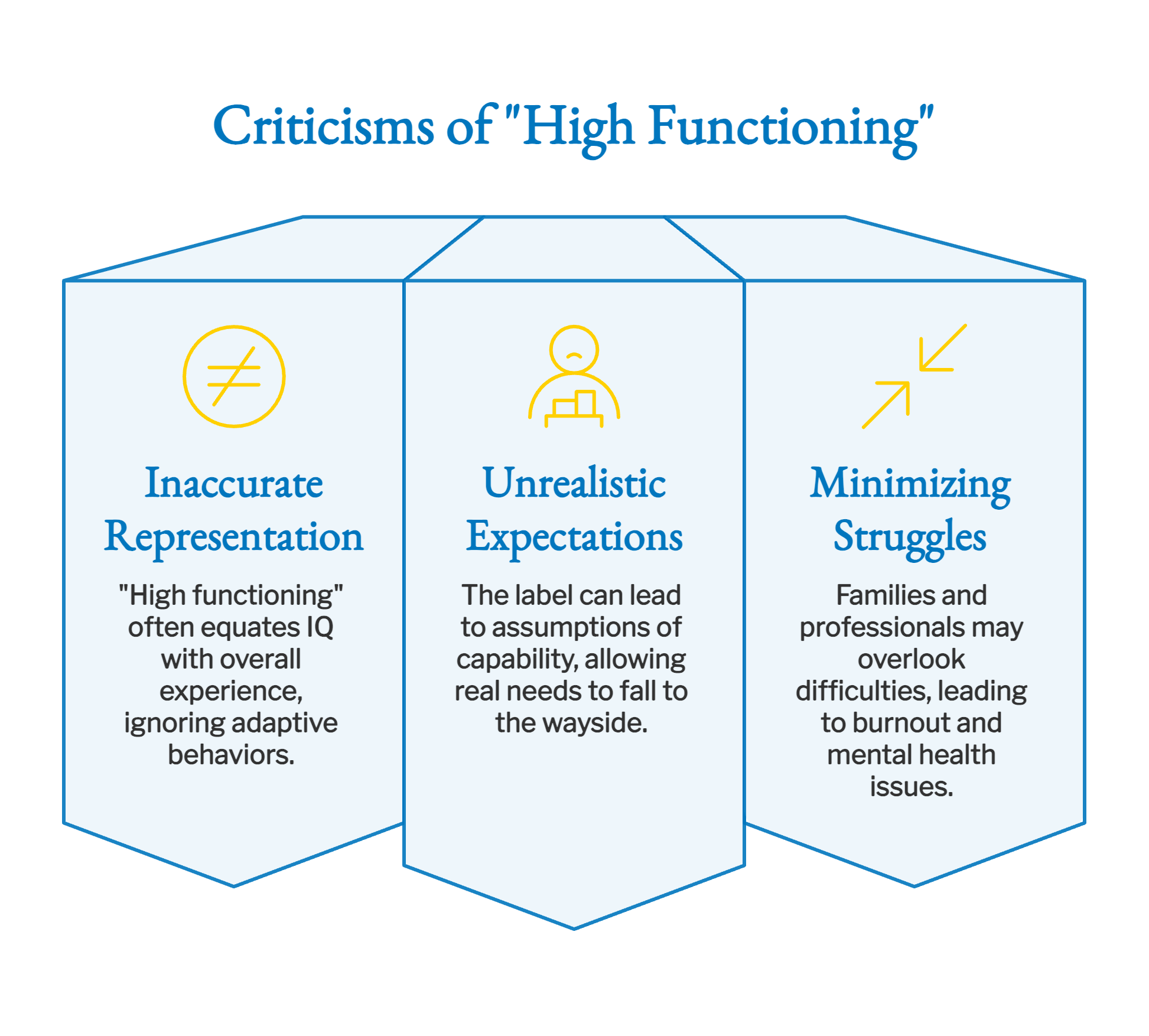
“High functioning” is most often used as a proxy for intelligence quotient (IQ) or verbal ability. But IQ and verbal ability do not capture a person’s full experience with autism.
Research consistently shows that adaptive behavior, meaning the ability to manage daily living skills and function independently, does not always match IQ or verbal ability.
A child can be academically gifted and still struggle with tasks like managing a morning routine, navigating a change in plans, or regulating emotions after a hard day at school.
This label can create unrealistic expectations in school, work, and family settings because people may assume that someone who presents as capable doesn’t need accommodations or support.
And that assumption can be quietly harmful. Masking difficulties day-in-day-out is a grind. Without the right support, it can lead to burnout, anxiety, and sometimes depression. So, using terms like “high-functioning” can glaze over difficulties and dismiss real needs.
Signs and Characteristics That Parents Often Notice
If you’re a parent who’s landed on the term “high-functioning autism,” you might be here because something about your child’s experience doesn’t quite match what you expected autism to look like - and you’re searching for language that captures it more accurately.
Your child may not fit the descriptions of autism you’re come across. But you can’t help but notice they’re struggling in ways the outside world might not see.
And that experience deserved to be understood.
Children with autism who might have once been described as “high-functioning” often share some common experiences.
Here’s what that can look like:
Social communication
- Speaks fluently but struggles to keep a back-and-forth conversation going, especially with peers
- Has a genuine desire to connect with others but finds the unspoken rules of social interaction confusing
- May talk at length about a specific interest but have difficulty shifting to topics others bring up
- Finds group conversations hard to follow or join naturally
Flexibility and routine
- Does well in predictable environments but struggles significantly when plans change unexpectedly
- May have strong emotional reactions to transitions that may seem minor to others
- Relies on routines to feel comfortable and regulated throughout the day
Masking and energy
- Appears fine in public or at school but comes home completely depleted
- Works hard to hold it together in social settings, which takes enormous effort over time
- Without the right support, this sustained effort can lead to burnout, anxiety, or withdrawal
Sensory and executive functioning
- Experiences sensory sensitivities that others may not notice but that significantly affect comfort and focus
- Struggles with executive functioning skills like organization, planning, time management, and transitions, even when intelligence is not in question
- May have difficulty initiating tasks or shifting attention from one activity to another
While someone looking in from the outside may brush off these characteristics as “personality quirks,” that isn't the full picture.
They aren’t “phases” or quirks. They are difficulties your child may face day in and day out. The challenge with the "high-functioning" label is that it often causes these very real experiences to be minimized or missed entirely, and a child may not receive the support they need because the label suggests they are doing “fine.”
Don’t dismiss what you’re noticing. There could be areas where your child needs support, and you don’t have to face it alone.
What Should We Use Instead of “High-Functioning”
Now, we have better tools to determine autism levels. The DSM-5 replaced the old category system with a single autism spectrum disorder diagnosis and introduced three support levels.
These levels describe how much support a person needs across two areas: social communication and restricted, repetitive behaviors. They are a more useful starting point because they’re tied directly to support needs rather than perceived ability.
That said, even DSM-5 levels do not capture everything, because a support level is only a starting point. Clinicians and researchers recommend using strengths-based, specific descriptions that reflect a child's actual communication, sensory, behavioral, and adaptive needs.
Instead of “high-functioning autism” or “low-functioning autism,” here are a few examples of up-to-date language:
- “A child with autism who has strong verbal skills and needs Level 1 support with daily routines and transitions.”
- “A person with autism with Level 3 support needs in communication and daily living.”
Specific descriptions like these have a longer shelf life. Not only do they show exactly where a child needs support, they also allow for flexibility as environments and specific needs change.
A Few More Examples of Accurate Language
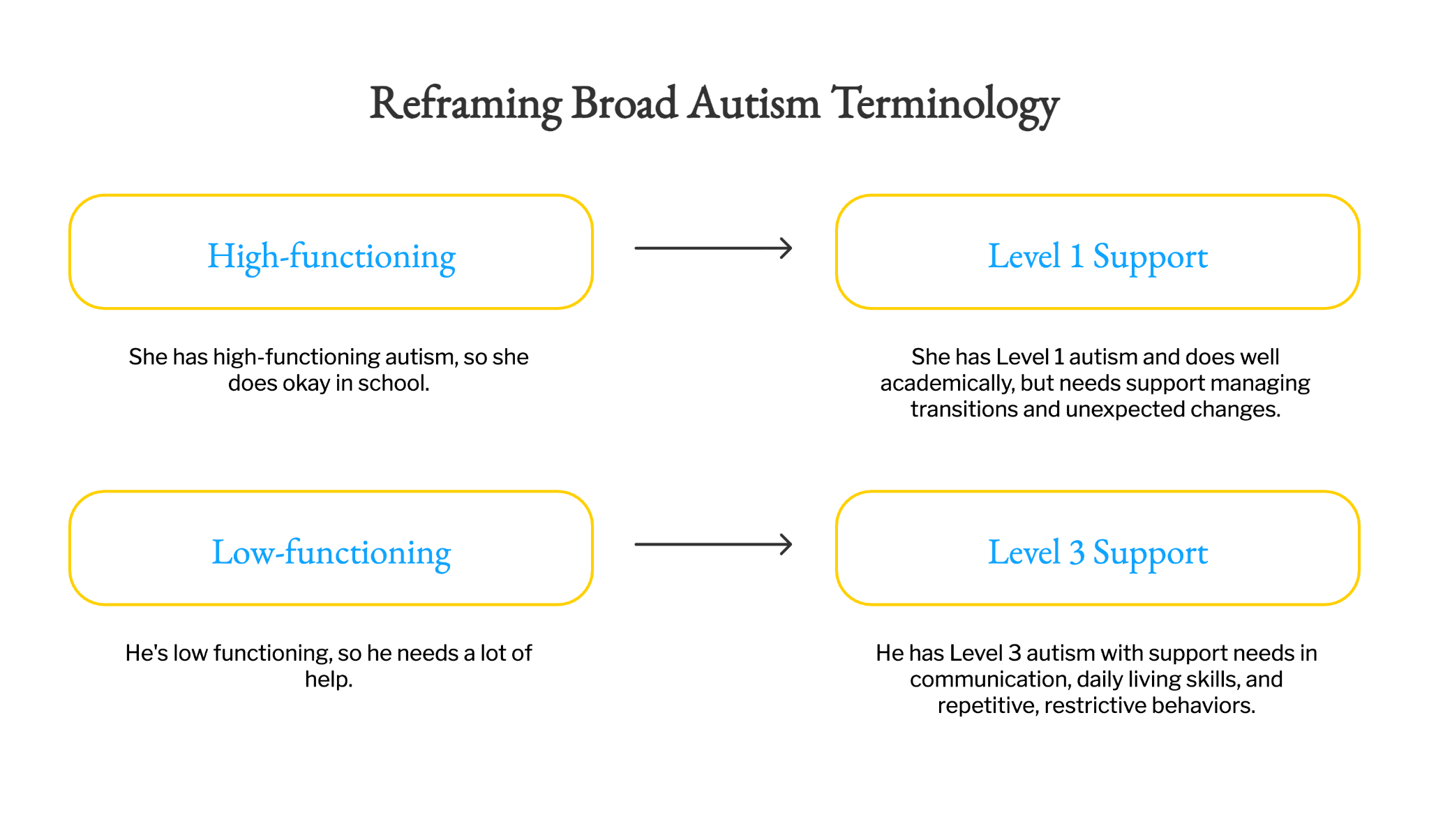
Instead of: “She has high-functioning autism, so she does okay in school.”
Try: “She has Level 1 autism and does well academically, but needs support managing transitions and unexpected changes.”
Instead of: “He's low functioning, so he needs a lot of help.”
Try: “He has Level 3 autism with support needs in communication, daily living skills, and repetitive, restrictive behaviors.”
Instead of: “They seem pretty high functioning, I don't think they need much support.”
Try: “They have strong verbal skills but may need Level 1 support with sensory regulation and executive functioning.”
At Behavior Frontiers We Don’t Use Labels
“High-functioning autism” was a shorthanded term used to make a complicated system seem easier to understand. While well-intended, this may have allowed real needs to disappear into the background.
That’s why at Behavior Frontiers, we never see labels when we look at your child. We see a person sparkling with their own unique strengths and goals. Our Board Certified Behavior Analysts (BCBAs) design individualized programs built around exactly what your child needs, tracked in real time through our proprietary PrioraCare™ platform. This way, you never miss out on your child’s progress.
If you'd like to learn more about how we support children across the autism spectrum, reach out to us. After a brief intake, you'll be connected with a BCBA, and together we’ll begin building a plan tailored to your child's unique needs.
Frequently Asked Questions
Is high-functioning autism a real diagnosis?
No. “High-functioning autism” is not an official clinical diagnosis and does not appear in the DSM-5. It was used informally to describe people with autism who did not have an intellectual disability or who appeared more verbally able, but the term is now considered outdated. The current diagnostic framework uses a single autism spectrum disorder diagnosis with three support levels that better reflect what a person actually needs.
What replaced the term high-functioning autism?
The DSM-5, updated in 2013, replaced separate autism categories including Asperger's Syndrome and Autistic Disorder with a single autism spectrum disorder diagnosis. Clinicians now use three support levels to describe how much support a person needs across social communication and restricted, repetitive behaviors. Many clinicians also recommend using specific, strengths-based descriptions that reflect a child's individual profile rather than broad labels.
Can someone with autism mask their difficulties?
Yes, and this is one of the most important reasons functioning labels can be misleading. Masking refers to the conscious or unconscious effort some people with autism make to appear neurotypical in social situations. It can be exhausting and is often associated with burnout, anxiety, and mental health challenges. A child or adult who masks well may appear “normal” to the outside world while carrying a significant hidden load.
Does a Level 1 autism diagnosis mean a child does not need support?
No. Level 1 autism means a child requires support, not that they need very little. Children with Level 1 autism may have strong verbal skills or academic abilities and still need meaningful support with transitions, social communication, sensory regulation, or executive functioning. A level describes support needs, not ability or potential.
Can we compare high functioning autism vs. ADHD?
Before diving into the differences, it’s important to know that “high-functioning autism” is no longer the preferred term. Clinicians now use DSM-5 support levels and specific, needs-based descriptions that more accurately reflect what a person with autism experiences. So while you may still see “high-functioning autism” used in everyday conversation, the more accurate framing today would be something like “Level 1 autism” or “autism with lower support needs.”
That said, autism and ADHD can look similar on the surface, which is part of why they are sometimes confused or misdiagnosed. Both can involve difficulty with attention, impulsivity, social challenges, and emotional regulation. But the underlying reasons for those challenges are different, and so is the support that helps.
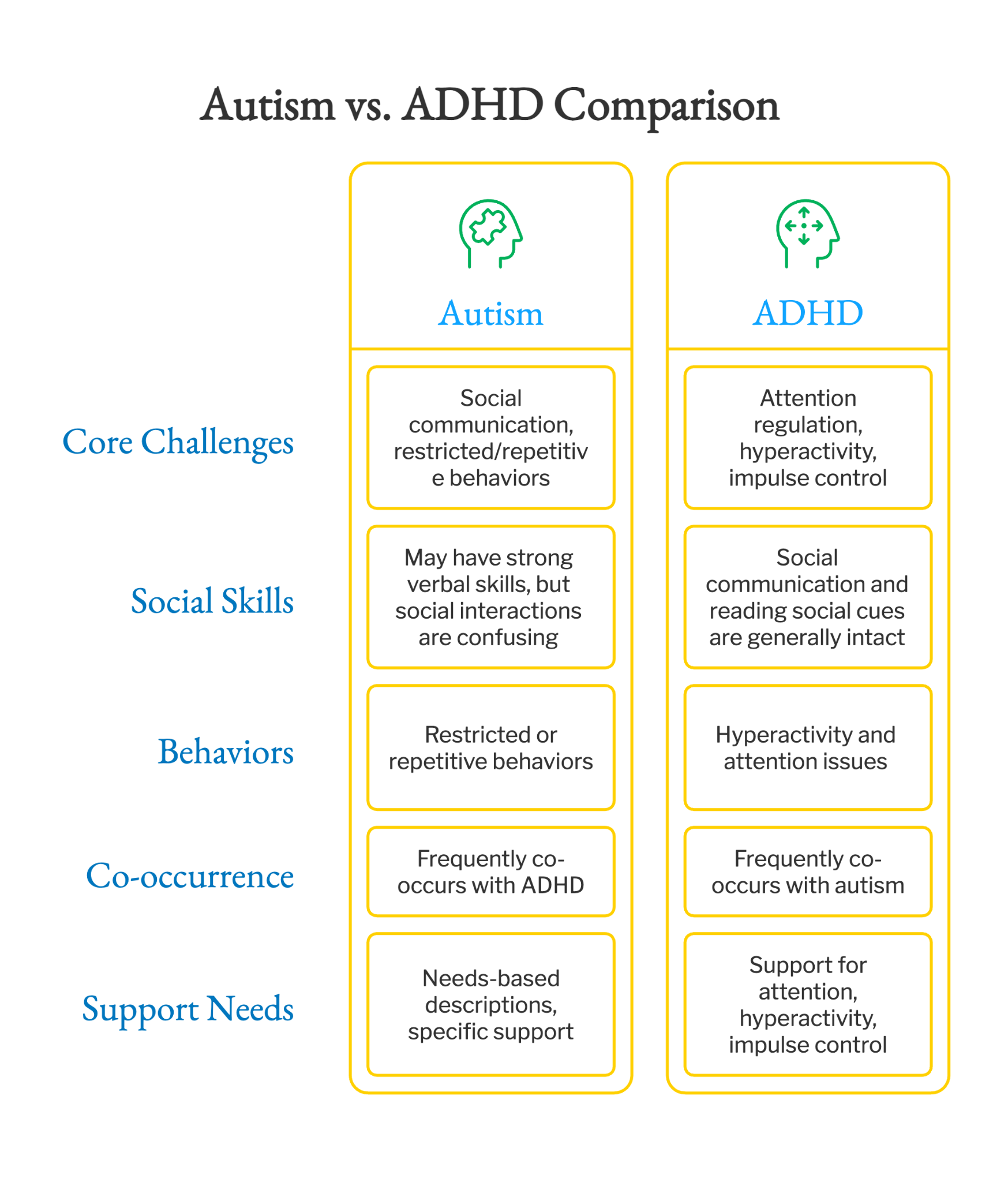
ADHD is primarily characterized by difficulties with attention regulation, hyperactivity, and impulse control. Children with ADHD may struggle to stay focused, sit still, or think before acting, but their social communication and ability to read social cues is generally intact.
Autism, on the other hand, involves differences in social communication and the presence of restricted or repetitive behaviors. A child with autism may have strong verbal skills, yet still find social interactions confusing.
Also, ADHD and autism frequently co-occur. Research suggests that a significant number of people with autism also meet criteria for ADHD, and vice versa. When both are present, a thorough evaluation helps ensure a child receives support that addresses the full picture.
If you are wondering whether your child's challenges reflect autism, ADHD, or both, a comprehensive evaluation by a qualified clinician is the clearest path forward.
What language should I use when talking about my child's autism?
The most helpful language is specific and tied to your child's actual needs rather than broad labels. Instead of "high functioning" or "low functioning," try describing what your child can do independently and where they benefit from support.
For example: "my child has strong verbal skills and needs support with daily routines and unexpected changes." This kind of description communicates more clearly and holds up better across school, clinical, and family settings.